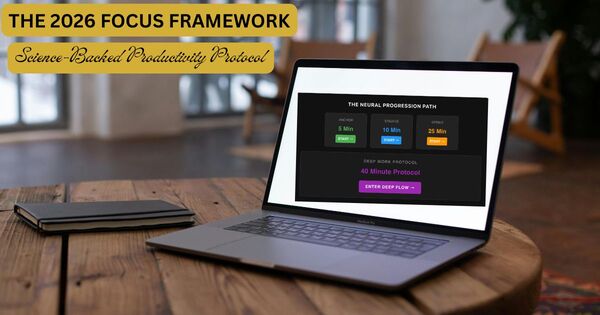

If you want to bypass procrastination, the 2026-framework provides a science-backed productivity protocol engineered to instantly lock in your attention.
The 2026 Focus Framework is a system by Dwayne Dixon designed to trigger the Task-Positive Network (TPN) and bypass procrastination.
Table of Contents
THE NEURAL PROGRESSION PATH
Configuring Your Device Interface for the 2026-Framework
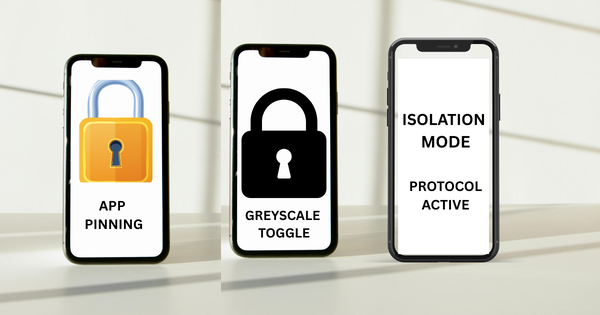
Because you are utilising our countdown tools directly on your mobile browser, your operating system must be structurally locked down to prevent external notification alerts from shattering your visual boundary. Before activating your first 5-minute anchor, enforce these three mobile system protocols:
- Engage Application Pinning: Use your phone’s built-in accessibility settings to pin or lock your browser screen. This physically blocks incoming banners and prevents impulsive, muscle-memory app switching when focus gets tough.
- The Grayscale Toggle: Saturated display colors continuously trigger micro-doses of dopamine in your visual cortex, constantly tempting your eyes away from your workspace. Flip your mobile display settings to grayscale to render background distractions visually inert.
- Orientation Isolation: Keep your device in landscape mode while running our 40-minute high-density protocol. This alters your psychological relationship with the device, treating it like a dedicated desktop dashboard rather than a handheld communication portal.
The Neuroscience of Focus: TPN vs. DMN
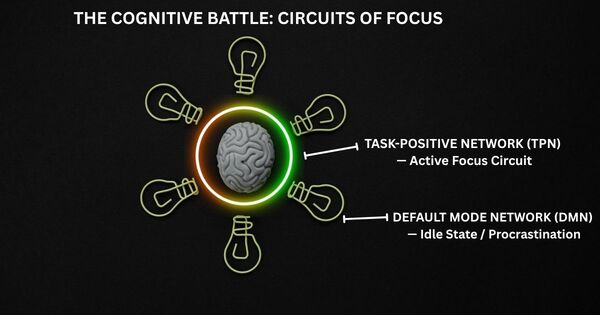
To understand why the 2026 Focus Framework works, we must look at the battle between two neural circuits: the Task-Positive Network (TPN) and the Default Mode Network (DMN)
The DMN is the brain’s “idle” state, responsible for daydreaming, overthinking, and the internal monologue that leads to procrastination. When you are stuck in the DMN, your brain is essentially offline from the task at hand.
The Task-Positive Network (TPN) is the direct antagonist to procrastination. It is the circuit that engages when you are focused on an external objective or a complex problem. These two networks are anti-correlated, meaning when one is active, the other is suppressed.
By using our specific timer anchors, you are not just starting a task, you are physically forcing the brain to deactivate the DMN and hand over the controls to the TPN.
Detailing the Resistance Gate: The First 300 Seconds
To lower the Resistance Gate, you need a dedicated, visual countdown tracker that anchors your attention before distractions can hijack your brain. Utilising our 5-minute tool is incredibly effective here because it transforms your device from a high-distraction workspace into a single-purpose focus interface.
By keeping this dedicated browser window active, you create an explicit visual boundary that keeps your Default Mode Network (DMN) at bay. If a real-world interruption strikes during your first 300 seconds, tap pause right on your screen to keep your Task-Positive Network (TPN) warm. Once the distraction passes, you can resume your countdown immediately, allowing you to complete your neural anchoring without shattering your mental momentum or breaking your flow state.
Phase 1: The 300-Second Neural Anchor
The objective of Phase 1 is not to complete deep, complex work. The sole goal is to survive the first 300 seconds without allowing your attention to break.
When you look at our 5-minute visual countdown timer, you give your prefrontal cortex a distinct, real-time focal point. This initial micro-sprint acts as a cognitive bridge. By forcing your eyes to return to the clock whenever a distracting impulse arises, you manually suppress the wandering impulses of the Default Mode Network (DMN) and kick-start the Task-Positive Network (TPN).
Your Action Protocol for this Phase:
- Select low-stakes friction targets: Open your workspace and simply format your text headings, organise your research browser tabs, or clear out old lines of junk data from your files.
- Maintain physical contact: Keep your hands on your keyboard or mouse and keep your eyes fixed within the visual boundary of the timer.
Once the countdown hits zero, your brain has officially bypassed the initial resistance gate, making the transition into the next engagement thresholds completely seamless.
Phase 2: Neutralising Limbic Friction
Procrastination isn’t a character flaw; it’s a biological state called Limbic Friction. This is the measurable physiological resistance in your nervous system when you try to move from an idle state into an active focus state. To overcome this, modern behavioural science highlights the value of mutually agreed tailoring, a clinical concept proving that protocols are vastly more effective when individuals actively alter the timing and structure of their routines to fit their immediate environmental needs.
Think of your brain like a cold engine in winter. Attempting to jump straight into a 90-minute deep work session creates massive friction, causing the engine to stall. This is why you find yourself checking your phone or cleaning your desk instead of working. By utilising our 5-minute Anchor phase, you aren’t trying to finish the work, you are simply generating enough thermal energy in your prefrontal cortex to lower that friction. Once the 300 seconds pass, the resistance dissipates, and the transition into your focus session becomes mechanically inevitable.
The 300-Second Neural Toggle
Phase 1: The Anchor (0 to 300s) Generating thermal energy to switch states.
To systematically collapse this friction as you transition from an idle state to deep focus, Phase 2 scales your attention through two critical progression steps:
- The 10-Minute Engage Threshold: Moving immediately from your anchor to our mobile 10-minute tool acts as a cognitive stabiliser. In this step, you aren’t aiming for deep creativity; you are simply organising your immediate queue, sorting data, or drafting execution outlines to build easy momentum.
- The 25-Minute Sprint Threshold: Activating our mobile 25-minute tool is where your prefrontal cortex begins synthesising consistent dopamine. Because your brain knows this block is short, the psychological resistance remains incredibly low, allowing your TPN to fully suppress the default overthinking loops.
Phase 3: The Ultradian Peak (40-Minute High-Density Session)
Once you have successfully navigated the 5-minute Anchor and the 10-minute Engine threshold, your brain enters a state of cognitive ease. This is the beginning of an Ultradian Rhythm, a biological cycle that lasts approximately 90 minutes, during which your brain is primed for maximum focus and complex problem-solving.
We utilise a 40-minute Protocol as the High-Density Session because it aligns with the peak of your neural alertness before cognitive fatigue sets in. At this stage, your Task-Positive Network (TPN) is fully saturated with dopamine and acetylcholine, creating a Neural Shield that makes external distractions feel irrelevant.
Overcoming Focus Blockages: What to Do When the TPN Fails to Fire
Even with a science-backed protocol, biological variance means you will occasionally hit a day where the 300-second anchor feels insufficient to drop your limbic friction. When your Task-Positive Network fails to activate, it is typically caused by one of two neurological bottlenecks:
- The Glycogen Deficit: Intense focus requires massive glucose utilisation by your prefrontal cortex. If you attempt a progression cascade in a deeply fasted or depleted state, your brain will flag the effort as a survival risk, inducing procrastination. Fix this by drinking a glass of water paired with a clean trace-mineral source before starting your next 5-minute tool block.
- Cortisol Overload: High baseline anxiety traps your nervous system in a reactive state, making a proactive focus interface feel threatening. If you find your mind racing during the anchor phase, drop down to our 10-minute stabilisation zone and focus purely on low-stakes administrative clearing rather than high-density creative tasks.
Beating the Novelty Trap: Keeping Your System Alive Long-Term
A major trap when using any new productivity tool is hitting the Novelty Window. When you start a new system, the pure freshness gives your brain an easy dopamine hit. Within two weeks, that novelty wears off. Your brain will automatically try to drag you back to your old scrolling and procrastination habits.
The 2026 Focus Framework beats this adaptation cycle by keeping your brain guessing. Instead of rewarding yourself for every single finished block, you must introduce strategic variance.
How to Schedule Focus Rewards
Predictable Approach (Fails)
Finish 40 Min Session → Get Reward Every Time → Brain Adapts → Focus Drops
Framework Approach (Succeeds)
Finish 40 Min Session → Flip a Coin → Unpredictable Win → Dopamine Spikes
Figure: Randomizing rewards prevents your neural pathways from getting lazy or bored.
The Unpredictable Reward Rule Do not give yourself a reward after every single focus block. If your reward is entirely predictable, your brain gets lazy. Instead, roll a digital dice or flip a coin after your 40-minute session. If it lands on heads, treat yourself to a coffee or a quick break. If it lands on tails, go straight to a neutral rest. This unpredictable variance keeps your brain highly alert and eager for the next session.
The 5-Minute Cool Down: How to Avoid a Mental Crash
True mental endurance isn’t just about how intensely you focus. It is about how cleanly you turn that focus off. Jumping straight from an intense 40-minute deep work block into checking a stressful message inbox causes your brain to overheat, which leads directly to that brutal afternoon crash.
The moment your final countdown timer hits zero, give your nervous system a mandatory two-minute reset right from your chair before jumping back into the digital world:
- Soft Visual Focus: Take your eyes completely off the screen. Look at a blank wall or out a distant window for 60 seconds. Let your visual processing field completely relax.
- The Physiological Sigh: Take two quick, deep breaths in through your nose, followed immediately by one long, slow exhale through your mouth. Repeat this pattern three times to instantly dump physical stress and lower your heart rate. Stanford research details how this exact dual-inhale configuration immediately regulates respiratory rate.
By protecting the space immediately following your high-density work, you maintain a stable dopamine baseline, saving your energy for your next round of tasks later in the day.
Aperiodic Scaling: How to Progress Your High-Density Thresholds
As your prefrontal cortex adapts to the framework, your baseline limbic friction will naturally decrease. Within 30 days of consistent execution, the 5-minute anchor will feel effortless. To prevent mental fatigue, you must systematically scale your progression pathways to build greater focus endurance.
Do not expand the duration of your anchor phase. Keep the 300-second gate brief to maintain a low barrier to entry. Instead, scale your system by daisy-chaining your high-density blocks. Move from a single 40-minute session to a twin block protocol: complete a 40-minute session, execute your 5-minute cool down, reset with a 10-minute engage buffer, and immediately launch a second 40-minute high-density session. This structured compounding safely builds deep-work endurance without risking cognitive burnout.
What should I actually do with my hands during the first 5-minute anchor?
The magic of the 300-second anchor is lowering your baseline friction, so you should only work on low-stakes, zero-resistance actions. Open your document and format the headings, clear out junk lines from your file, or sketch a simple bulleted checklist of what you intend to do. Do not try to solve difficult problems or write perfect prose yet. The goal is simply to keep your eyes locked on our visual countdown tool while making low-effort physical contact with your workspace.
Can I change the order of the steps if I already feel motivated?
It is highly recommended to follow the exact progression path from start to finish. Skipping straight to the 40-minute high-density protocol relies entirely on raw willpower, which triggers sudden limbic friction and leads to immediate procrastination loops. Think of the 5, 10, and 25-minute blocks as an automated runway. Even if you feel ready to go, running through a quick anchor block stabilizes your Task-Positive Network, protecting your focus against sudden interruptions later on.
What do I do if a major interruption breaks my focus during the 40-minute session?
If a real-world distraction lasts longer than two minutes, your Task-Positive Network will begin to cool down, allowing the Default Mode Network to slip back into control. Do not try to force yourself right back into complex work immediately after the interruption. Instead, reset your neural momentum by dropping back down to our 10-minute stabilization zone. Spend those 10 minutes re-reading your previous notes or setting up your files to clear out the mental residue before jumping back into deep focus.
How many complete progression cascades can I perform in a single day?
For most individuals, the human brain can only sustain roughly three to four high-density blocks before hit by severe cognitive fatigue. Trying to force your way through more than that depletes your prefrontal cortex of vital glycogen reserves, causing your focus to break entirely. Space your sessions across the day, and make sure to utilize the 5-minute cool down protocol after every block to fully reset your system baseline.