
This page gives you a 30 minute timer you can start straight away. It’s long enough for a proper piece of deep work, short enough to keep momentum, noticeably longer than a quick 15-minute timer, and a natural length for a power nap or a solid study block
Table of Contents
How to use this timer
- Take a minute to define exactly what you’re working on, one specific outcome, not a vague area of work.
- Work on that one thing for the block, treating distractions as things to jot down and deal with later, not now.
- In the last minute, briefly note what you got done and what’s left, so the next session picks up cleanly.
Why a 30 minute timer helps
It generally takes some time to properly settle into a task, often cited as somewhere in the 15 to 20 minute range before people feel genuinely immersed, though this varies a lot between people and tasks. A 30-minute block gives you room to get past that initial settling-in period and still have a meaningful stretch of focused time afterward.
There’s also real research behind the idea of “attentional residue,” the lingering pull of a previous task on your attention when you switch to something new. Working in a defined block, rather than drifting between tasks, is one practical way to limit how much of that residue follows you around.
A structure for this session
This site’s own suggested breakdown, not a scientifically mandated formula, but a genuinely useful structure:
Pre-flight (about 1 minute): define the one thing you’re doing this session.
The work block (about 28 minutes): single-task focus. Note distractions rather than acting on them.
Cognitive close (about 1 minute): briefly log what you got done and what’s next.
This approach is supported by real research on “implementation intentions”: pre-deciding your actions and triggers ahead of time measurably reduces the friction of actually starting. You can read the original research here: Implementation Intentions (Gollwitzer, 1999).
30 minutes versus a full hour
Longer sessions aren’t automatically better. A one-hour block can feel spacious enough that it’s easy to drift or procrastinate early on, since the deadline feels distant. A 30-minute block creates a bit more useful urgency, you know the window is short, so there’s less room to put off starting. Neither length is objectively correct, some tasks and people genuinely suit longer blocks better, this is just one reasonable argument for a shorter one.
Stacking three sessions into 90 minutes
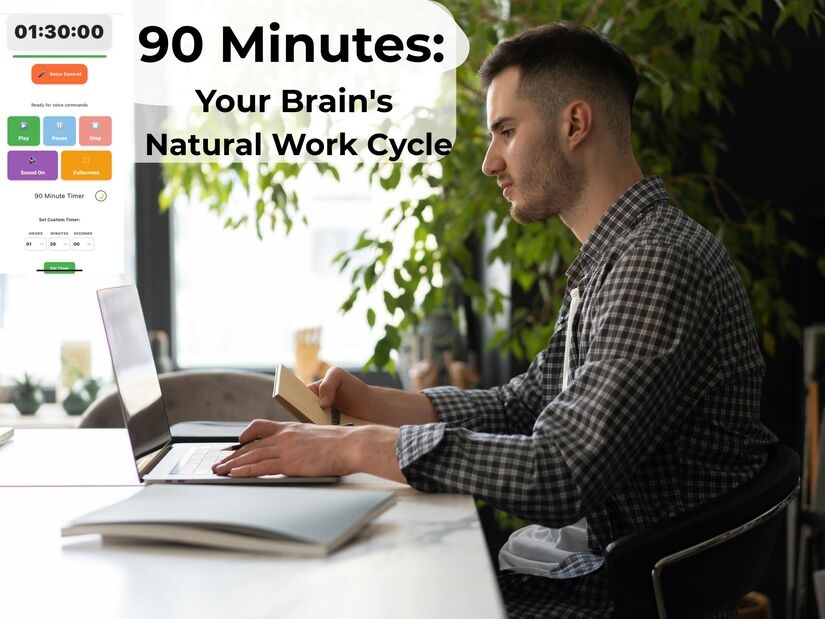
If you want a longer stretch of deep work, three 30-minute sessions with short breaks in between is one practical way to structure it, loosely in line with the idea of ultradian rhythms, the general pattern of energy and alertness fluctuating in roughly 90 to 120-minute cycles through the day. A 90 minute timer can manage the whole block for you automatically, with a 5 minute timer for the short resets in between:
0–30 min: first session
30–35 min: short break
35–65 min: second session
65–70 min: short break
70–100 min: third session
Using this for a nap
A 30-minute cap is often recommended for naps, since it gives you a good chance of waking before you drop into deeper sleep, which is what tends to cause grogginess on waking. This varies from person to person, so treat it as a reasonable starting point.
Using this for studying
Thirty minutes is a solid length for a focused study block. What you do with that time matters more than the length itself, our guide on best study techniques covers approaches like spaced repetition and active recall that pair well with a timed session like this.
Frequently asked questions
How do I handle an emergency interruption?
Treat it as a forced reset rather than a failure. Quickly jot down where you were before you deal with the interruption, it makes picking the session back up much easier.
What should I do if I finish early?
Use the remaining time to tidy up, review what you did, or prepare for the next session, rather than jumping straight into something new without any transition.