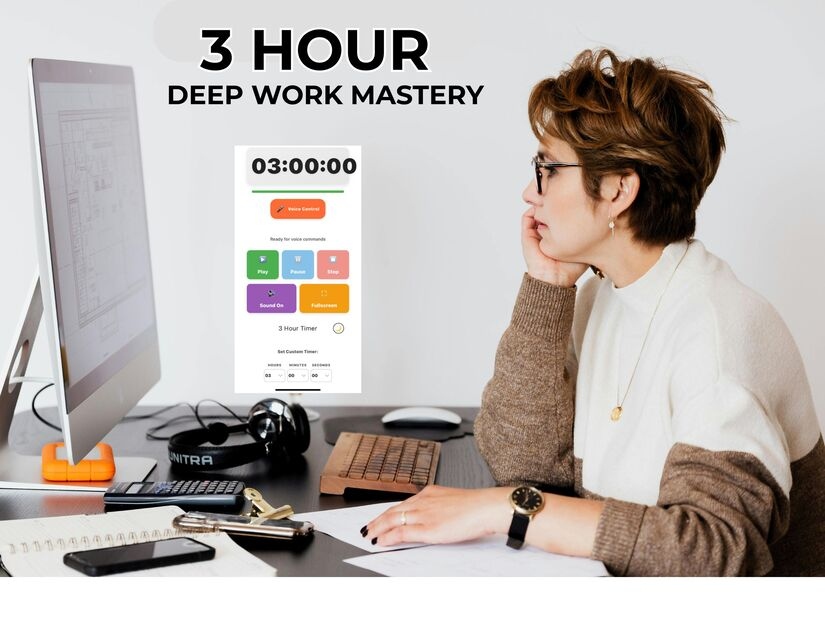


Try our free silent 5 minute timer below for an immediate focus boost.
For the best results, scroll down to learn the ‘Waiting Room Effect’ protocol used by high-performance professionals to eliminate distraction.
5 Minute Timer
Add This Timer to Your Website
Perfect for productivity, meditation, workouts, and focus sessions – just copy and paste:
Table of Contents
How Silent Timers Boost Focus and Concentration
Silent 5 minute timer technology reduces cognitive load by eliminating alert anticipation, with studies showing up to 15% improvement in mental performance when audio notifications are disabled.
Disabling sound helps your brain reach a deeper state of sustained attention free from distraction.
Companies adopting quiet workplace practices report productivity gains of around 23%, emphasising the impact of noise control on focus.
Silent timers are perfect for shared office environments, late-night work without disruption, libraries, meditation and meetings.
Visual countdowns and browser notifications provide effective, unobtrusive time awareness.
Using a silent timer respects others’ need for quiet while sharply enhancing your concentration.
When you need focused time without disturbing others, a silent 5 minute timer becomes your most valuable productivity companion.
Whether you’re working late while your partner sleeps, studying in a bustling library or managing tasks in a shared office space, quiet timing solutions respect everyone’s need for peace while maintaining your productivity momentum.
In our increasingly connected world, research tells us that downtime is essential to mental processes; that when resting, our brains are anything but idle.
Yet finding those precious moments of uninterrupted focus, without creating auditory distractions for others, has become more challenging than ever.
That’s where the power of silent timing transforms your approach to productivity.
Why Choose a Silent 5-Minute Timer Over Traditional Alarms?
The Burnout Report 2025, published by Mental Health UK, presents rigorously gathered data from a YouGov survey of over 4,400 UK adults, revealing that high stress and workload intensify difficulties in maintaining focus and sustained attention during the workday.
This underscores the critical need for quieter, well-structured work environments that minimise distractions and support employee wellbeing and productivity.
As burnout is recognised by the World Health Organisation as a syndrome resulting from chronic workplace stress,
This authoritative report highlights the societal and organisational imperative to create supportive environments to prevent burnout and enhance mental resilience.
When you add disruptive audio alerts to an already fractured attention landscape, you’re not just interrupting your focus, but you’re potentially derailing everyone around you.
Workplace Etiquette and Shared Office Spaces
Modern workplaces demand consideration for colleagues’ concentration needs.
Surveys show that we care more about interior acoustics than other environmental factors.
When you use a quiet 5-minute timer, you demonstrate respect for shared spaces while maintaining your productivity rhythm.
Companies prioritising quiet environments see remarkable boosts: Ollie Campbell, CEO and co-founder of Milanote, said that introducing “quiet time” made his team 23% more productive.
The workplace noise problem also impacts health, contributing to hearing loss, stress, and cognitive decline.
Library and Study Environment Considerations
Academic environments have sophisticated noise zoning.
Silent study areas require quiet, with policies to silence noisy devices and phone calls.
A silent 5 minute timer online bridges this gap perfectly, providing structure without sound pollution.
Home Use Without Disturbing Others
Sleep research reveals the critical importance of maintaining quiet domestic environments.
Comparing noise-reduced settings, studies show that quiet environments improve sleep quality significantly.
Using a noiseless 5-minute timer keeps household harmony when family members have differing schedules.
How to Use a Silent 5 Minute Timer Online Effectively
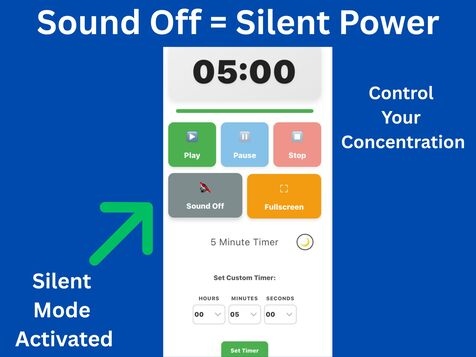
Accessing a silent 5-minute timer requires no special software or downloads. Simply navigate to the top of this page, configure your session and ensure audio notifications are disabled.
The visual countdown provides clear time awareness without acoustic disruption.
The psychological benefits of visual timing are substantial.
Research suggests meditation may change brain structure, and timed sessions support this neuroplasticity.
Your silent countdown timer becomes a tool for better attention habits (Harvard Health on mindfulness).
Visual Notification Methods and Browser Alerts
Modern browsers offer silent notification options.
When sessions are complete, discrete visual alerts, such as gentle screen flashes or pop-ups, maintain focus without disturbing others.
These cues are especially effective in shared spaces where sound would be disruptive.
Defeating the “Waiting Room” Effect: The Neuroscience of Silent Timing
One of the most profound benefits of a silent 5 minute timer is the elimination of what neuropsychologists call Vigilant Attention.
When a timer is loud, your brain allocates a portion of its “background RAM” to anticipate the coming noise.
This creates a “waiting room” effect where you never fully enter a deep flow state because you are subconsciously bracing for a startle.
By switching to a silent mode, you trigger Auditory Gating.
This allows your prefrontal cortex to shut out the “anticipation tax” and commit 100% of your neural resources to the task at hand.
This is the difference between “watching the clock” and “losing yourself in the work.”
Best Use Cases for Silent 5-Minute Timers

- Meditation and Mindfulness Practice Sessions: Research shows 5-minute “micropractice” sessions significantly reduce stress. Try our 5-minute meditation timer designed for silent mindfulness sessions.
- Late-Night Study and Work Sessions:
Silence is scientifically shown to be more relaxing than music for brain relaxation during focus (noise impact on sleep). - Professional Meeting Time Management:
Time-conscious meetings benefit from visual timing methods preserving flow without jarring audio interruptions (Forbes on productive meetings).
The 5-Minute “Quiet Glow” Protocol
Choosing to go silent isn’t just about being quiet for others; it’s about Cognitive Sovereignty,the ability to keep 100% of your attention under your own control.
When you remove the “threat” of a loud alarm, your brain stops scanning for distractions and sinks deeper into your work.
To get the most out of your silent 5 minute timer, follow this simple protocol to stay on track without using sound:
| Step | Action | Why It Helps |
| 1. The Anchor | Turn “Sound Off” before starting | Stops your brain from “waiting” for a loud noise. |
| 2. The Sight | Keep the timer tab visible | Gives you a quick way to check time without clicking away |
| Gives you a quick way to check the time without clicking away | Watch for the 00:00 visual reset | Signals the end of your task without a “jarring” interruption. |
Auditory Gating and the “Startle Response” Strategy
Most users think a silent timer is just about not disturbing others, but the true benefit lies in Auditory Gating.
Every time a traditional alarm “beeps,” it triggers a micro-startle response in the amygdala, which spikes cortisol and momentarily shatters your Task-Positive Network (TPN).
By using a silent 5-minute timer, you bypass this “acoustic shock.” This allows for a smoother transition between high-intensity focus and rest.
This is known as Low-Latency Switching, where the brain remains in a “cool” state of awareness rather than being jolted into a “hot” state by a loud alarm.
For high-performance professionals, this preserves mental stamina for 20% longer over the course of a workday.
The Psychology Behind the “Sound Off” Toggle: Why Less Is More

The “Sound Off” toggle represents a shift in attention management.
Neuroscience research shows audible alerts create a ‘cognitive tax’ or vigilant attention that reduces cognitive resources by up to 15%.
Disabling sound frees cognitive bandwidth, enabling a “pure focus state” and “cognitive sovereignty,” where your attention remains under your control without anticipation of distractions.
Silent Timer Features and Visual Alternatives to Sound
Effective silent timers rely on visual feedback, such as:
- Changing colour countdown displays
- Subtle animations for peripheral awareness
- Browser notifications without sounds
- Screen flash signals on completion
These maintain awareness with minimal disruption, fostering creative thinking and problem-solving.
Transform Your Productivity with Respectful Timing
Using a silent 5-minute timer respects others and enhances your own focus. Whether in shared offices, late-night studies or meditation, silent timers structure your time without acoustic disturbance.
For deeper insights, explore our guide on 5 minute timer productivity techniques.
Your journey toward focused, respectful productivity begins with five quiet minutes.
💡 Productivity Pro-Tip: If you already know the framework and just need a distraction-free environment, you can use our dedicated 5 Minute Timer Tool for rapid, one-click access during your workday.
FAQ: Common Silent 5 Minute Timer Questions
⏱️ 5-Minute Timer Quick Quiz
Master the 2026 Focus Framework