10 Productivity Hacks to Beat Phone Addiction Using Modern Productivity Tools
The 40-Word Summary
To stop phone addiction at work, you must implement Dopamine Anchoring. These productivity hacks replace digital triggers with timed work intervals, retraining your brain to anticipate rewards only after completing deep work sprints using professional focus tools and timer stacking.
The Neurobiology of the Variable Reward Trap
Phone addiction is not a character flaw; it is a conditioned neurological response driven by a variable reward schedule.
This is the same mechanism used in slot machines, where the uncertainty of a hit (a like, a message, or a news update) makes the behaviour addictive.
Every notification triggers a dopamine spike that pulls your attention away from complex tasks.
Experts suggest that breaking this loop requires Fixed Reward intervals. By using a 40-minute timer, you create a Fixed Anchor.
This process forces the brain to shift from a reactive state to a proactive one, where the reward is earned through completion rather than granted through interruption.
10 Actionable Productivity Hacks
- 🚀 Hack 1: The Phone Parking Zone. Proximity predicts distraction. Place your phone in a separate room to remove the visual cue.
- ⚓ Hack 2: The Dopamine Anchor. Establish a high-intensity focus block where the only reward is the completion of the countdown.
- 🌊 Hack 3: The 90-Second Urge Surf. When the impulse to check your phone peaks, wait 90 seconds. Most distraction urges fade if they aren’t immediately fed.
- 🧼 Hack 4: The Digital Palate Cleanser. Set a 25-minute timer for deep work, followed by a strict break for intentional scrolling.
- 🌑 Hack 5: Grayscale Mode. Remove color from your screen; a black-and-white interface is significantly less stimulating.
- 🧠 Hack 6: The Two-Minute Friction Buffer. If a task gets difficult, sit in silence for two minutes to force your prefrontal cortex to re-engage.
- 🎧 Hack 7: Sensory Shielding. Pair your timer with Lo-Fi or Pink Noise to create a dual-layer sensory anchor.
- 📦 Hack 8: Notification Batching. Turn off all non-human notifications and only check messages during designated breaks.
- 🧹 Hack 9: The Pre-Flight Tab Purge. Close every non-essential browser tab before starting an anchor block to reduce cognitive load.
- 🔄 Hack 10: The 5-Minute Desk Reset. Use a 5-minute timer at the end of each block to clear your physical and digital workspace.
The Workspace Environment Audit
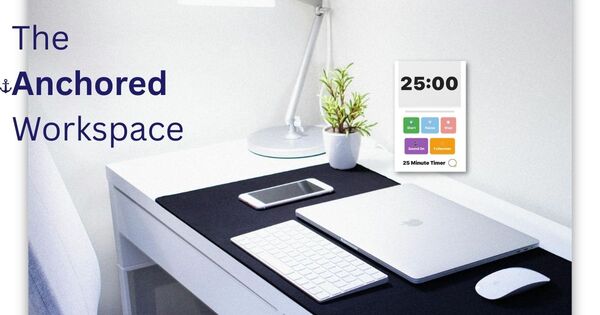
Your physical workspace acts as a silent director of your behaviour.
To maximise the effectiveness of these productivity hacks, you must perform a weekly environmental audit.
This involves identifying objects that trigger a desire for distraction and replacing them with focus cues.
For example, replacing your phone on the desk with a dedicated timer display shifts your mental focus from connectivity to temporality.
The Science of “Self-Interruption”
Research shows that if you are frequently interrupted by external sources, you eventually begin to “Self-Interrupt.” Even when your office is quiet, your brain has been conditioned to crave a distraction every 47 seconds.
As Dr Gloria Mark explains in her research on digital distraction:
“We found that as the rate of external interruptions increases, people’s rate of self-interrupting also increases. People become conditioned to being interrupted. After a while, they don’t even need an external trigger anymore; they just do it themselves.” Dr. Gloria Mark, Attention Span
To combat this, you must treat your focus like a muscle. Use the visual cue of a 25-minute timer to prove to your brain that the task is still active. This “Environmental Anchor” provides a physical signal that overrides the habituated urge to switch tasks, allowing you to rebuild your cognitive endurance one sprint at a time
The High Cost of the “Quick Glance”
One of the most effective productivity hacks involves understanding the Neurological Interference caused by a single notification.
When you glance at your phone for even two seconds, you aren’t just “checking a message.” You are triggering a Dopamine Dip that destabilises your focus for minutes afterwards.
Dr Adam Gazzaley, a neuroscientist at UCSF and author of The Distracted Mind, explains this as a fundamental limitation of our hardware:
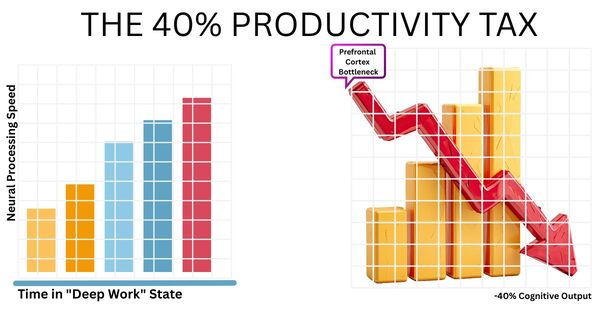
“The conflict between our high-level goals and our low-level interference (distractions) creates a ‘bottleneck’ in the prefrontal cortex. Even a minor interruption forces the brain to perform a ‘top-down’ reset, which is metabolically expensive and physically exhausting.” Dr. Adam Gazzaley, The Distracted Mind
The 2026 Reality: Why the “Quick Glance” is Toxic
- The Interference Effect: According to Dr Gazzaley’s research, every time you switch tasks, your brain must “de-activate” the neural network for Work A and “re-activate” the network for Work B. This isn’t a flip of a switch. It is a slow ramp-up.
- The Pain-Pleasure Balance: As Stanford’s Dr Anna Lembke notes in Dopamine Nation, every “hit” of digital pleasure from a notification is followed by an equal and opposite “pain” response. This creates an immediate urge to check the phone again, trapping you in a loop of Micro-Withdrawal while you’re trying to work.
- The 40% Deficit: This constant neural recalibration is why “multi-taskers” (who are actually just rapid-switchers) see a 40% drop in IQ-related performance during deep work sessions.
To bypass this bottleneck, you must use a 25-minute timer to “lock” the prefrontal cortex into a single goal-state. This prevents the “interference” from taking root before your brain has completed its current neural cycle.
Cognitive Refuelling: How NSDR (Non-Sleep Deep Rest) Breaks the Cycle of Phone Addiction
Focus is a finite metabolic resource, not just a mental state. Most professionals fail to beat phone addiction because they attempt to “power through” mental fatigue. This creates Cognitive Friction, where the brain naturally seeks “low-effort recovery” otherwise known as doom-scrolling.
To break this cycle, you must implement a strategy that resets the Autonomic Nervous System rather than just “taking a break.”
Andrew Huberman, a neurobiologist at Stanford University, identifies NSDR (Non-Sleep Deep Rest) as a primary tool for “offline” neural processing:
“NSDR can replenish the brain’s ability to focus by allowing the prefrontal cortex to go ‘offline’ for a brief window. By deliberately disengaging our visual system and heart rate, we reset the neural circuits that were exhausted by high-level task demands.”

The Ground Truth Protocol: 5-Minute Resets
To implement a successful recovery block, use this evidence-based protocol to physically reset your neural state:
- The 5-Minute NSDR Bridge: Use a 5-minute timer to perform a guided NSDR (Non-Sleep Deep Rest) session. This is a metabolic reset that lowers baseline cortisol and restores dopamine tone.
- Panoramic Vision Reset: Spend 2 minutes looking at the furthest point on the horizon. This physically deactivates the “alert” circuits triggered by the narrow, high-stress focus of a smartphone screen.
- The 20-20-20 Rule: Every 20 minutes of deep work, look at something 20 feet away for 20 seconds. This prevents the Ciliary Muscle fatigue that often triggers the biological urge to seek a digital distraction.
By using a 5 minute timer as a hard boundary, you prevent “break creep,” where a quick rest accidentally turns into a 30-minute social media rabbit hole.
Social Productivity Tools: Why “Body Doubling” Kills the Urge to Scroll
While individual discipline is often the focus of productivity hacks, the most effective way to manage phone addiction is often social, not solitary. In clinical circles, Body Doubling, the practice of working in the presence of another person, is recognised as a powerful tool for task initiation and sustained focus.
The mere presence of a peer acts as a “Social Anchor.” Biologically, this stimulates the dopamine reward pathway, providing the baseline neural stimulation that your brain usually tries to find by checking notifications. When you work with a “Body Double,” you aren’t just being watched; you are co-regulating your focus.
The “Focus Field” Protocol
To turn a colleague or friend into a functional productivity tool, implement the following structure:
- Synchronised Sprints: Set a synchronised 25-minute timer with your partner. The shared deadline creates a “Focus Field” where the social cost of breaking focus (by picking up your phone) becomes higher than the effort of staying on task.
- Neutral Accountability: Your body double shouldn’t be a manager or someone who critiques your work. The goal is “Non-Evaluative Presence” Simply knowing someone else is in the “deep work” trenches with you lowers the Activation Energy required to start a difficult task.
- The Virtual Doubling Hack: If you work remotely, joining a deep-work stream or a quiet video call acts as a digital version of this protocol. It restores the ambient structure of an office without the interruptions of traditional meetings.
The Biological Rebuild: How Timers Physically Reverse Phone Addiction
Neuroplasticity is not just a buzzword; it is a measurable biological ROI for your time. According to the inverted-U relationship between cognitive load and neural adaptation, the most significant growth happens when you are at the edge of your focus threshold.
Every time you successfully outlast an Urge Surge (that 90-second neurochemical spike where your brain screams for a notification) you are not just waiting. You are engaging in slow-stage learning.
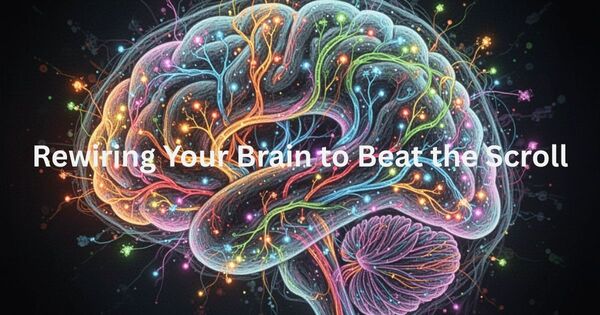
This process recruits specialised motor neurons to physically thicken the grey matter in your prefrontal cortex.
While fast-stage learning gives you a temporary boost, it is the repetitive completion of timed intervals that rewires your brain to prefer sustained deep work focus over fragmented, dopamine-seeking distraction.
By treating focus as a muscle subject to Hypertrophic Training, you transition from a mind that reacts to one that architecturally dominates its environment.
Scaling Productivity Hacks to Your Cognitive Demand
Productivity is a highly personal neurochemical state. Our 2026 Focus Framework provides the tools to scale your effort based on your current cortical thickness and mental energy:
- 🚀 High-Velocity Sprints: Use short bursts to overcome initial resistance and break through procrastination.
- ⚓ Deep Work Anchors: Use longer sessions to stabilise focus during complex, high-value tasks.
- 🛠️ Custom Intervals: Explore our full suite of productivity timers to match your shifting cognitive demands.
By matching your timer to the complexity of the task, you stay within the optimal zone of the inverted-U relationship between stress and performance.
Troubleshooting Your Focus Blocks
If you find yourself repeatedly reaching for your phone, stop the clock and perform a “Mind Dump.” Spend two minutes writing down every task or worry currently occupying your thoughts. Once these “Open Loops” are on paper, your brain no longer needs to use active energy to remember them, allowing you to re-engage with your 5-minute timer to reset and try again.
FAQs: Productivity Hacks for Phone Addiction
What are the most effective productivity tools for staying focused?
The best tools are those that “externalise” time, moving it from a vague feeling in your head to a visible, objective countdown. Using dedicated digital timers (such as your 5- and 25-minute links) and site-blocking software creates a physical and digital boundary that protects your deep work sessions.
How do I stop “phantom vibrations” while working at my desk?
Phantom vibrations, the sensation of your phone buzzing when it hasn’t, are a symptom of digital overstimulation. The only proven “hack” to stop them is creating physical distance. By moving your phone to a separate room, you break the neurological expectation of a notification, allowing your nervous system to settle.
Can these productivity hacks actually clear “brain fog”?
Yes. The high cognitive cost of constant task-switching often causes brain fog. By using “Timer Stacking” (working in dedicated blocks with set breaks), you allow your brain to remain in a single cognitive mode. This reduces mental fatigue and restores clarity by preventing the exhaustion that comes from jumping between your work and your phone.
Conclusion: Reclaim Your Professional Agency
Winning the battle against phone addiction is about building robust systems, not relying on fleeting willpower. By using these productivity hacks, you transform your workspace into a high-output environment. Start your transition today by launching a simple 5-minute timer to clear your desk and prepare for your first deep work session.

Dwayne is a productivity practitioner and the architect of the 2026 Focus Framework. As a self-taught specialist in cognitive endurance, he spent over a decade reverse-engineering task inertia and “flow-state” mechanics to create the systems found on 5 Minute Timer. Unlike theoretical consultants, Dwayne’s methodology is rooted in Neural Anchoring and zero-latency logic, practical tools developed through years of in-the-trenches testing. He specialises in helping high-performance professionals ‘drop in’ to awareness and activate the Task-Positive Network (TPN) to eliminate procrastination at the source.