
What is the Best Morning Routine for Night Owls to Stop Brain Fog?
Stop fighting your biology with willpower. Our strategic 40-minute science protocol is the ultimate morning routine for those who struggle to wake up. By using a 40-minute deep work session, you can trigger cortisol release naturally and stay focused.
The Night Owl Friction Test
1. When your alarm first goes off, what is your immediate biological response?
Morning Routine Checklist: At a Glance
- 0-5 Mins: Thermal Break (Leg lifts or light stretching).
- 5-15 Mins: Optical Reset (Seek out natural lux exposure).
- 15-20 Mins: Metabolic Spark (Drink water/electrolytes).
- 20-45 Mins: Momentum Lock (Start your deep work session using our 25 minute timer).
Pro Tip: The Dedicated Focus Advantage
Why use this timer instead of a standard phone alarm? A phone alarm is a gateway to dopamine seeking. The moment you reach for your phone to silence it, your brain instinctively scans for notifications, emails, or social media updates. This triggers a distraction loop before your work even begins. Our dedicated tool is designed to function as an environmental anchor. By keeping your phone out of reach and relying on a single purpose web tool, you remove the friction of decision making and protect your fragile morning focus from the digital noise that kills productivity.
Science-Backed Circadian Hacks for Night Owls
Night owls frequently experience a “Delayed Sleep Phase,” a biological pattern in which core body temperature and cortisol rhythms run 2–4 hours later than standard work schedules.
This misalignment forces you awake before your biology is ready, triggering Sleep Inertia, a state of cognitive impairment that can last up to 4 hours. Without a structured daily protocol, your brain remains in a low-arousal state, effectively losing half your productive day to grogginess.
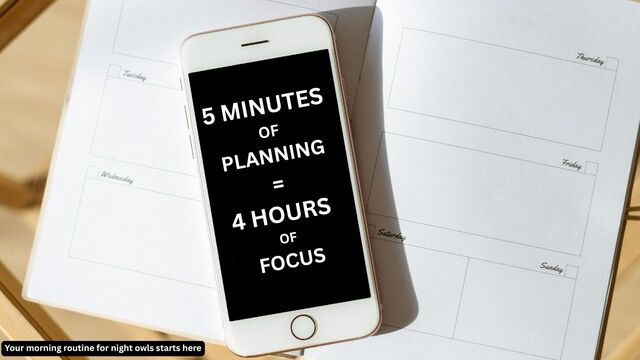
By implementing a timed system, you bypass the “willpower gap” and manually spike cortisol levels. Instead of making complex decisions while impaired, your initial actions are dictated by the sequence.
This transition allows night owls to reach peak cognitive performance within a predictable 40-minute window.
“Understanding your body clock is the first step to transforming how you wake up and structure your mornings.” Dr. Russell Foster, Professor of Circadian Neuroscience, University of Oxford.
By using timed micro-goals, you provide the brain with “External Scaffolding.” Instead of deciding what to do, the timer dictates the action, preserving your limited morning willpower for high-value tasks later in the day.
To provide a defensible asset for your readers, use the following interactive-style table. This layout highlights the “Link Loop” between your educational content and the functional tools on your site.
The Night Owl Launch Table
Night Owl Morning Routine Checklist
| Protocol Phase | Time | The Night Owl Action | Biological Shift | Active Timer |
|---|---|---|---|---|
| 1. Inertia Break | 5 Mins | Micro-Stretching | Spikes core temperature and oxygen flow. | Start 5m Timer |
| 2. Optical Reset | 10 Mins | Lux Exposure | Halts melatonin via retinal saturation. | Start 10m Timer |
| 3. Cognitive Load | 25 Mins | Skill Deep Work | Anchors the Focus Framework momentum. | Start 25m Timer |
Step-by-Step Guide: The “No-Brainer” Protocol
Follow this 40-minute morning routine checklist to move from ‘standby mode’ to peak cognitive output.
- The Bedside Catalyst (0-5 Mins): Do not leave the bed. Use a 5-minute timer page for dynamic movements (leg lifts, arm circles). This raises your heart rate and forces blood to your extremities, shortening the “thawing out” period significantly.
- The Solar Flush (5-15 Mins): Move to a window or a 10,000 Lux light box. This is Retinal Saturation. It is the only way to signal the Suprachiasmatic Nucleus (the brain’s master clock) that the day has begun.
- The Metabolic Spark (15-20 Mins): Drink 500ml of water with a pinch of sea salt. Night owls are often more dehydrated than early birds due to longer evening activity. This restores electrolyte balance for neurotransmitter firing.
- The Momentum Lock (20-45 Mins): Sit down at your desk. Set a 25-minute timer page. Work exclusively on one high-depth task from your 30 Day Skill Plan.
Managing Your Brain’s Reward System: The Low-Dopamine Morning
For a Night Owl, the biggest threat to a productive morning isn’t laziness, it’s Dopamine Seeking. Because your brain is in a low-arousal state during sleep inertia, it instinctively looks for a “quick hit” of dopamine to feel awake. This is why you grab your phone before your eyes are fully open.
To manage this, you must implement a Low-Dopamine Morning protocol:
- The 25-Minute “Value First” Rule: Do not check social media or email until your first 25-minute timer is complete. This trains your brain to associate the “reward” with completing a task rather than passive consumption.
- Successive Wins: Each time you finish one of your timed blocks (5, 10 or 25 minutes), your brain releases a small pulse of dopamine. This creates a “Success Spiral,” making the next task easier to start.
- The Reward Prediction Error: According to research on Dopamine and Reward Prediction, your brain’s motivation is driven by the difference between expected and actual rewards. By completing a structured 40-minute routine, you “reset” your baseline, making your workday tasks feel significantly more satisfying.
🚀 Case Study: Reclaiming the “Lost” Morning
“I always identified as a night owl, which usually meant my mornings were a write-off. I would wake up, but my brain would not ‘plug in’ for hours. I was essentially operating on 50% battery until the afternoon.”
- Snoozing through cycles
- Decision fatigue by 9:00 AM
- Checking notifications in bed
- State: Persistent Brain Fog
- 5-minute thermal reset
- 10-minute light exposure
- 25-minute momentum block
- State: 100% Focused
The Result: By following the structured sequence and using the 5 minute and 25 minute timer pages, the ‘thawing out’ period was cut by 80%. This is not about willpower. It is about using a system that dictates the action when your brain is not ready to decide.
Common Pitfalls: Why Most Routines Fail
Snooze Button Suicide: Every time you hit snooze, you fall back into a new sleep cycle. When the alarm goes off again, you are in a deeper sleep than before. This causes Confusional Arousal that “where am I?” feeling that ruins your morning and induces heavy sleep inertia.
The Caffeine Timing Trap: Coffee blocks the receptors that make you feel sleepy, but it doesn’t actually remove the sleepiness chemicals from your brain. If you drink it before completing your 10-minute light exposure, you will likely experience a severe crash in the afternoon.
Social Jetlag: According to the American Academy of Sleep Medicine, social jetlag is the biological equivalent of flying across multiple time zones every Friday and flying back again every Monday. This occurs when you wake up early for work during the week but sleep in significantly later on the weekends. To maintain your progress and protect your circadian rhythm, aim to keep your wake-up time consistent within a 60-minute window every day of the week.
The “Pitfall Prevention” Dashboard
The Night Owl Pitfall Guard
| The Mistake | Why It Fails | The Timer Fix |
|---|---|---|
| Snoozing | Fragments sleep cycles. | Set a 5m Stretch Timer 1 foot from bed. |
| Early Caffeine | Blocks natural waking. | Wait until after your 10m Light Reset. |
| Weekend Shift | Causes “Monday Blues.” | Use a 25m Creative Block even on Saturdays. |
Personalisation: The Habit Stacking & Staging Architecture
The most effective routine is a Defensible Asset, a system so tailored to your life that it becomes your greatest competitive advantage. We achieve this through Habit Stacking: anchoring a new, difficult habit to a “trigger” action (an existing behaviour) you already perform without thinking.
Staging Your Environmental “Nudges”
To make this work long-term, you must “stage” (prepare) your physical space so your routine requires zero willpower. According to research on Willpower and Self-Control published by the American Psychological Association, willpower is a finite resource that acts like a muscle; it can be exhausted throughout the day.
Don’t waste this limited energy on deciding what to do or searching for your tools in a morning fog. Instead, automate your environment to remove friction:
- The Physical Trigger: Place your water bottle directly on top of your phone. To check your notifications, you must first physically move the water, triggering your hydration phase.
- The Visual Anchor: Leave your planner or task list open on your desk the night before. Seeing the specific task immediately removes the “decision fatigue” that often leads night owls back to bed.
Bridging the Productivity Gap
Night owls often experience a “mid-morning slump” a temporary drop in energy, once the initial adrenaline of waking up wears off. To prevent this, implement a Focus Bridge. Instead of switching to “shallow work” (low-value tasks like checking emails), transition directly into a structured block of deep work.
This maintains your momentum and ensures your brain remains in a Flow State until your first scheduled break. By anchoring your focus early, you bypass the cognitive dip that typically leads back to distraction or fatigue.
The “Phase-Lock” Technique
For true mastery, use your final 25-minute timer session for a “High-Value Output” task. This locks in the neural pathways (brain connections) associated with productivity early in the day. Research on Neuroplasticity from Harvard Health suggests that learning and focus are most effective when the brain is transitioning between states, exactly what this timer protocol exploits to turn a struggling night owl into a productivity powerhouse.
Advanced Circadian Hacks: Beyond the Basic Routine
To transition from “surviving the morning” to elite productivity, you can layer in these biological shortcuts. These techniques address the specific physiological delays that night owls face, such as late-rising core temperatures and the “dopamine-starved” state of the early brain.
The Thermal Reset (Thermoregulation)
While light is the primary signal for your brain’s master clock, body temperature is the secondary driver of alertness. Night owls naturally have a delayed rise in core temperature.
- The Technique: Perform a “thermal contrast” by washing your face with warm water or taking a brief warm shower immediately after waking.
- The Value: This manually triggers the metabolic shift that normally happens naturally for “early birds,” effectively tricking your body into daytime mode.
- Scientific Validation: Thermoregulation and Sleep-Wake Cycles (Direct link to peer-reviewed research on temperature-driven alertness).
The “Uphill Task” Cognitive Triage
The first hour of clarity is a night owl’s most fragile asset. Many waste it on “reactive” tasks like checking notifications, which leads to cognitive fragmentation.
- The Technique: Dedicate your first focused work block exclusively to an “Uphill Task”—a high-value project that requires deep logic or creativity.
- The Value: This protects your peak brain power from being drained by administrative chores, ensuring your most important work is done before the mid-morning slump hits.
- Scientific Validation: To understand why this consistency is vital, you must consider the impact of Task Switching and Cognitive Fatigue. Research shows that attempting to multitask or “catch up” on sleep during the early morning destroys your daily output by fragmenting your focus. This cognitive drain is exactly why a structured morning routine is superior to a flexible one.
Digital Friction and Environmental Cues
Willpower is a finite resource that acts like a muscle; it can be exhausted. To save this energy, you must let your environment do the heavy lifting.
- The Technique: Implement “Digital Friction” by using app blockers that stay active until your routine is finished, or charging your phone in a separate room overnight.
- The Value: This replaces an internal mental struggle with a physical boundary, making the “right choice” the only choice available.
- Scientific Validation: To make this consistency permanent, you must leverage the power of Environmental Cues and Habit Formation. Research into behavioural psychology confirms that your brain relies on external triggers to initiate a routine. ace is a mechanical necessity rather than just a convenience.
Frequently Asked Questions
1. Why do night owls experience such intense “brain fog” compared to early birds?
This is known as Sleep Inertia. For night owls, the body’s core temperature and cortisol levels rise 2–4 hours later than the average person.
When you wake up “early” for work, your brain is physically still in a sleep state, with high levels of residual adenosine (the sleep-pressure chemical) still present.
Using a 5-minute movement phase helps manually spike your core temperature to “thaw out” the brain faster.
2. Is it better for a night owl to wake up at the same time every day, even on weekends?
Yes. This prevents “Social Jetlag.” If you wake up at 7:00 AM during the week but 11:00 AM on weekends, you are effectively flying across four time zones every Friday and flying back every Monday.
This constant shifting prevents your circadian rhythm from ever “locking in.” Maintaining a consistent anchor time is the only way to make early mornings feel natural over time.
3. Can caffeine replace a structured morning routine for night owls?
No. Caffeine is an adenosine antagonist; it blocks the receptors that make you feel sleepy, but it doesn’t actually remove the sleep-inducing chemicals from your system.
This is why many night owls “crash” at 2:00 PM. A science-backed routine uses light and movement to actually clear those chemicals.
We recommend delaying caffeine until after your first 25-minute focus session to ensure your alertness is driven by biology, not just a stimulant.
4. How can I stop hitting the snooze button and actually start my routine?
The snooze button is a night owl’s greatest enemy because it triggers “Confusional Arousal.” Every time you hit snooze, you start a new sleep cycle that you cannot finish, leaving you groggier than before.
The best fix is Environmental Staging: place your water and your alarm across the room. By the time you walk over to turn off the alarm, you have already completed the hardest part of the Inertia Break.
5. What if I have children or a busy household? How do I stage my environment then?
Staging your environment is actually more critical when you have external distractions. If you cannot control the noise in the house, focus on what you can control within your immediate reach.
Prepare your “Bedside Catalyst” by placing your phone and a glass of water across the room the night before. This requires you to get out of bed to silence the alarm.
You can also use noise-cancelling headphones during your 25-minute focus block to signal to your family that you are in a deep-work window. By automating these small physical cues, you protect your morning routine from the unpredictable nature of a busy home.
6. Can I perform the movement phase while I am still in bed?
While getting out of bed is the gold standard for breaking sleep inertia, you can certainly begin the process before your feet hit the floor.
If you find it impossible to move, start with dynamic stretching or tensing and releasing your muscles under the covers.
This generates initial body heat and begins the process of raising your core temperature. However, you should transition to the 5-minute timer page as soon as possible.
The goal is to move from a horizontal position to a vertical one to fully trigger the cortisol awakening response and clear the fog for night owls.