

The best focus session length depends on the task, your current attention level and the time you have available. No single duration works equally well for everyone.
Use these durations as starting points rather than strict rules:
Five minutes: Start a difficult task, clear one small action or overcome hesitation.
12 minutes: Complete one short, clearly defined work, study, writing, reading or revision task.
25 to 45 minutes: Complete routine-focused work, study, administration or editing.
60 to 90 minutes: Work on learning, writing, analysis or other complex tasks.
Two hours: Use for selected projects that need extended concentration and feel sustainable.
Your best session length is the one that allows you to make useful progress without excessive fatigue or unnecessary interruption.
When a five-minute session helps
A five-minute session can be useful when you need to start a task, overcome hesitation or complete one small action. Use the 5-minute timer to choose a clearly defined first step.
You could use five minutes to open your notes, outline a paragraph, review a few flashcards, clear one distraction or prepare the next stage of a larger task.
When the countdown ends, you can stop, take a short break or continue into a longer focus session. The purpose is to create a manageable starting point, not to force every task into five minutes.
When a 12-minute focus session helps
A 12-minute focus session can be useful when five minutes feels too short to make meaningful progress, but a longer session feels difficult to begin or does not fit the time available.
Use a 12-minute focus timer for one defined task, such as drafting an email, reviewing a short document, answering a small set of practice questions, writing a paragraph, organising notes or planning the next stage of a project.
Twelve minutes is not a scientifically proven ideal focus duration. It is a practical middle-length block: long enough to complete one contained action, but short enough to use between meetings, lessons, appointments or other commitments.
When the timer ends, review your progress. Stop if the task is complete, continue if you have useful momentum or take a break before beginning another session.
When a 20-minute session helps
A 20-minute session can be useful when a 12-minute block ends before a task is finished, but the full 25 to 45-minute range feels like more time than the task needs or more than you want to commit to right now.
Use a 20-minute timer for a single task with a bit more scope than a quick action, planning a short piece of work, drafting a longer email, working through a small set of problems, or making a start on reading or research before deciding whether to continue.
Twenty minutes sits between the quick single-action length of 12 minutes and the more established Pomodoro-style block of 25 minutes. It isn’t a formally studied interval the way the Pomodoro’s 25 minutes is, it’s a practical middle step for when neither of the surrounding options quite fits.
When the timer ends, review what you’ve completed. Stop if the task is done, continue into a longer session if you have momentum, or take a short break before starting again.
Choosing a focus-session length
25 to 45 minutes: routine-focused work
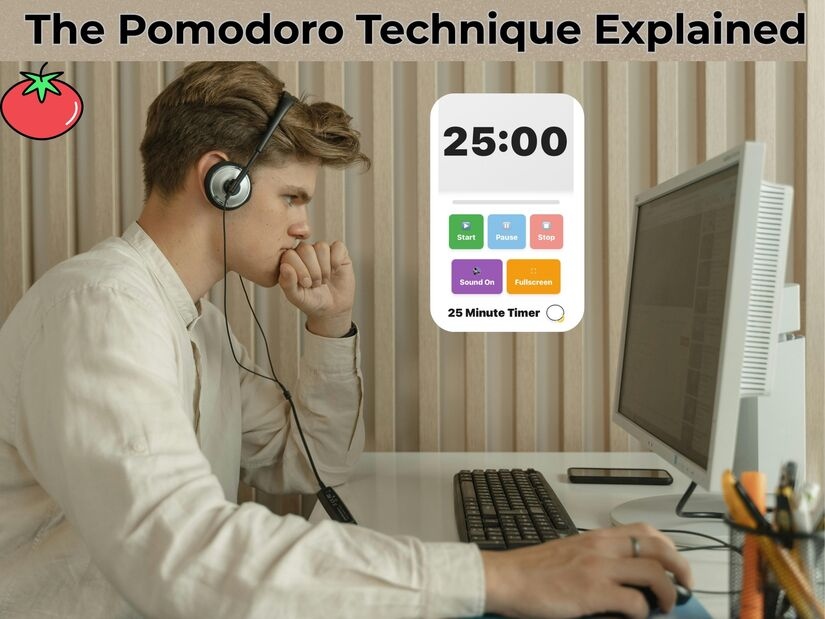
This range can suit study, writing, emails, editing and tasks with a clear boundary. It gives you enough time to make progress without requiring a long uninterrupted block. The lower end of this range isn’t arbitrary: 25 minutes is the interval at the heart of the Pomodoro Technique, developed by Francesco Cirillo in the late 1980s, though Cirillo himself has said the exact number is “one expression” of the technique, not a fixed rule.
60 to 90 minutes: complex focused work
A longer session may suit learning, writing, research, analysis and projects that need more time to develop. Take a break if your work quality or concentration begins to decline.
The upper end of this range lines up with research on the brain’s basic rest-activity cycle, first identified by sleep researcher Nathaniel Kleitman, which found alertness naturally rises and falls in roughly 90-minute cycles even during waking hours. Huberman Lab has popularised applying this cycle to structure focused work, generally suggesting one or two such sessions a day before returns diminish.
Two hours: selected deep-work tasks
A two-hour session may suit complex creative or analytical work, but it is not automatically more productive. Use it when the task genuinely benefits from extended concentration and the duration feels sustainable.
The best duration is the one that matches the task and allows you to produce useful work without excessive fatigue.
Match the duration to the task
| Task | Possible starting duration |
|---|---|
| Beginning a difficult task | 5 minutes |
| Quick administration or email | 5–12 minutes |
| Short writing, review or revision task | 12 minutes |
| Routine study or editing | 25–45 minutes |
| Reading or learning | 45–60 minutes |
| Writing or analysis | 60–90 minutes |
| Complex creative or technical work | 90–120 minutes |
These are possible starting ranges rather than fixed rules. A simple writing task may need less time, while a complex report or research project may benefit from a longer session. Choose the duration according to the task, your current capacity and the time available.
How long can a person actually focus?
There’s no single studied number for the absolute limit of human focus, attention isn’t a battery with a fixed capacity, and it depends heavily on the task, how meaningful or stimulating it is, and how rested you are. But two things are worth knowing if you’re asking this out of genuine curiosity rather than looking for a session length.
The commonly cited range is 10 to 52 minutes for sustained attention on one task. Harvard Health’s overview of concentration research notes that studies looking at work and classroom performance place sustained attention span anywhere from 10 minutes to 52 minutes, a wide range because it depends heavily on the task and the person.
This is a different question from how long a productive session should be (which can run much longer with brief internal resets you don’t consciously notice), it’s specifically about how long attention stays locked onto one unbroken stimulus before naturally drifting.
The “8-second human attention span” claim isn’t real. You’ll see it repeated constantly, that humans now have a shorter attention span than a goldfish, usually cited as 8 seconds. BBC journalist Simon Maybin investigated this claim in 2017 and traced it back through a Microsoft-commissioned report to a source that doesn’t actually support the number, no rigorous study has produced it, and attention researchers have disputed it since it started circulating.
If you came here after seeing that stat somewhere, it’s safe to disregard it, human attention is measured in minutes for sustained tasks, not single-digit seconds.
Total daily capacity is a separate question again. Anecdotally and in less formal writing, 3 to 5 hours of genuinely deep focus a day is often cited as a realistic ceiling, even for people whose whole job is concentration-heavy work, on the reasoning that the brain can’t sustain peak engagement for a full 8-hour day.
There isn’t a single definitive study behind that specific figure, so treat it as a useful rule of thumb rather than an established fact, in the same spirit as the ranges elsewhere on this page.
If what you actually need is a session length for a specific task rather than a biological limit, the sections above and the table below are the practical answer, this section is here because a meaningful number of people land on this page asking the science question directly, and it deserves a straight answer rather than silence.
Build your focus duration gradually
If you currently struggle to focus for a long period, begin with a duration you can complete consistently. This might be five minutes for starting, 12 minutes for a short defined task or 25 minutes for a more established work block.
A simple progression is:
- Choose a manageable starting duration.
- Use it consistently for several sessions.
- Review the quality of your work.
- Increase the time only when the current duration feels sustainable.
- Reduce the duration when your circumstances change.
Your concentration can vary with sleep, stress, workload, interruptions and task difficulty. A flexible approach is more practical than following one fixed schedule every day.
When to shorten a session
Shorten the session or take a break if you notice:
- Your work quality is declining.
- You are repeatedly rereading the same material.
- You are switching between unrelated tasks.
- You feel increasingly frustrated.
- You are experiencing physical discomfort.
- You are no longer making meaningful progress.
The timer should help you organise your work, not pressure you to continue after the session has stopped being useful.
Take useful breaks
Breaks should reflect the length and intensity of the session. After a short session, a few minutes may be enough. After a longer session, take more time before returning to demanding work.
This isn’t just about comfort: research by Dr. Gloria Mark at UC Irvine found it takes an average of 23 minutes and 15 seconds to fully return to a task after an interruption, so a break that’s too short to actually disengage can leave you paying that same cost on the way back in.
During a break, you could stand up, move around, get some water, look away from the screen or write down the next action.
Before ending a session, record where you will begin next time. This makes it easier to resume the task without spending time deciding what to do.
Prepare before starting
Before the timer begins:
- Choose one specific task.
- Decide what progress will look like.
- Gather the information and tools you need.
- Silence unnecessary notifications.
- Close unrelated tabs.
- Keep a note nearby for distractions or ideas.
- Start the countdown when you are ready to work.
“Write the introduction” is a clearer starting instruction than “work on the article.”
For a 12-minute session, choose a task that has a visible endpoint. For example, draft one paragraph, review two pages, answer five flashcards, process three emails or organise one set of notes.
Frequently asked questions
How long should a focus session be for beginners?
Start with a duration you can complete without excessive strain. This might be five minutes to begin a difficult task, 12 minutes for one short defined action or 25 minutes for a more established work block. Review the quality of your work and adjust gradually.
Is a longer focus session always better?
No. A longer session can be useful for complex work, but it is not automatically more productive. The best duration depends on the task, your concentration and how sustainably you can work.
Is five minutes enough for a focus session?
Five minutes can be useful for starting a difficult task, completing a small action or creating momentum. It does not need to be long enough to complete the entire project.
How long can a human actually focus, at maximum?
There’s no single agreed number. Research on sustained attention for work and classroom tasks puts it anywhere from 10 to 52 minutes before focus naturally drifts, though this varies a great deal by task and person. The “8-second attention span” figure sometimes quoted online has been traced back to an unverified source and isn’t considered reliable by attention researchers.
How many focus sessions should I do in a day?
There is no universal number. Schedule sessions around your workload, energy and recovery needs. Several shorter sessions may suit one person, while another may prefer fewer longer blocks.
What should I do when the timer ends?
Record your progress, decide on the next action and choose whether to stop, take a break or continue with another session.
Is 12 minutes enough for a focus session?
Twelve minutes can be enough for one short, defined task, such as drafting an email, reviewing a document, answering a few practice questions or writing a paragraph. It is less suitable for tasks with a long setup phase or work that needs extended uninterrupted concentration.