

“Work expands to fill the time which is available for its completion.” That’s Parkinson’s Law, coined by C. Northcote Parkinson, and it’s the reason most goals stall before they start.
Most people don’t fail to reach a goal because they lack motivation, they fail because the finish line feels too far away. When a project feels massive, your brain treats it as a threat and responds with resistance: procrastination, avoidance, and the specific flavour of stalling known as analysis paralysis.
The way out is timer-based goal setting. Instead of aiming at the whole outcome, you aim at a specific, timed interval. Instead of “write a book,” the goal becomes “focus for 15 minutes.” That single shift, from outcome to interval, removes most of the fear attached to starting.
This changes your actual relationship with work. Vague intentions turn into concrete, manageable sessions that build their own momentum. If traditional planning has never stuck for you, learning to build a daily schedule with timers is the natural next step once this clicks.
Table of Contents
The Psychological Architecture of Timer-Based Goal Setting
Most people focus on what they want to do and never pin down when they’re actually going to do it. That’s where Parkinson’s Law becomes either your best friend or your worst enemy. Give yourself all day to write an email, and it will genuinely take all day. Set a 15-minute timer instead, and the brain stops chasing the perfect sentence and just starts typing, because the constraint is now the timer, not the task’s imagined difficulty.
A timer works because it functions as a commitment device. Deciding in advance exactly when and for how long you’ll work is a form of implementation intention, the “if-then” planning structure that behavioural research has repeatedly linked to a much higher rate of actually starting a task. Fixing the “when” in advance lowers the mental cost of getting going, and that lower cost is most of what neutralises procrastination in the first place.
There’s a second piece worth building around: your own energy naturally rises and falls across the day in cycles of roughly 90 minutes, often called ultradian rhythms. Structuring your sessions around that rhythm, rather than fighting it, means intense focus gets followed by real recovery instead of running straight into fatigue and eventual burnout.
The Goal-Setting Power Stack
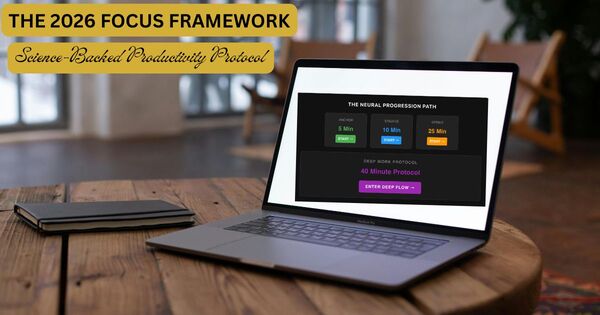
You can’t sprint indefinitely. The biggest productivity crashes tend to happen when people try to work for hours with no structure at all. The stack below is built to work with your energy cycle rather than against it: start small to defuse the initial “I don’t want to do this” resistance, then move into deeper work once real momentum exists.
| Phase | Tool | Purpose |
|---|---|---|
| 1. Activation | 1-minute timer | Overcome initial task inertia and trigger the first physical action |
| 2. Strategy | 18-minute timer | High-intensity planning and mapping out the project |
| 3. Execution | 90-minute timer | A full focus cycle for complex, deep project work |
How to Get Started in 5 Minutes
The hardest part of any goal is the first five minutes, a timer just makes that first step non-negotiable. Here’s the sequence:
- Identify one goal you’ve been avoiding for more than a week.
- Define the very next physical action it needs, “open the spreadsheet” or “draft one email,” not the whole project.
- Clear your desk of distractions, phone in another room or on aeroplane mode.
- Start a 5-minute timer and commit to nothing more than the setup and the first few steps.
- Begin the moment the countdown starts. Do not check email first.
- When the timer ends, decide honestly whether you have the energy to continue into a longer block.
The Goal-Achievement Matrix: Precision Intervals for Execution
Different kinds of work call for different interval lengths. This is the full range used across the framework above:
| Focus Phase | Interval | What It’s For |
|---|---|---|
| Micro-Momentum | 2-minute timer | Killing task-initiation friction with a commitment of just 120 seconds |
| Rapid Assimilation | 10-minute timer | Fast administrative review or clarifying a daily goal |
| Task Densification | 15-minute timer | Peak focus during a mid-day slump |
| Cognitive Endurance | 25-minute timer | The standard Pomodoro-style block for sustained goal progress |
| Strategic Overhaul | 60-minute timer | High-level strategy work or major project architecture |
The Sustained Momentum Protocol
1. Visual urgency and environmental anchoring. Keep your timer somewhere you can actually see it. That visual feedback creates a healthy, low-level urgency that heads off perfectionism before it stalls you. Pairing this with a consistent environment, the same lighting, the same seat, for the same kind of work, cuts the mental cost of switching between tasks.
2. Sequential stacking. Front-load your day with a rapid-fire block to clear small administrative tasks and bank an early win, then move directly into your longest, deepest focus cycle while that momentum is still there. This is really just time blocking applied to goal work specifically, sequencing your day so your best cognitive window lands on your hardest task.
3. Aim for roughly 80% completion, not 100%. Real days are volatile, so treat a fully completed block as a bonus, not the baseline. A more useful measure than “did I finish the task” is interval volume, how many focus sessions you actually ran this week. That number tells you more about your real capacity than any single day’s outcome does. There’s no strict research-backed rule that 80% is the magic number, it’s simply a realistic target that leaves room for the days that don’t go to plan.
Cognitive Friction: Avoiding Strategic Failures in Timed Execution
1. Underestimating ramp-up time. Setting a short timer for work that needs real depth just guarantees frustration when the alarm goes off before your brain has properly engaged. Use the first five minutes of any new session to gauge how complex the task actually is before you commit to a final duration.
2. The flow state fallacy. Ignoring the timer because you’re “in the zone” is one of the more common routes to afternoon burnout. When it rings, respect it, finish your current sentence or calculation, then move straight into a proper recovery period rather than pushing on.
3. Environmental dilution. A focus block only works as a closed system. Notifications, a quick email check, a glance at your phone, all of it dilutes the intensity of the session. If this is a recurring problem, our guide to digital detox breaks covers how to make your actual breaks screen-free too, so the discipline holds on both sides of the timer.
4. Vague objective assignment. “Work on my business” is too abstract to point a timer at. Set a granular, physical target for every block, “draft three social posts” or “reconcile this one statement,” not general work, so the time has something concrete to be spent on.
Adaptive Execution: Scaling the Framework to Your Life
The activation phase: the five-minute threshold. If task-initiation friction is your main problem, commit to your primary objective for just 300 seconds. In most cases, the momentum built in that short window is enough to carry you straight into a longer session without a second decision point.
The efficiency phase: interstitial timing. Busy schedules, especially for parents working from home, rarely offer a clean hour. Using the small gaps between other commitments for short, timed bursts reclaims real productivity that would otherwise be lost waiting for a perfect block that never arrives.
The mastery phase: bi-modal scheduling. More experienced users can alternate deliberately between high-depth focus sessions and short, genuine resets rather than one long, flat push. Oscillating between the two protects consistency over the long run without trading away your energy to get there.
FAQs: Common Questions on Timer-Based Goal Setting
What is the psychological basis of timer-based goal setting?
It’s built to counter Parkinson’s Law directly, the idea that work expands to fill whatever time you give it. Put a firm boundary on the time available, and the brain is forced to prioritise the actions that actually move the goal forward over low-value perfectionism.
Why is 15 minutes often treated as the “gold standard” for getting started?
It’s long enough to get past the brain’s initial resistance to a task that feels big, but short enough that it doesn’t trigger the same overwhelm the full task would.
Pro tip: the Ovsiankina effect. A short timer creates what researchers call a “tension system,” an unfinished-task state your brain stays primed to resolve, closely related to the Ovsiankina effect first described in the 1920s. Once a 15-minute block ends, that lingering tension often makes it noticeably easier to roll straight into a longer session. It’s a useful trick for a sluggish Monday morning specifically: tell yourself it’s only 15 minutes, and there’s a decent chance you won’t want to stop once the alarm actually goes off.
How do I handle a goal that needs more than one timed session? Track interval volume instead of binary completion. If a block ends and the task isn’t done, log the session, take a genuine recovery break, and schedule the next one. Steady effort across several blocks beats one session pushed through on exhausted hyper-focus.
Why use a dedicated online timer instead of a phone app? Mainly to avoid digital friction. A phone is already a high-distraction environment; everything else you use it for is one swipe away. A browser-based timer keeps your focus tool separate from the device that’s also holding your messages, social apps, and everything else competing for your attention.
Start Your First Timed Block
You don’t need the whole framework running on day one. Pick the one goal you’ve been avoiding, define its very next physical action, and set a 5-minute timer to just get started. Everything else here, the longer blocks, the scheduling, the recovery periods, is easier to add once that first five minutes has actually happened.