
2 Minute Timer
2 Minute Timer
A 2 minute timer runs for exactly 120 seconds and works for micro-tasks, habit building, stretching, meditation, and exercises that break through resistance. Use it for quick focus bursts instead of long sessions.
Add This 2 Minute Timer to Your Website
Perfect for quick tasks and micro-breaks – just copy and paste:
Table of Contents
Quick Summary
2 minutes equals 120 seconds of action that breaks through overwhelm and creates immediate momentum.
In 2 minutes, you can start writing (first paragraph done), respond to one email, complete a stretching routine, practice meditation breathing, tidy one drawer completely, do quick exercises like push-ups or squats, outline your next task or make a quick decision you’ve been avoiding.
This works for anyone who struggles with procrastination, gets overwhelmed easily, or has trouble starting tasks.
2 minutes is not random. It rests on documented science about how your brain makes decisions.
Key Facts:
- 2 minutes = 120 seconds of focused action on micro-tasks
- Falls below your brain’s resistance threshold (proven by psychology research)
- Perfect for habit building, stretching, meditation, tidying and quick exercises
- Ideal for overcoming task paralysis and breaking through resistance
- Most tasks you start for 2 minutes naturally extend longer
- Scale up to a 5 Minute Timer or a 10 Minute Timer when 120 seconds is not enough for your task.
Why Does a 2-Minute Timer Break Through When Everything Else Fails?
Two minutes feels doable when two hours feels impossible. That mental difference creates all the momentum you need.
The Problem With Most Productivity Advice
Most productivity methods ask too much.
Thirty-minute focus sessions, hour-long deep work blocks, and detailed morning routines. They all assume you have tons of motivation and zero resistance.
Real life doesn’t work that way.
You wake up already overwhelmed. Your task list has seventeen items, each one causing a small spike of anxiety. Your brain looks at the effort required and quietly suggests checking your phone instead.
This isn’t laziness. This is amygdala-driven resistance, your brain’s threat detection system protecting you from what it perceives as high-resource danger. Identifying what you can do in 2 minutes performs a “neural bypass” of this fear response.
Two minutes gets you around this entire defence mechanism.
What Happens in Your Brain
Committing to 120 seconds of action stops your brain from sounding the alarm bells that a longer commitment would trigger.
Research Backing: Dr BJ Fogg at Stanford’s Behaviour Design Lab found that tiny behaviours (under 30 seconds) succeed at much higher rates than longer commitments, even when motivation stays the same. Duration determines whether you’ll actually do it. Source: Stanford Behaviour Design Lab Research
Where Did the 2-Minute Rule Come From?
David Allen created the 2-Minute Rule in the early 2000s as part of his Getting Things Done system. The rule bridges the gap between planning and action.
Scientific Spotlight: The 120-Second Threshold
Research into executive function shows that the “Activation Energy” required to start a task is significantly higher than the energy required to maintain it.
Defining what you can do in 2 minutes lowers the “barrier to entry” for your brain’s prefrontal cortex. This initiates the Task-Positive Network (TPN) and triggers a dopaminergic reward cycle upon completion.
His 2-Minute Rule states simply: complete a task immediately if it takes less than two minutes, rather than adding it to your list.
The deeper truth wasn’t about quick tasks. It was about how your brain handles commitments.
Your brain makes constant calculations about every action you consider. Large commitments trigger resistance: rationalising, procrastinating, distraction-seeking.
Small commitments slip past these defences.
A 2-minute timer sneaks action past your mental security system.
💡 Pro-Tip: Don’t just plan, execute.
The best way to master the 2-minute rule is to track your speed. Visit our Home Page to access our full suite of timers. Using a timer turns a vague intention into a measurable, high-impact sprint.
Most Tasks Don’t Stop at 2 Minutes
Most tasks you start for two minutes don’t stop at two minutes. The mental friction exists at the starting point, not during the work itself.
Once you’re actually doing something, continuing takes way less energy than starting did.
James Clear built his entire Atomic Habits framework around this idea. His advice: make your habits so small they take less than two minutes.
Two minutes of reading becomes an hour. Two minutes of exercise becomes a full workout. Two minutes of writing becomes deep creative work.
This is how your brain actually works. The energy to start differs completely from the energy to continue.
Test Your Knowledge: 2-Minute Mastery Quiz
What Happens in Your Brain During a 2-Minute Timer?
Your Brain’s Gatekeeper System
Your prefrontal cortex checks every potential action against your available mental energy before you commit to it.
Figure 1: How the 2-minute rule bypasses the brain’s gatekeeper system. Reducing task size lowers the “activation energy” required by the prefrontal cortex, sneaking past amygdala-driven resistance.
Thinking about a big task triggers threat mode in this check:
- Do I have enough brain power?
- What if I fail?
- What else could I do with this time?
These questions create the feeling of resistance.
Choosing without acting creates mental load. Every task you think about but don’t complete adds a small weight to your brain.
This builds up and creates the paralysis you feel with overwhelming lists. Source: Psychology Today – The Science of Decision Making
How 2 Minutes By-passes the Security System
Your prefrontal cortex stops running complex checks when commitment drops to 120 seconds.
The risk check concludes: tiny commitment, almost no resources needed, go ahead immediately.
Dr Wendy Wood’s research at USC on habit formation proves that context matters more than willpower for automatic behaviours.
Her studies show habits form through repetition in consistent settings, not through motivation.
This consistency builds the foundation for long-term success.
Two-minute actions create high-frequency repetition chances that longer commitments can’t match.
You can try twelve 2-minute actions in the time needed for one 25-minute session. Each try strengthens the brain pathways. Each completion gives positive feedback.
The repetition speed makes habit formation faster. Source: USC Research on Habit Formation
The Dopamine Advantage
Your brain releases dopamine, the reward chemical, at task completion, not during the work.
Twelve 2-minute completions equal twelve dopamine hits. One 25-minute session equals one dopamine hit.
Your brain’s reward system reinforces frequent tiny actions more powerfully than longer efforts.
Dr Teresa Amabile’s research at Harvard Business School on the Progress Principle showed that small wins, not breakthroughs, most reliably boost motivation and well-being.
Workers reported higher energy from completing small tasks than from working on large projects without visible progress markers.
Two-minute actions provide constant visible progress. Source: Harvard Business Review – The Progress Principle
What Can You Actually Do in 2 Minutes?
Writing and Creating
| Task Type | What You Can Complete |
| Writing | First paragraph (75-100 words) or outline three main points |
| One complete response or draft subject lines for three emails | |
| Blog Posts | Opening hook and main promise written |
| Planning | List next three actions for any project |
| Research | Find and bookmark 3-4 relevant sources |
Organisation and Life Tasks
| Task Type | What You Can Complete |
| Tidying | One drawer, one shelf, or desktop surface completely clear |
| Kitchen | Wash dishes from one meal or wipe all counters clean |
| Bedroom | Make bed perfectly or fold one laundry load |
| Bathroom | Quick clean of sink and mirror, or organise the medicine cabinet |
| Paperwork | Sort mail into keep/toss/action piles |
| Digital | Delete 15-20 old emails or organise one folder |
Why 2 minutes works for tidying: You can finish one small space in 120 seconds. This creates visible progress and often motivates you to continue to the next space.
Health and Wellness
| Task Type | What You Can Complete |
| Quick Exercises | 20 push-ups, 30 squats, or 2-minute plank holds |
| Stretching | Full body stretch routine (neck, shoulders, back, legs) |
| Meditation | Complete breathing exercise, mindfulness practice, or body scan |
| Hydration | Drink full glass of water slowly and mindfully |
| Movement | Quick walk around your building or block |
| Yoga | Simple sun salutation or 3-4 basic poses |
Why Starting Matters More Than Finishing:
You’re not trying to finish everything. You’re trying to start something. Once started, it usually continues naturally.
These brief concentration periods are perfect for building consistent habits.
How Do You Use 2 Minutes With the Micro-Action Method?
Setting Up Your 2-Minute Practice
Your success depends entirely on preparation, not motivation.
Step 1: Identify Your Resistance Points
These moments show where 2-minute actions work best: the points where tasks feel impossible to begin.
Common resistance points:
- Opening your laptop to start work
- Looking at your messy inbox
- Beginning exercise when you feel tired
- Starting a writing project with a blank page
- Making a phone call you’ve been avoiding
Step 2: Create Your “2-Minute Actions” List
This isn’t your main to-do list. This is your resistance-breaking list.
Each item should be either a complete tiny task or the very first action of a bigger project.
Good examples:
- “Open the project file”
- “Write the email subject line”
- “Clear desk surface”
- “Read first paragraph”
- “Put on workout clothes”
Bad examples:
- “Work on project” (too vague)
- “Exercise” (no specific action)
- “Deal with email” (overwhelming)
Step 3: Keep Your List Visible
Physical index cards work well because you can rip them up after completion. That physical destruction feels satisfying.
Digital options should live where you’ll actually see them, not buried in an app you never open.
Step 4: Set Up Your Timer Before You Need It
Test the alarm. Confirm it works. Zero obstacles between deciding and doing keeps resistance from winning.
Setting up your timer at the moment resistance hits adds just enough friction to kill momentum.
Running Your 2-Minute Session
The Exact Protocol:
- Move to your workspace immediately when resistance appears
- Start your 2-minute timer before your brain can argue
- Begin the action instantly
- Focus only on the process, not the outcome
- Stop the moment the timer sounds; permission is automatic
Critical Rule: Permission to stop is mentally crucial. It proves the commitment was real, truly only two minutes.
Most times you’ll want to continue. Allow this natural extension without making it required.
After Your Session
Write down what you did when you stop at two minutes. Even tiny progress deserves recognition.
This documentation does two things:
- Provides visible proof of accumulated progress
- Reinforces the behaviour through attention
Let the work flow until resistance comes back or you hit a natural stopping point when you continue past two minutes. Then deliberately stop.
This prevents exhaustion from pushing through resistance too long. You’re building sustainable practice, not testing your limits.
How Do You Make Every 2 Minutes Count?
The Specificity Rule
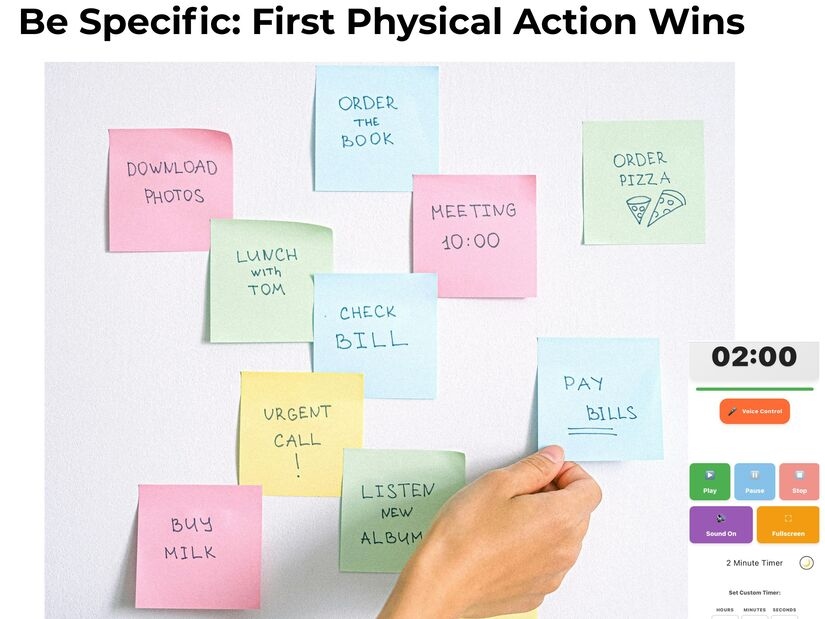
Vague plans fail. “Work on the project” triggers maximum resistance.
Choose the most granular, physical action possible when you narrow down a 2-minute task.
“Open the project file and read the first paragraph” gives you concrete action.
Your 2-minute tasks must state exactly what you’ll do during those 120 seconds.
Use the “First Physical Action” Method
Ask what the very first physical movement required is, for any overwhelming task.
Not the first big step. The first literal action.
Examples:
- Task: Write report → First action: Open blank document
- Task: Clean kitchen → First action: Pick up five items from the counter
- Task: Exercise → First action: Put on workout shoes
- Task: Call dentist → First action: Find phone number
This question bypasses your brain’s complexity alarm and reveals the genuinely simple starting point.
Habit Stacking Strategy
Pair 2-minute actions with habits you already do. James Clear calls this “habit stacking.”
Format: “After I [current habit], I will [2-minute action].”
Examples:
- After I pour my morning coffee, I will tidy the kitchen counter for 2 minutes
- After I sit at my desk, I will write for 2 minutes before checking email
- After I finish lunch, I will walk outside for 2 minutes
- After I brush my teeth, I will do 2 minutes of stretching
The existing habit provides the trigger. You’re not adding willpower needs. You’re riding existing momentum. Source: James Clear’s Habit Stacking Guide
Environmental Design
Make the desired action the easiest option.
Place your notebook and pen exactly where you’ll write, the night before, if you want a 2-minute writing practice.
Physical preparation removes micro-decisions that create resistance. A well-prepared environment makes starting the path of least resistance.
How Did One Person Use a 2-Minute Timer?
“My resistance showed up every morning, facing my inbox. I felt instant dread seeing all those unread messages.
I created a 2-minute rule: open inbox, read three emails, do nothing else. Just read them.
Within one week, I naturally started responding briefly to one or two emails. Within a month, email anxiety vanished completely.
The mental shift was everything. Instead of ‘I must clear my entire inbox’ (overwhelming), it became ‘I’ll read a few things’ (easy).
That small change fixed years of email avoidance.”
The 2-minute commitment stayed the same. The actual behaviour naturally expanded. Keeping permission to stop at two minutes made it psychologically safe to start.
How Do You Build a 2-Minute System in 8 Weeks?
Real power comes from treating 2-minute actions as a complete system, not random tactics.
Week 1-2: Single Domain Mastery
Choose one specific area where resistance always shows up. Apply 2-minute actions only here.
Goal: Prove to your brain that this system works reliably.
Examples:
- Morning email resistance → 2-minute email check every morning
- Evening exercise resistance → 2-minute movement every evening
- Writing resistance → 2-minute writing session every workday
Track your attempts. Did you do it? Yes or no. That’s all.
Week 3-4: Pattern Recognition
Document what happens after each session:
- How often do you continue naturally past 2 minutes?
- What tasks resist extension?
- Which times of day work best?
- What moods or situations help or hurt?
This data reveals your personal patterns and best strategies.
Week 5-6: Strategic Expansion
Add 2-minute actions to a second area, only after consistency exists in your first area.
Don’t expand too fast. Solid habits in one area beat scattered attempts across many.
Week 7-8: System Integration
Start linking 2-minute actions into chains. One action triggers the next.
Example chain:
- Tidy desk for 2 minutes (clears mental space)
- Review notes for 2 minutes (activates context)
- Outline for 2 minutes (creates structure)
- Extend into a full writing session (natural flow)
You’re creating momentum cascades where single starts produce long productive periods.
The Long-Term Goal
You’re not trying to work in 2-minute bursts forever. You’re using 2-minute commitments to rewire your relationship with starting.
Most tasks extend naturally over time. Keeping permission to stop at two minutes preserves the mental safety that makes the system work.
What Are 3 Ways to Scale Your 2-Minute System?
Energy-Based Scaling
Match your commitment to your current state:
High energy days: 2-minute commitments quickly become 25-minute focus sessions
Medium energy days: 2-minute actions extend to 10-15 minutes
Low energy days: Genuine 2-minute actions maintain momentum without causing exhaustion
Try a 5 Minute Timer for extended focus blocks as your capacity builds.
Duration Ladders
Build capacity gradually for recurring tasks:
- First attempt: 2 minutes
- Second attempt: 5 minutes
- Third attempt: 10 minutes
- Fourth attempt: Natural extension
Your brain adapts to increasing commitments when growth feels natural rather than forced.
Diagnostic Use
Drop back to 2-minute commitments when motivation vanishes for normally easy tasks.
This reveals whether you’re facing temporary resistance, which yields to brief action, or actual burnout, which needs rest.
What Are the Common Problems With the 2-Minute Method?
Problem 1: “I Keep Working Past 2 Minutes and Feel Obligated”
Working past two minutes is not failure. It is the natural result of momentum.
The problem starts when you turn an optional extension into a required continuation.
Solution:
Say out loud before each session: “I have permission to stop at two minutes.”
Deliberately stop at exactly two minutes for your next three sessions, even when you want to continue.
This rebuilds the truth that stopping is genuinely optional, not just theoretical.
The mental safety of knowing you can stop at any moment enables natural extension. Your brain starts treating 2-minute commitments as hidden 20-minute requirements when extension becomes expected. Resistance returns.
Enforce strict 2-minute limits occasionally, even when motivation is high. This maintains system credibility.
Problem 2: “The Actions Feel Too Small to Matter”
This reaction shows you’re still judging productivity through completion rather than starting.
Two-minute actions aren’t designed to finish projects. They’re designed to eliminate the resistance preventing starts.
Solution:
Track starting success, not completion outcomes.
Simple tally: how many times this week did you use a 2-minute timer to beat resistance?
This metric shows your actual progress: building the skill of starting despite resistance.
The math: Twenty-six 2-minute actions across one week equal 52 minutes of work that wouldn’t exist without the method.
Across one year, that is 45 hours of reclaimed time from procrastination.
The smallest actions compound into major capabilities. Dr BJ Fogg’s research subjects who started with “floss one tooth” eventually built complete dental routines.
Action size matters far less than consistency of taking action despite resistance. Source: Tiny Habits by BJ Fogg
Common Questions About 2-Minute Timers
This FAQ answers the specific questions people ask about what you can do in 2 minutes, so you use the timer correctly.
Q: What can you actually accomplish in 2 minutes?
A: You can write the first paragraph of a document, reply to two quick emails, clear a desk surface, review meeting notes and identify next steps, outline three bullet points for a presentation, tidy one drawer completely, make a rapid decision on something postponed, read and process three short articles, make progress notes on a project, or prepare materials for a larger task, when you focus on starting rather than finishing.
The mental trap is judging 2-minute actions by completion standards. These aren’t designed to finish projects. They’re designed to destroy starting resistance.
Most tasks you start for two minutes naturally extend longer. The resistance exists at the start, not continuing.
Q: Is 2 minutes too short to be productive?
A: Only when you measure productivity through completion instead of starting.
The basic misunderstanding is thinking productive sessions must be long.
Most lost productivity comes from never starting, not from short sessions.
David Allen’s original 2-Minute Rule addressed this directly: complete a task immediately when it truly takes under two minutes, because tracking it costs more than doing it.
2-minute commitments serve a different purpose for larger tasks: they remove the energy barrier preventing starts.
Research on habits shows consistency matters more than duration. Frequent brief actions create stronger pathways than rare long sessions.
The productivity isn’t in the two minutes themselves. It’s in the behavioural pattern you’re building: taking action despite not feeling motivated.
Q: How does this compare to the Pomodoro Technique?
A: These are different tools for different situations.
The Pomodoro Technique uses 25-minute work blocks with 5-minute breaks, designed for sustained focus on complex tasks.
Two-minute actions serve a completely different purpose: overcoming resistance and starting when motivation is absent.
Think of them as complementary:
- Reasonable motivation + clear task = Use Pomodoro (25 minutes)
- Stuck in procrastination + overwhelming resistance = Use 2-minute commitment
Many people use both strategically: 2-minute actions to break through resistance, then a 25 Minute Timer for a focused Pomodoro session once momentum exists.
Q: Is 2 minutes enough for meditation or mindfulness?
A: Yes. Two minutes builds a consistent meditation practice.
Most people never start meditating because “proper meditation” feels like it needs 20-30 minutes. That commitment triggers resistance.
What you can do in 2 minutes:
- Box breathing (4 counts in, 4 hold, 4 out, 4 hold – repeat 4 times)
- Body scan meditation (quick check-in from head to toes)
- Mindfulness practice (focus on breath, notice thoughts passing)
- Gratitude reflection (three things you’re grateful for)
- Simple breathing exercise (deep belly breaths, counting to 10)
Research from the American Psychological Association shows that even brief mindfulness practices reduce stress and improve focus. Consistency matters more than duration.
The goal is not to become a meditation master in 2 minutes. The goal is to build the habit of pausing and checking in with yourself daily. Many people naturally extend their practice once established.
Q: Can you use 2 minutes for exercise?
A: Yes. It is one of the most effective uses of a 2-minute timer.
Exercise resistance usually sits entirely at the starting moment.
The thought “I should exercise for 30 minutes” triggers immediate mental negotiation. The thought “I’ll move for 2 minutes” barely registers as commitment.
Research shows even very brief physical activity, 60-90 seconds, elevates heart rate, increases oxygen to your brain, and shifts your body chemistry toward alertness. These effects last 30-45 minutes after you stop.
Perfect 2-minute exercise applications:
- 2 minutes of bodyweight exercises (push-ups, squats, planks)
- 2 minutes of stretching or mobility work (neck, shoulders, back, legs)
- 2 minutes of walking (great for breaking up sitting)
- 2 minutes of yoga poses (sun salutation or basic sequence)
- 2 minutes of high-intensity intervals
- Quick exercises requiring brief concentration
Brief, frequent movement breaks throughout the day provide real health benefits by breaking up sedentary time. Consistency is the key factor: even short bouts of activity support heart health and overall fitness.
Using a 2-minute countdown timer for exercise builds the identity of someone who exercises regularly. Every session reinforces “I’m someone who exercises,” regardless of duration.
Q: What if I can’t focus for even 2 minutes?
A: This signals one of three things.
1. Real exhaustion: You need rest, not productivity techniques, when you genuinely can’t sustain attention for 120 seconds. Honour what your brain is telling you.
2. Environmental problems: Remove distractions before starting your timer. Close browser tabs, silence all notifications, and clear your desk. Your 2-minute session should happen in a space set up for those two minutes.
3. Extreme resistance: Reduce commitment further. Try 30 seconds. Try one minute. Duration matters less than proving you can override resistance.
Dr BJ Fogg’s research shows that behaviour failure requires making the task easier, reducing the ability threshold, rather than boosting motivation, which is unreliable.
You’ve found your current threshold when 2 minutes feels impossible. Start below it, succeed consistently, then gradually scale up.
Q: Should I use 2-minute intervals all day?
A: No. That misses the entire purpose.
Two-minute actions are designed specifically for breaking through resistance and starting tasks, not for structuring your whole productivity system.
Use them strategically in three situations:
- When facing procrastination on a specific task
- When building a new habit that isn’t automatic yet
- When transitioning between activities and needing momentum
Longer structured sessions work better for sustained work outside these contexts.
The ideal system combines multiple durations strategically:
- 2-minute commitments to overcome starting barriers
- 5-10 minute sessions for quick tasks
- 25-minute Pomodoro sessions for focused work
- 90-minute blocks for complex work requiring deep mental models
A 2-minute timer is one specific tool, not your entire toolkit. Match the tool to the challenge you’re facing right now.
Q: Does the 2-minute method work for big projects?
A: Yes, through starting, not completing.
You use 2-minute commitments to start working on big projects, not to complete them in 2-minute chunks.
Big projects feel overwhelming because your brain sees the entire scope at once. That triggers maximum resistance.
The 2-minute method works by breaking projects into starting actions:
Big project: Write a 5,000-word report
2-minute starting action: Open a blank document and write the title
Big project: Organise entire garage
2-minute starting action: Sort items in one small corner
Big project: Learn a new programming language
2-minute starting action: Install development environment
Once you start, the work usually extends naturally. The 2-minute commitment gets you past the mental barrier.
Ready to Start? Your Action Plan
Put the theory into practice now that you have a complete list of what you can do in 2 minutes.
You understand the psychology. You know the research. You have the strategies.
Now start a 2-minute timer and prove this works.
Knowledge without action stays theoretical. Direct experience creates transformation.
Experiencing a 2-minute commitment shifts your identity from procrastinator to starter almost instantly.
Reading about activation energy is useful. Experiencing how easily you bypass it through 2-minute commitments changes behaviour.
One successful session where you overcome resistance delivers more proof than reading a dozen articles.
Your Exact Next Steps (Do This Right Now):
- Open our free 2-minute timer in a new tab
- Identify one micro-task you’ve been avoiding (tidying, stretching, email, meditation)
- Write down the first physical action to start it
- Click START on the timer before your brain can argue
- Take that first action for exactly 120 seconds
- Stop when the alarm sounds; continuing is optional, never required
- Notice whether you actually want to continue
- Repeat three times today with different quick tasks
You’ll have real evidence about whether this approach works for you, at the end of the day.
Your brain is sceptical because you’ve tried many systems that failed. That doubt is reasonable.
Repeated successful experiences prove that this works differently. That is the only way past the scepticism.
Two-minute sessions succeed because they don’t require motivation, willpower, or perfect conditions. They only require 120 seconds of commitment.
Start Your Free 2 Minute Timer
Works on all devices instantly. No download or signup needed. Includes customizable alarm sounds and full-screen mode. Perfect for micro-tasks, habit building, stretching, meditation and quick exercises.
Why Use Our 2 Minute Timer?
- Instant browser-based countdown (no apps to install)
- Works on desktop, tablet, and mobile devices
- Customizable alarm sounds to match your preferences
- Fullscreen mode for distraction-free focus
- Perfect for quick exercises, stretching routines, and meditation
- Ideal for building consistent micro-habits
- Free forever, no hidden costs or subscriptions
Additional Resources
Related Timers for Different Situations:
- 1 Minute Timer: For ultra-quick resets and decisions
- 5 Minute Timer: Natural progression as capacity builds, ideal for extended micro-tasks, meditation sessions, and stretching routines
- How Long Should a Focus Session Be: Complete guide to choosing the right timer duration for your goals.
Understanding Timer Duration: Starting with a 2 minute timer builds your capacity for longer focus sessions. Many people progress from 2-minute micro-actions to 5-minute focus blocks within a few weeks. The short duration makes starting easy, while the option to extend naturally builds sustainable habits.