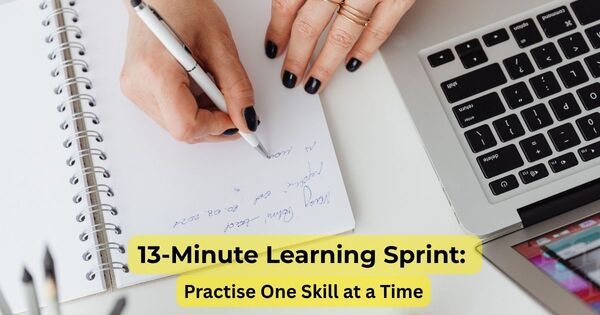

A 13-minute learning sprint is a short, focused block for practising one narrowly defined part of a skill. It is useful when you want to test yourself, apply what you know or correct a specific weakness—not when you are trying to cover an entire topic.
Thirteen minutes is a practical duration to try, not a scientifically proven optimum. The quality of the practice matters more than the exact length: choose one clear target, work actively, check what happened and record the next step.
To try the method now, start a 13-minute timer and use it for one precise practice target.
This guide explains what a learning sprint is, why a timer alone does not produce improvement and how to structure a short practice block so that it supports active learning.
What Is a 13-Minute Learning Sprint?
A 13-minute learning sprint is a short, bounded period used to practise, test or correct one specific piece of a skill, such as a set of vocabulary words, one type of maths problem, or a single paragraph of writing.
It’s different from simply spending 13 minutes near your study material. Sitting with a textbook open, rereading notes or watching a tutorial passively can fill the same amount of time without producing much measurable improvement.
For a sprint to function as practice rather than passive exposure, it generally needs two things: a single clear target, and an active task built around that target. “Practise Spanish” is not a target. “Recall and use these 8 verb conjugations in original sentences” is a target.
The narrower the focus, the easier it is to tell, by the end of 13 minutes, whether you made progress or simply spent time on the task.
Learning Sprint vs Work Sprint
It’s worth being clear about how this differs from a general 13-minute work sprint, since the two are easy to confuse.
A work sprint is designed to move a task towards completion. A learning sprint is designed to practise, test and improve one specific skill component.
| Purpose | Main question | Example | What counts as success |
|---|---|---|---|
| 13-minute learning sprint | Did I improve at one specific skill component? | Recall and correctly use 8–10 vocabulary items in new sentences | You can identify what you got wrong and what to try next |
| 13-minute work sprint | Did I move a task closer to completion? | Draft the opening section of a report | A visible piece of the task is completed or advanced |
The two can overlap; for example, a coding sprint might both teach you something and move a project forward, but it helps to know which goal you’re aiming at before you start the timer, since it changes what you should do with the minutes.
Why the Timer Is Not the Learning Method
The timer’s job is simply to set a boundary. It creates a defined start and end point, which can make it easier to begin a task and decide when to pause or reassess. But the timer doesn’t do the learning.
The quality of a 13-minute sprint depends almost entirely on what happens inside it: whether the goal is appropriately narrow, whether the difficulty matches your current level, whether you’re actively retrieving or applying the material rather than just reviewing it, and whether you get some form of feedback or correction.
Two learning strategies are especially useful to build into a short sprint: retrieval practice and spaced practice.
Retrieval practice means trying to recall or apply information without looking at the answer first—for example, answering a question from memory, solving a problem or explaining a concept aloud. It is generally more useful for long-term retention than simply rereading notes. Read an overview of retrieval practice and spacing.
Spaced practice means returning to the material across separate sessions rather than doing all of the practice at once. Research reviews have identified practice testing and distributed practice as among the more effective learning techniques, although their benefits depend on the task, feedback, previous knowledge and the way they are used.
This evidence supports active recall and repeated practice over time. It does not show that 13 minutes is an ideal learning interval. A 13-minute block is simply one manageable way to fit a short, retrieval-based practice session into your day; the same principles can apply in a 12-, 15- or 20-minute session.
A 13-Minute Practice Template
The following structure is a starting template, not a fixed rule. Adjust the timing if your particular activity needs more setup or a longer retrieval phase.
| Time | What to do |
|---|---|
| 0–1 minute | Define one precise target for the sprint |
| 1–9 minutes | Practise actively without switching to another task |
| 9–11 minutes | Retrieve from memory, test yourself, or compare your work against feedback or a correct answer |
| 11–12 minutes | Correct one or two specific errors you noticed |
| 12–13 minutes | Record the exact next practice step for your following sprint |
The final minute helps make the next practice session easier to begin. Writing down the next specific step, rather than a vague intention to “keep practising”, is what makes it easy to start the next sprint with a clear target instead of having to decide all over again.
Should you use a 12-minute or 13-minute learning sprint?
Both lengths can work for a short, focused learning session. A one-minute difference is unlikely to determine whether you learn effectively. What matters more is choosing one clear target, practising it actively, checking your work and returning to it over time.
Use a 13-minute learning sprint when you want to follow the full template on this page, including time to define a target, practise, test yourself, correct an error and note the next step.
Use a 12-minute timer for study when you have a slightly shorter gap or simply want a straightforward countdown for one focused task, such as reviewing flashcards, solving a small set of problems or recalling key points from a reading.
Whichever length you choose, keep the task narrow enough that you can attempt it, check it and identify a useful next step before the timer ends.
Examples of Useful 13-Minute Learning Sprints
- Language learning: Retrieve and use 8–10 vocabulary items in original sentences, then check them against a dictionary or reference.
- Mathematics: Solve several problems of one specific type, then identify the pattern behind any repeated errors.
- Coding: Complete one narrow exercise, run and test it, and note one bug or one specific improvement to make next time.
- Writing: Revise a single paragraph for one skill at a time, such as clarity, sentence variety or transitions, rather than editing everything at once.
- Music: Practise one difficult phrase slowly and deliberately, then record the specific adjustment to try in the next attempt.
- Reading and study: Read a short section, close the material, and try to recall the key points from memory before checking what you missed. If you are applying this in a classroom setting, see our 13-minute reading timer for the classroom for a related timed-reading use case.
When 13 Minutes May Be Too Short
A 13-minute block is not well suited to everything. Deeper problem-solving, extended writing, sustained reading of long material, complex projects, or any activity that needs significant setup time before you can properly start will often need a longer block to be useful.
If you’re unsure how long to set aside in general, how long a focus session should be looks at this question more broadly, and the 13-minute timer vs Pomodoro comparison covers how a shorter sprint stacks up against a longer, more traditional focus block.
None of this rules out using a 13-minute sprint as a starting point. It can still work well as the block you use to begin a difficult task, before moving into a longer, uninterrupted session once you’ve built some momentum.
How to Repeat Learning Sprints Over a Week
A single sprint rarely produces noticeable improvement on its own. Skill development generally comes from repeated sessions, review, and gradually increasing the difficulty of what you practise. A simple way to structure this across three sessions is:
- Session 1: Identify the weak point. Practise and note exactly where things break down.
- Session 2: Repeat the same or a closely related task, this time with feedback or correction included in the sprint.
- Session 3: Test recall of the material, or apply the skill in a slightly new context, to check whether the practice has actually transferred.
If you want a longer-term structure for tracking this kind of progression, the 30-day skill plan sets out a more extended approach to building a skill over several weeks.
Common Mistakes
- Choosing a target that is too broad. “Get better at French” isn’t a sprint target; “recall these 10 words in context” is.
- Passive rereading instead of active practice. Looking at material again is not the same as retrieving or applying it.
- Practising without feedback or checking. Without some way to see what you got wrong, errors can go uncorrected and even become more established.
- Treating the timer as proof that learning happened. Completing 13 minutes tells you time was spent, not that anything was learned.
- Repeating the same easy task without raising difficulty. If a task no longer challenges you, the sprint stops producing much benefit.
- Judging the method after a single sprint. One session, good or bad, doesn’t tell you much about whether the approach works for you.
Frequently asked questions
Is 13 minutes enough to learn a skill?
It is enough to practise one narrow component of a skill and get feedback on it, but it is not enough on its own to build a skill to a high level. Progress usually comes from repeated practice over time, not a single session.
Can I use a 12-minute timer for learning?
Yes. Twelve minutes can be enough for one narrow, active task, such as recalling flashcards, solving one type of problem or testing your understanding of a short reading. The difference between 12 and 13 minutes matters less than having a clear target, checking your work and returning to the material later. A 12-minute study timer can be a practical choice if that length fits your available time.
Is a 13-minute learning sprint better than Pomodoro?
Neither is inherently better. A learning sprint is defined by a narrow practice goal and active retrieval, while Pomodoro is a general focus structure. You can use Pomodoro-length blocks for learning too; what matters most is the activity inside the block, not its exact length.
What should I practise in a 13-minute learning sprint?
Pick one specific target you can meaningfully attempt and check within the available time, such as a small set of vocabulary, one type of problem or one paragraph, rather than a broad topic.
Can students use a 13-minute learning sprint?
Yes. A short practice block with a clear target and some form of self-checking can suit revision and skill practice, particularly for students who find longer study sessions difficult to sustain.
How many learning sprints should I do in a day?
No fixed number suits everyone. It depends on the skill, your available time and how demanding each sprint is. A small number of focused sprints spaced across the day or week may be more useful than cramming many into one session.
Does a timer make practice more effective?
A timer can make it easier to start and stop at a planned point, but it does not improve the practice itself. The activity inside the timed block—particularly whether it involves active retrieval and feedback—is what determines whether the sprint is useful.
Start a 13-minute learning sprint
Choose one small, specific skill to practise. Work actively rather than passively, check your result against feedback or a correct answer, and write down the next step before the timer ends.
Use the practice template above for your next 13-minute session. If a different duration better suits the task, choose a timer length that lets you complete one focused attempt without rushing.