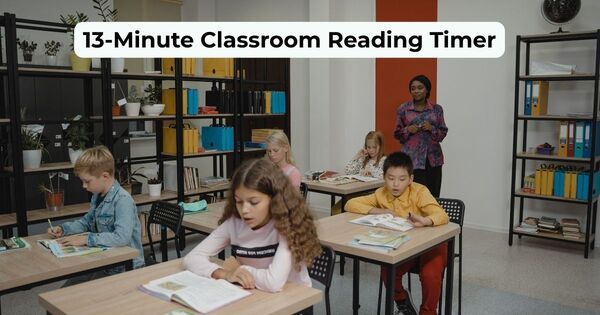

A 13-minute classroom timer provides a visible, manageable time block for reading, independent work, spelling practice and other short classroom activities.
Classroom timing decisions depend on the age of the students, the activity and the needs of the group. A 13-minute block is not a universal attention limit or a scientifically established optimum. It is a practical duration that teachers can test and adjust according to the class, the task and individual learning needs.
A visible countdown gives students a shared reference point for how much time remains. That can make the task boundary clearer than a verbal instruction alone and may help students pace themselves during a defined activity.
For the free tool, use the 13-minute timer on a classroom display, interactive whiteboard or shared screen.
Choosing a Classroom Time Block
There is no single timer duration that suits every class or activity. A short reading task, a spelling exercise and a transition between lessons may each require a different amount of time. Ten minutes may be appropriate for a quick task or younger learners, while fifteen or twenty minutes may be more suitable when students need time to read, write or complete a multi-step activity.
The important question is whether the time limit matches the task and whether students understand what they are expected to complete.
A 13-minute block can be useful when you want something longer than a short starter but more contained than an open-ended work period. It gives the class a defined endpoint without assuming that every student will work at the same speed or maintain attention in the same way.
Research on classroom attention does not support treating a single time period as a universal threshold for every student or activity. Read more about attention during classroom learning.
Should you use a 12-minute or 13-minute classroom timer?
Both lengths can work for a short classroom activity. The one-minute difference is unlikely to determine whether students complete useful work. More important is choosing a clear task, explaining the expected outcome and allowing appropriate support or adjustments.
Use a 13-minute timer when you want a slightly longer, contained block for quiet reading, independent work, vocabulary practice, a short writing task or small-group work.
Use a 12-minute classroom timer when the activity is slightly shorter, such as a quick reading response, a short review task, a small set of practice questions or a brief writing exercise.
Choose the duration that matches the complexity of the task, the age of the group and the support students need. A visible countdown should support clear teaching and classroom routines, not replace them.
Where a 13-Minute Block May Fit
A 13-minute block may suit quiet reading, a short writing task, vocabulary practice, small-group work or independent work with one clearly defined outcome.
Check that the number and difficulty of questions are appropriate, allow reasonable adjustments and avoid rushing students who need more time.
A 13-minute period may also work as a classroom work sprint, giving students time to focus on one task before reviewing their progress.
The visible countdown can help students understand when the activity will end and give teachers a consistent point at which to provide the next instruction.
For actual transitions, such as moving seats, collecting resources or changing activities, a shorter timer may be more suitable. The appropriate duration depends on the number of students, the classroom layout and the complexity of the changeover.
Guidance on classroom transition timers commonly focuses on short, task-specific countdowns rather than one universal duration. See this guide to using transition timers.
How a Visual Countdown Can Help
A visible countdown gives students a concrete reference point for how much time remains. Instead of relying on repeated verbal reminders, the teacher can display the remaining time while students work towards a clearly explained goal.
This may support self-monitoring and make the end of the activity more predictable, particularly for students who benefit from visual structure. It should be used alongside clear instructions, modelling and appropriate support rather than as a replacement for classroom teaching.
A visual timer can also reduce unnecessary timing interruptions. Once the countdown is visible, students can check the remaining time independently while the teacher circulates, answers questions and supports individual learners. For students who benefit from visual routines, read our page about visual timers in SEN classrooms.
Supporting Attention Without Assuming a Fixed Limit
Attention varies substantially between students and changes according to age, subject, task difficulty, classroom environment and teaching approach.
A timer should therefore be used as a flexible classroom tool, not as a definition of how long students are capable of concentrating.
A 13-minute block may help some groups because it creates a manageable endpoint for one clearly defined activity.
Other groups may need a shorter period, a longer period or a change of activity before the timer ends. The teacher should observe whether students are completing the intended task, becoming distracted, rushing or needing additional support.
Use those observations to adjust the next session rather than assuming that the same duration will work every time. For independent work, explain the expected outcome before starting.
Building a Repeatable Classroom Routine
Introduce the routine by explaining:
1. What students need to do.
2. How long the activity will last.
3. What should happen when the timer reaches zero.
4. What students should do if they finish early.
5. How they can ask for help during the activity.
A predictable sequence can reduce the need for repeated explanations, but it should remain flexible. Adjust the duration when the task, class, or individual learning needs require it.
For teachers using several timed activities during the day, a consistent countdown format can give students a shared reference point for reading, writing, practice and review.
Homeschooling and Small Groups
The same approach can be used at home or in a small group. A visible 13-minute countdown can separate a reading period from a writing task, maths practice or a short review activity without requiring a parent or tutor to announce the remaining time repeatedly.
For younger children or shorter tasks, a 5-minute timer for kids may be a more suitable starting point. Choose the duration according to the child’s age, the task and the level of support required.
Setting Up the Classroom Timer
Using the timer requires little preparation. Display the countdown on an interactive whiteboard, projector or shared screen, then explain the activity and the expected outcome before starting it.
For a reading session, tell students what they should read and what they should do when the timer ends. For independent work, define the number of questions, pages or paragraphs they should attempt. For a transition, use a duration that matches the practical changeover rather than assuming that 13 minutes is necessary.
A consistent routine might look like this:
- Explain the task and the expected outcome.
- Display the countdown where students can see it.
- Start the timer.
- Circulate and provide support while students work.
- Give students a clear instruction when the timer ends.
- Review the activity and adjust the next time block if necessary.
The 13-minute timer can be used for reading, independent work and other short classroom activities where a visible endpoint is helpful.