Quick Start: How The System Works
30 Minute Timer: Deep Work Output Tracker
Use this 30 minute timer log to track your focus. Where did this session take you?
Table of Contents
The Science of the 30-Minute Sprint
When you utilise a 30-minute timer to structure your day, you are doing more than just counting down seconds. You are aligning your biological output with your brain’s natural rhythm for sustained cognitive load.
The Flow State Threshold
It typically takes the human brain 15 to 20 minutes to reach a state of flow. This is that optimal headspace where you are fully immersed in a task.
By using this specific duration, you ensure you do not just scratch the surface of your work. You are giving your prefrontal cortex enough time to fully load the task context, allowing you to spend the final 10 to 15 minutes of your session in a state of peak productivity.
The 30-Minute Efficiency Ratio
0–18 Mins: Task Initiation & Context Loading.
19–30 Mins: Peak Flow State & High-Intensity Output.
Managing Cognitive Load
The human brain is not designed for open-ended, multi-hour stretches of high-intensity decision-making.
By capping your deep work session at 30 minutes, you proactively avoid the cognitive overload that leads to burnout.
This shorter, structured block allows you to exert maximum effort because your brain knows a clear, definitive endpoint is approaching.
Combating Attentional Residue
One of the biggest productivity killers is attentional residue. This is the lingering mental energy left over from a previous task.
When you jump between tasks without a reset, that old mental tab stays open, dragging down your current performance.
This protocol acts as a hard stop, ensuring your 30-minute block is dedicated solely to the task at hand and preventing the drift that causes the average professional to lose up to 40% of their productive time to multitasking.
How to Structure Your 30-Minute Sprint
To maximise your performance with this timed focus interval, you must treat the session as a structured system rather than an open-ended countdown.
This method is supported by the psychological concept of Implementation Intentions, which suggests that when you pre-define your actions and triggers, you significantly reduce the friction of task initiation.
Step 1: The Pre-Flight (1 min): Define the “One Thing”
Step 2: The Deep Work Block (28 min): The Core Sprint
Step 3: The Cognitive Close (1 min): Briefly Log Progress
The Three-Phase Sprint Protocol
To maximise performance, you must treat your focus interval as a structured system rather than an open-ended countdown.
This method is supported by the psychological concept of Implementation Intentions, which suggests that pre-defining your actions and triggers significantly reduces the friction of task initiation.
Follow this three-phase cycle to move from preparation to completion:
The Psychological Framework
This structure works because it satisfies the brain’s need for Cognitive Closure. Research consistently shows that we are more likely to stay engaged with tasks that have clear, bounded structures.
By breaking your session into these three distinct phases, you transition from managing time to managing your cognitive capacity, which is the hallmark of high-performance output.
Why 30 Minutes Outperforms 60 Minutes

Many professionals believe that longer work sessions equal higher productivity. However, research into the “Law of Diminishing Returns” proves that your brain’s ability to sustain high-intensity focus drops significantly after a certain threshold.
The Cost of Cognitive Fatigue
When you attempt a 60-minute or 90-minute block of deep work, you are fighting against the natural limits of your prefrontal cortex.
As you cross the 30-minute mark, your neural resources begin to deplete, leading to a rise in “mental noise.”
This causes you to lose focus, check your phone, or succumb to minor distractions that would not bother you during a fresh, shorter sprint.
By limiting your sessions to 30 minutes, you effectively exit the task before you hit the wall of cognitive fatigue. This allows you to maintain your “mental freshness” throughout the day, enabling you to chain multiple high-quality sessions together rather than one long, mediocre slog.
The Advantage of Controlled Urgency
A 60-minute window often feels large enough to accommodate procrastination. It is common to waste the first 15 minutes of a long session because the deadline feels distant. A 30-minute block, however, creates a sense of controlled urgency.
You know you only have a brief window to make progress, which forces your brain to prioritise the “One Thing” and ignore secondary distractions.
This creates a cycle of high-intensity performance where every minute is purposeful. You are not just working longer; you are working with higher quality, resulting in more actual output at the end of the day.
Advanced Stacking: The 90-Minute Rhythm
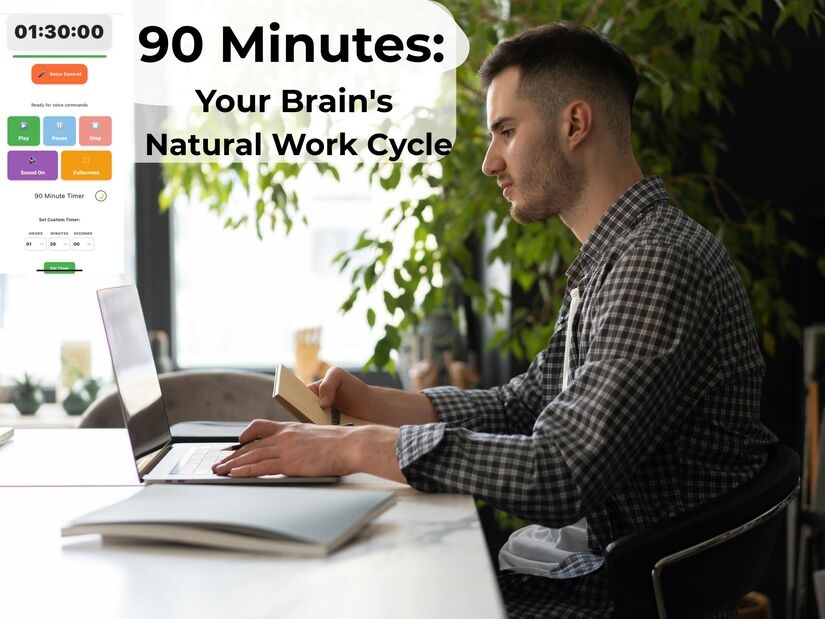
While a single sprint provides a powerful burst of focus, you can achieve true professional-grade output by stacking three consecutive sessions into a 90-minute “Ultra-Productivity” block.
This rhythm respects the body’s Ultradian Rhythms, which naturally govern our energy levels in 90 to 120-minute cycles. To streamline your workflow and ensure you stay on track across the full duration, you can utilise a dedicated 90 minute timer to manage the entire block automatically.
How to Execute the 90-Minute Rhythm
To successfully stack these sessions while maintaining the efficiency of your primary 30-minute timer, you must manage your transitions with precision.
The 90-Minute Ultra-Productivity Block
Frequently Asked Questions
Can I set a 30-minute timer for a nap?
Yes, a 30-minute window is often ideal for a power nap. Research suggests that keeping a nap under 30 minutes helps you avoid entering deep sleep, which prevents the grogginess known as sleep inertia. Using a timer ensures you wake up during the lighter stages of sleep, leaving you feeling refreshed and alert rather than disoriented.
Is 30 minutes enough for studying?
💡 Pro-Tip: Enhance your study sessions.
A 30-minute timer is a perfect tool for focus, but the technique you use during that block matters most. Combine your timer with the strategies in our guide, Best Study Techniques: 8 Science-Backed Methods to Learn Faster, to ensure you are encoding information effectively.
Absolutely. In fact, 30 minutes is often more effective for intensive study than longer, drawn-out sessions. Because the brain struggles to maintain high-level information retention after the 30-minute mark, these shorter, high-intensity intervals help you capitalise on the primacy and recency effects. By focusing for 30 minutes at a time, you ensure that the material you are covering remains the primary focus of your cognitive energy, resulting in better recall and reduced mental fatigue.
How do I handle emergency interruptions?
If an emergency arises during your sprint, treat the interruption as a necessary “forced reset.” Rather than feeling guilty about breaking your flow, use the moment to quickly note down exactly where you left off. This “closing thought” makes it significantly easier to restart your sprint later without losing the context you already built.
What should I do if I finish my task before the timer ends?
If you finish your primary objective early, use the remaining time for a “Cognitive Close.” Instead of immediately jumping into a new, unrelated task, spend the remaining minutes organising your workspace or reviewing your progress. This prevents the “rushed” feeling that occurs when you jump from one task to the next without a moment of mental transition.
Achieve Peak Focus Today
The structure provided here, the 30-minute sprint, the dedicated 28-minute focus block and the intentional cognitive close, is not a simple suggestion; it is a system built on cognitive science.
By implementing this protocol, you are training your brain to reject the fragmentation of multitasking and embrace the sustained focus required for high-level output.
Start Your First Session
This page is a resource. You now understand the science of the threshold, the cost of fatigue and the power of urgency.
The final step is execution. Ready to take control of your daily output? Use the interactive 30-minute timer at the top of this guide to initiate your first scientific sprint now.