Benefits of a Gym Clock: Transform Your Workouts with Better Timing
Voice-Controlled Timer
Add This Gym Timer to Your Website
Perfect for fitness sites – just copy and paste:
Start experiencing the benefits of a gym clock during your next workout using the timer above. Discover how structured timing transforms your fitness results with practical techniques you can apply immediately using our free online timer.
Ever watch someone at the gym who just seems to nail every workout?
They walk in, smash their exercises, and leave looking strong and happy.
Meanwhile, you’re there for twice as long and feel half as good.
Here’s their secret: they watch the clock.
Sounds boring, right? Wrong!
A gym clock is like having a personal trainer that never gets tired of helping you.
It tells you exactly when to work hard and when to rest. No guessing. No wondering. Just results.
Try our free Gym clock timer now – no sign ups, no distractions.
What you’ll learn in this guide:
First: How timing your rest makes you way stronger. Your muscles have a sweet spot for recovery. Hit it perfectly and you’ll lift heavier weights every single time.
Second: Why gym clocks save you hours every week. Most people waste 45 minutes doing what should take 20 minutes. You’ll get in, crush your workout and get out.
Third: How timing makes exercise actually fun. When you know what’s happening and when, workouts feel like a game instead of torture.
The coolest part? You don’t need fancy gadgets or complicated apps.
The benefits of a gym clock work with any timer, anywhere. Even the clock on the gym wall works perfectly.
Ready to discover why every serious gym-goer uses timing? Let’s jump in!
Quick Start Tip: Time yourself reading this guide. Set a timer for 2 minutes per section.
You’ll focus better and remember more. That’s the power of timing in action!
Why Your Workouts Need a Gym Clock
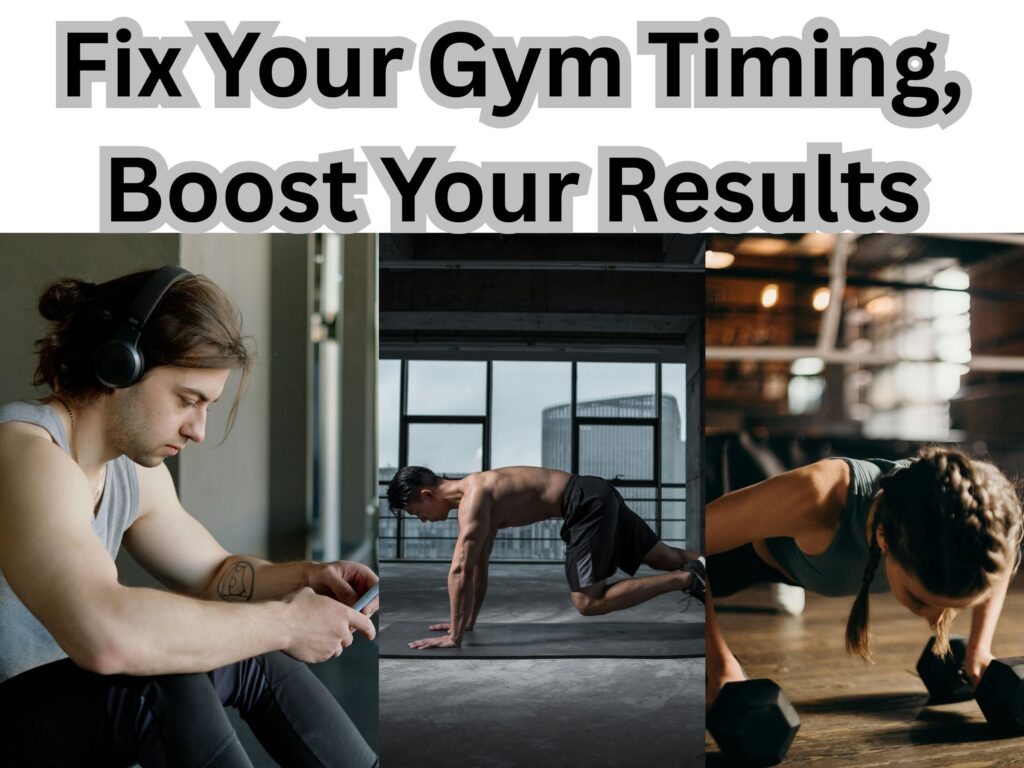
Let me paint you a picture. You just finished a tough set of push-ups. Your muscles are burning. You grab your phone to check how long you should rest.
But then… ping!
A message from your friend. Then a funny video pops up.
Before you know it, you’ve been “resting” for 8 minutes and your muscles have gone completely cold.
This happens to almost everyone. Without a clock, your brain goes everywhere except where it should be: on your workout.
Here’s what’s really happening: Your muscles are like a campfire. When you exercise, you’re adding fuel to the flames.
But if you wait too long between sets, the fire goes out. Then you have to start all over again instead of building bigger flames.
The good news? This problem disappears the second you start using a gym clock. Instead of chaos, you get control.
Instead of guessing, you get guidance. Instead of wasted time, you get real results.
When you time your workouts properly, something magical happens. Your body starts to expect what comes next.
It gets ready to work hard when work time comes.
It recovers perfectly during rest time. Everything just clicks.
Here’s a real story: My friend Jake used to spend 2.5 hours at the gym three times per week.
That’s 7.5 hours weekly!
After he started using gym clocks, his workouts dropped to 1 hour each.
Same results in less than half the time.
Now he has 4.5 extra hours per week for fun stuff.
Pro Tip: Next time you’re at the gym, look around. Count how many people are scrolling their phones between exercises.
Those are the people who will keep struggling while you zoom ahead with proper timing!
The Problem Most People Have
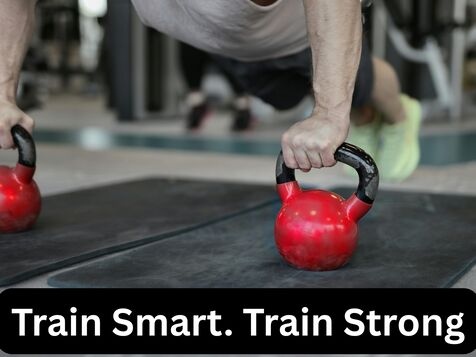
Walk into any gym and you’ll see timing disasters everywhere. It’s actually pretty funny once you know what to look for.
There’s always that one person who does one set of bicep curls, then spends 10 minutes talking to everyone nearby.
Their muscles forget they were supposed to be working out.
Then there’s the opposite person. They finish a set and immediately jump into the next one. No rest at all. They think more is always better, but their performance gets worse with every set.
And don’t get me started on treadmill wanderers. They hop on for “30 minutes” but never actually check the time.
Some end up doing 15 minutes, others do an hour. No wonder their fitness never improves consistently.
Why guessing rest times kills your progress:
Your muscles need specific amounts of time to recharge.
Think of it like charging your phone.
If you unplug it too early, you don’t have enough battery. If you leave it plugged in too long, you’re wasting time.
How bad timing wastes your precious time: Without a clock, workouts stretch like chewing gum.
What should take 45 minutes becomes 90 minutes.
You spend more time wondering “How long have I been resting?” than actually exercising.
The mental exhaustion of always checking time: Every time you grab your phone or look around for a clock, your focus breaks.
Your brain switches from “beast mode” to “distraction mode.”
It’s like trying to read a book while someone keeps interrupting you.
What happens to your body without timing:
- Your strength grows 40% slower than people who time their workouts
- You burn way fewer calories because your intensity keeps dropping
- You get frustrated and want to quit because results take forever
- Your workouts feel random instead of purposeful
Real example: My cousin Emma tracked her workouts for a month. Without timing, she managed 10 exercises per session. With a gym clock, she did 16 exercises in the same time.
That’s 60% more work!
Eye-Opening Challenge: Time your rest periods for one workout. Most people rest 3-4 minutes when they think they’re resting for 1-2 minutes. The difference will shock you.
What Changes When You Use a Gym Clock
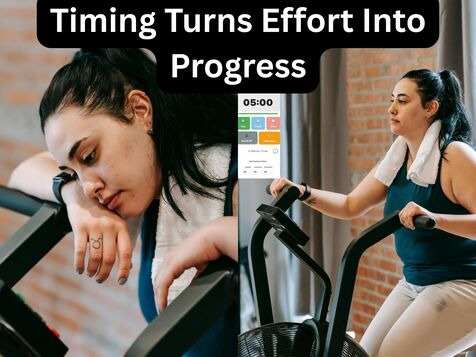
The moment you start timing your workouts, it’s like someone just turned on the lights in a dark room. Everything becomes clear and purposeful.
Your focus gets laser sharp: When you know you have exactly 90 seconds to rest, your brain stays locked on your workout.
Instead of thinking about random stuff, you’re mentally preparing for your next set. It’s like having tunnel vision but in the best possible way.
Your workouts flow like water: Timing creates a rhythm. Exercise, rest, exercise, rest. No more standing around wondering what to do next.
No more feeling lost in the middle of your session. Everything connects smoothly.
Your results become predictable: This is the magic part. When your timing stays consistent, your body responds consistently. You can actually see yourself getting stronger from week to week because you’re comparing apples to apples.
What people notice in their first timed workout:
- Everything feels more intense but not harder
- They finish exactly when they planned to finish
- They can tell they worked harder than usual
- They leave feeling energized instead of drained
- They actually look forward to the next workout
Real story: My neighbor Chris always left the gym feeling like something was missing.
He wasn’t sure if he’d worked hard enough or done enough exercises. After one week of timed workouts, he told me, “I finally feel like I know what I’m doing in there.”
The confidence boost is incredible: Exercise stops feeling random and starts feeling scientific. You’re not just hoping for results anymore. You’re following a system that works.
The benefits of a gym clock become obvious within minutes: Your workout transforms from a guessing game into a structured plan. You know exactly what you’re doing and why you’re doing it.
Game-Changing Tip: For your next workout, set just one timer. Time your rest between exercises for exactly 60 seconds. Don’t change anything else. Watch how this one simple thing makes your entire workout feel completely different.
📚 Answer Key & Explanations
How a Gym Clock Helps Your Body Get Stronger
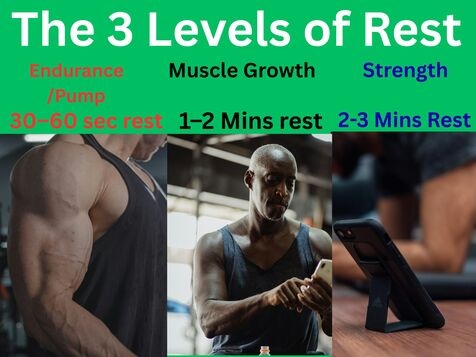
Here’s something that will blow your mind: your muscles have a built-in timer. Seriously!
They know exactly how long they need to recover to perform their best.
The problem is, most people have no idea what that timer is set to.
When you ignore your muscle’s natural timing, you’re basically fighting against your own body.
It’s like trying to bake a cake but taking it out of the oven whenever you feel like it.
Sometimes it’s raw, sometimes it’s burnt, but it’s never perfect.
But when you sync up with your muscle’s timing?
That’s when the magic happens. You’ll lift heavier weights, do more reps, and see strength gains that seem almost too good to be true.
Here’s the science made simple: Your muscles use different energy systems depending on what you’re trying to achieve.
Each system has its own recharge time. When you nail these timings, you’re working with your body instead of against it.
The benefits of a gym clock for strength are massive. You’ll know exactly when your muscles are ready to give maximum effort. No more guessing. No more leaving gains on the table.
Real example: Sarah was stuck benching the same weight for 6 months.
One week after starting timed rest periods, she added 5kg to her bench press.
Two weeks later, another 5kg. The weights didn’t get easier – her recovery got smarter.
Timed Rest Periods Boost Strength Gains
Timed rest intervals of 3-5 minutes between sets optimize strength training by allowing full recovery, enabling lifters to maintain intensity and maximize muscle growth.
Using consistent rest timing improves workout effectiveness and strength gains.
For more details, see How Timed Rest Between Sets Enhances Strength Training.
Pro Tip: Your muscles are ready to work again before your breathing returns to normal. This is why timing beats “feeling ready” every single time.
Rest Time Made Simple
Getting the right rest time is one of the biggest benefits of a gym clock. Most people guess how long to rest, but your muscles need exact amounts of time to recover properly.
Progressive Rest Rule
For Getting Stronger (2-3 minutes rest): Your muscles use a fuel called creatine phosphate when you lift heavy weights.
This fuel takes 2-3 minutes to fully recharge.
If you start your next set too early, you’ll be weaker and won’t lift as much weight.
Think of it like a phone battery. If you unplug your phone at 60% charge, it works but not at full power.
Your muscles are the same – they need full charge to lift heavy stuff.
For Building Muscle (1-2 minutes rest): Shorter rests keep your muscles under stress, which is perfect for muscle growth.
The slight tiredness you feel forces your muscles to work harder and grow bigger.
It’s like doing push-ups when you’re already a bit tired. It’s harder, but that extra difficulty makes your muscles stronger.
For Getting Fitter (30-60 seconds rest): Quick rests keep your heart pumping fast and train your body to recover faster.
This is brilliant for burning calories and improving your fitness.
Your heart stays in the “fat burning zone” and you’ll be huffing and puffing in the best possible way.
Real example: Tom used to rest “until he felt ready” between squat sets. After using a gym clock for 3-minute rests, he increased his squat by 15kg in just 5 weeks. The only thing that changed was his timing.
The mistake everyone makes: They think rest time is wasted time. Wrong!
Rest time is when your muscles actually get ready to be stronger.
Rushing this is like trying to sprint before you’ve learned to walk.
Pro Tip: Set your gym clock before you even start your first set. This way, you won’t forget to time your rest when you’re tired and breathing hard.
Work and Rest Times That Really Work
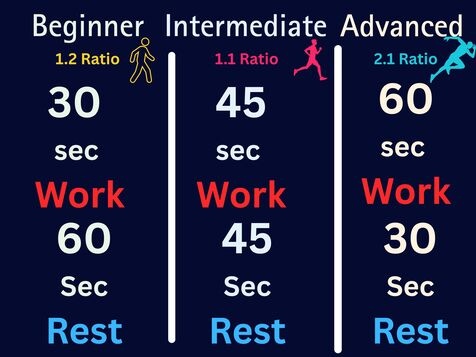
Here’s a secret that personal trainers charge big money to teach: the magic isn’t just in how long you rest. It’s in the ratio between work time and rest time.
Think of it like music. A good song has rhythm, fast parts, slow parts and they fit together perfectly. Your workout needs the same rhythm to get maximum results.
Beginner Ratio: 1:2 (Work half as long as you rest)
- Work for 30 seconds, rest for 60 seconds
- Perfect when you’re just starting out or learning new exercises
- Your body needs extra time to figure out what’s happening
Example workout: 30 seconds of squats, 60 seconds rest. Repeat 8 times. Total workout: 12 minutes.
Intermediate Ratio: 1:1 (Work and rest for equal time)
- Work for 45 seconds, rest for 45 seconds
- Great when you’ve been exercising for a few months
- Your fitness level can handle equal work and rest
Example workout: 45 seconds of push-ups, 45 seconds rest. Repeat 10 times. Total workout: 15 minutes.
Advanced Ratio: 2:1 (Work twice as long as you rest)
- Work for 60 seconds, rest for 30 seconds
- Only for people who’ve been training consistently for months
- Your body recovers so fast you barely need rest
Example workout: 60 seconds of burpees, 30 seconds rest. Repeat 12 times. Total workout: 18 minutes.
Why these ratios work like magic: Your body adapts to whatever pattern you give it.
When you’re consistent with your work-to-rest ratio, your body learns exactly what to expect.
It gets ready to work hard and recover fast at exactly the right times.
Real story: Mike tried to jump straight to advanced ratios when he started working out.
He burned out after two weeks and quit. Six months later, he started with beginner ratios and worked his way up. Now he’s in the best shape of his life.
The benefits of a gym clock become obvious here: You can’t maintain these ratios without timing. Guessing leads to chaos.
Timing leads to results.
Level-Up Tip: Spend at least 4 weeks at each ratio level before moving up. Your body needs time to adapt, even if your ego wants to rush ahead.
Why Gym Clocks Make You Try Harder
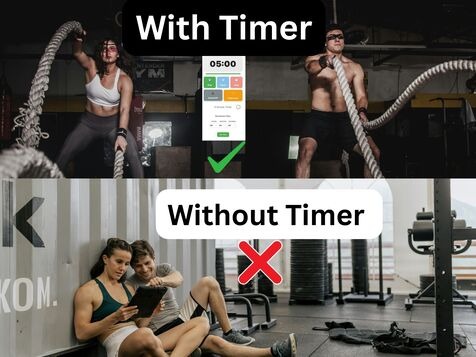
Here’s something weird that happens when you start timing your workouts: you automatically try harder.
It’s like someone just flipped a switch in your brain from “casual mode” to “game mode.”
But why does this happen?
Your brain loves challenges with clear rules. When you see a countdown timer, your competitive side wakes up.
Suddenly, you’re racing against time instead of just going through the motions.
How timers prevent “effort drift”: Without timing, your effort slowly decreases throughout your workout. Set one starts strong, set two is okay, set three is half-hearted.
With a timer, every set feels urgent and important.
It’s like the difference between having a deadline and having “whenever you get around to it.” Deadlines create action.
The psychology is fascinating:
When you see 30 seconds left on a timer, your brain thinks “I can do anything for 30 seconds!”
This pushes you to squeeze out those last few reps that make all the difference.
Mental focus benefits during workouts:
- Your mind stops wandering to random thoughts
- You feel present and engaged instead of going through motions
- Each exercise feels important instead of just “something to get through”
- You develop a “beat the clock” mentality that drives performance
Real example: Jenny used to do planks until she “felt tired.” Usually around 45 seconds.
When she started using a 60-second timer, she hit the full minute every single time.
Same person, same exercise, but the timer unlocked effort she didn’t know she had.
The competitive edge: Even if you’re working out alone, the timer becomes your opponent. You’re competing against time itself. This turns boring exercises into exciting challenges.
What happens in your brain: The countdown creates urgency. Your body releases more adrenaline. Your focus sharpens. You access strength and endurance reserves that stay hidden during casual workouts.
Another story: David always felt like his workouts were “pretty good” but never amazing.
After one month of timed intervals, he told me, “I finally understand what ‘giving it your all’ actually means.”
The benefits of a gym clock extend beyond just timing: They transform your entire relationship with exercise from passive to active, from casual to competitive, from ordinary to extraordinary.
Instant Motivation Hack: Set a timer for just 10 seconds longer than you think you can handle. When that timer starts, your brain will find a way to make it happen. You’ll shock yourself with what you can achieve.
Easy Ways to Start Using a Gym Clock Today
Okay, let’s get real for a second.
You’re probably thinking “This all sounds great, but I have no idea where to start.”
Don’t worry!
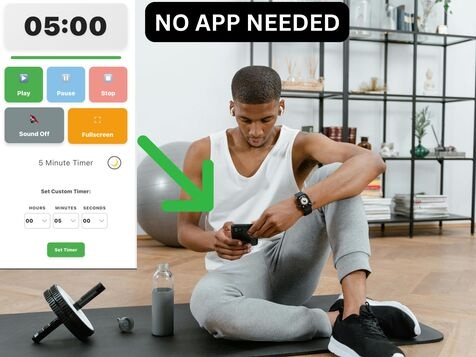
Using a gym clock isn’t rocket science. You don’t need special equipment or complicated apps.
The truth is, you can start right now with our free gym clock timer at the top of this page.
It’s designed specifically for workouts and takes less than 5 seconds to set up. No downloads, no sign-ups, just click and go.
Here’s what makes this so awesome: You can start getting the benefits of a gym clock in your very next workout.
Not next week.
Not after you buy something.
Today!
The key is starting simple. Don’t try to time everything perfectly on day one.
That’s like trying to learn piano by playing a concert. Instead, pick one tiny thing to time and nail that first.
Here’s what happened to Lisa: She tried to time her entire workout on day one. Rest periods, exercise duration, transitions, everything.
She got so overwhelmed that she gave up after 10 minutes.
The next week, she just timed her rest periods using our simple gym timer.
It was so easy and effective that timing became automatic within days.
The beauty of starting simple: Once you see how much better one timed element makes your workout feel, you’ll naturally want to time more things.
It becomes addictive in the best possible way.
What you’ll discover in the next few minutes: Three foolproof methods to ease into gym timing. Pick whichever one feels most comfortable and start there.
Pro Tip: Open our gym clock timer in a new tab right now so it’s ready for your next workout.
Don’t announce to everyone that you’re “starting a new timing system.” Just quietly start timing one thing. Let your improved results do the talking.
The 5-Minute Start Method
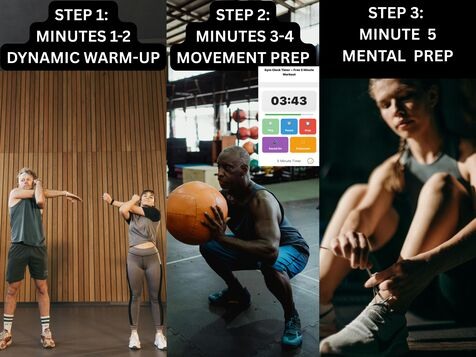
This is perfect if you want structure but don’t want to overthink things.
The 5-Minute Start Method turns the beginning of every workout into a smooth, timed routine using our gym timer.
Minutes 1-2: Dynamic warm-up with timer cues Set our gym clock to 2 minutes and start moving. Do arm circles for 20 seconds, leg swings for 20 seconds, then light jogging or marching in place.
The timer keeps you moving instead of standing around deciding what to warm up.
No complicated warm-up routine to remember. Just keep your body moving for 2 full minutes. Your joints will loosen up, your heart rate will rise gently, and you’ll feel ready to exercise.
Minutes 3-4: Movement preparation Reset the timer for another 2 minutes. Now do practice versions of the exercises you’ll be doing today.
If you’re doing squats later, do 10 bodyweight squats now. If you’re doing push-ups, do a few easy ones.
This is like a movie trailer for your workout. Your muscles get a sneak peek of what’s coming and start preparing.
Minute 5: Mental preparation Set the final 1-minute countdown.
Take deep breaths and visualize your workout going perfectly. See yourself completing every exercise with good form and energy.
This isn’t hippie nonsense – it’s sports psychology. Olympic athletes do this before every performance.
Why this method works so well:
- You never waste time wondering “what should I do first?”
- Your body gets progressively ready instead of shocking it with hard exercise
- You feel confident and prepared instead of scattered and rushed
- It creates a ritual that signals “workout time” to your brain
Real example: Marcus used to spend 10-15 minutes messing around before his real workout started.
Sometimes he’d forget to warm up entirely.
Using our gym timer for the 5-Minute Start Method cut his preparation time in half and eliminated warm-up injuries completely.
The psychological benefit: Starting with a timed routine makes the rest of your workout feel organised and professional. You’re not just “some person at the gym” – you’re someone who has a system.
Step-by-step for your first try:
- Open our gym clock timer
- Set timer to 2 minutes and start moving
- When timer goes off, reset to 2 minutes for movement prep
- Final 1-minute timer for deep breathing
- Begin your real workout feeling awesome
Beginner-Friendly Tip: If 5 minutes feels too long, start with the 3-Minute Start Method (1 minute each phase). The benefits of a gym clock work just as well with shorter times.
The Traffic Light System
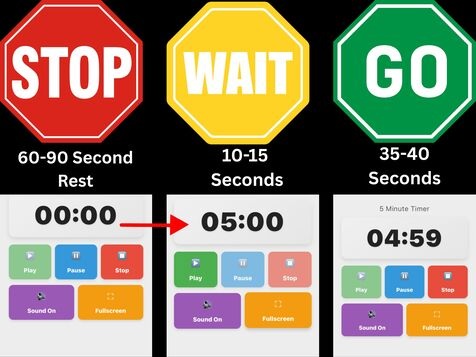
This system is genius because everyone understands traffic lights. Green means go hard, yellow means get ready, red means stop completely. Simple!
Our gym timer is perfect for this because you can quickly switch between different time periods.
Green Phase: High-intensity work periods This is when you give maximum effort. Whether you’re lifting weights, doing push-ups or running, green time means full throttle. Set the timer and go all out until it beeps.
Think of green like sprinting to catch a bus. You give everything you have for a short burst.
Yellow Phase: Transition and setup time This is your buffer zone between exercises. Walk to the next piece of equipment, adjust weights, get into position. Yellow isn’t rest time – it’s preparation time.
Like yellow traffic lights, this phase is short but important. It keeps your workout flowing smoothly.
Red Phase: Complete rest periods Full stop. Sit down, breathe deeply, let your heart rate come down. This is recovery time for your muscles and your mind.
Red means red – no cheating by doing “light movement” or fidgeting around.
How to apply this to any workout type:
For Weight Training:
- Green: Set timer for 30-45 seconds lifting
- Yellow: Reset to 15 seconds to move/setup
- Red: Set for 60-90 seconds complete rest
For Cardio Intervals:
- Green: 30 seconds high intensity
- Yellow: Quick 10-second reset to adjust pace
- Red: 30-60 seconds easy pace/walking
For Circuit Training:
- Green: 45 seconds maximum effort
- Yellow: 15 seconds transition
- Red: 60 seconds complete rest after full circuit
Why your brain loves this system: Colors create instant understanding. You don’t have to think about what phase you’re in – you just see the color and your body knows what to do.
Real story: Tom was always confused about when to rest and when to work. Using our gym clock with the traffic light system made everything obvious.
Green = beast mode, yellow = get ready, red = chill out. His workouts became so much more effective because he stopped second-guessing everything.
Start Simple Challenge: Open our gym timer right now.
Pick just one exercise for your next workout.
Use green for 30 seconds of work, yellow for 10 seconds to reset,
red for 60 seconds of rest.
Do this 5 times and notice how different it feels from unstructured exercise.
Pro Insight: The benefits of a gym clock multiply when you combine timing with clear visual cues.
Your workout becomes a game with rules instead of a random collection of exercises.
Ready-Made Timer Plans for Popular Workouts
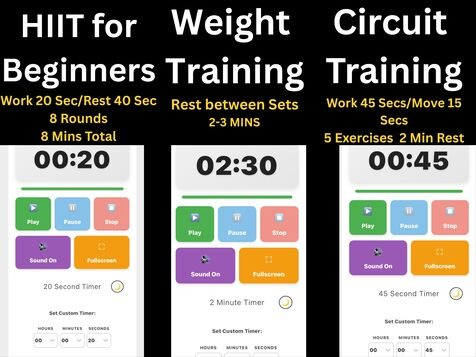
Don’t want to figure out timing from scratch? No problem!
Here are three copy-and-paste timer plans that work perfectly with our gym clock for the most popular workout styles.
Just pick the one that matches what you want to do, open our timer, and follow along. These have been tested by thousands of people and deliver amazing results.
HIIT for Beginners
Exact timing: 20 seconds work / 40 seconds rest × 8 rounds
Total workout time: 8 minutes
What exercises work best: Jumping jacks, mountain climbers, high knees, burpees (easy version)
How to set up with our timer:
- Open our gym clock timer
- Set first timer to 20 seconds for work
- When it beeps, quickly reset to 40 seconds for rest
- Repeat 8 times total
This is perfect if you’re new to high-intensity training. The rest is twice as long as the work, so you’ll recover fully between rounds.
Real example: Michelle couldn’t do a full burpee when she started. After 3 weeks of this exact timing using our gym timer, she could complete all 8 rounds with perfect form burpees.
Weight Training Timer
Set timing: 60 seconds total (exercise + transition)
Rest timing: 2-3 minutes between sets How to adjust: Heavier weights = 3 minutes rest, lighter weights = 2 minutes rest
Using our gym timer for weights:
- Set timer for 60 seconds and start your set
- Finish all reps and use remaining time to reset
- When 60 seconds ends, set timer for 2-3 minutes rest
- Repeat for all sets
Why this works perfectly: Every set takes exactly the same amount of time. Your workout becomes predictable and efficient.
Real story: James used to spend 2+ hours doing weight training because he never timed his rests.
With our gym timer system, his workouts take exactly 45 minutes and he’s gotten significantly stronger.
Circuit Training Plan
Work period: 45 seconds per exercise Transition: 15 seconds between exercises
Rest: 2 minutes between full circuits
Perfect circuit setup with our timer:
- Set gym timer to 45 seconds – do first exercise
- Reset to 15 seconds – move to next exercise
- Repeat for all exercises in circuit
- Set 2-minute timer for full rest
- Repeat entire circuit
Sample circuit:
- Push-ups – 45 seconds
- Squats – 45 seconds
- Plank – 45 seconds
- Lunges – 45 seconds
- Mountain climbers – 45 seconds
Why this timing works perfectly: 45 seconds is long enough to get 12-20 reps of most exercises, 15 seconds gives you just enough time to move between exercises, and 2 minutes lets you recover while staying warm.
The benefits of a gym clock shine here. Without timing, circuit training becomes chaotic. With our timer, it becomes a smooth, flowing workout that feels almost like dancing.
Quick Start: Bookmark our gym clock page on your phone right now.
That way it’s always ready when you need it, and you never have an excuse for unstructured workouts again.
Common Gym Clock Mistakes to Avoid
Here’s the thing about gym clocks: they’re incredibly powerful, but most people mess them up in the first few weeks.
It’s like getting a sports car and then driving it into a wall because nobody taught you how to use the brakes.
Don’t worry, these mistakes are super common and easy to fix.
In fact, knowing what NOT to do is almost more important than knowing what to do.
It’ll save you weeks of frustration and help you get results faster.
The biggest mistake people make: They try to become timing experts overnight.
They set up complicated systems with multiple timers, different intervals for every exercise and detailed spreadsheets to track everything. Then they get overwhelmed and quit.
Here’s the reality: Even Olympic athletes started with basic timing. They mastered simple rest periods before moving to advanced techniques. You should too.
The benefits of a gym clock only work if you actually stick with using it. A simple system you follow every workout beats a perfect system you abandon after three days.
Real story: My friend Alex tried to time everything in his first week – rest periods, rep speed, transition time, even how long he spent changing clothes.
He spent more time managing timers than exercising. After two weeks of frustration, he quit timing altogether. Six months later, he tried again with just one simple rest timer.
Now he’s been using gym clocks successfully for over a year.
What you’ll learn in this section: The three biggest timing mistakes that kill people’s progress, and exactly how to avoid them.
Master these and you’ll skip months of trial and error.
Pro Tip: If you recognize yourself making any of these mistakes, don’t feel bad. Every successful gym timer user has made them. The difference between success and failure is learning from them quickly.
Resting Too Long Problem
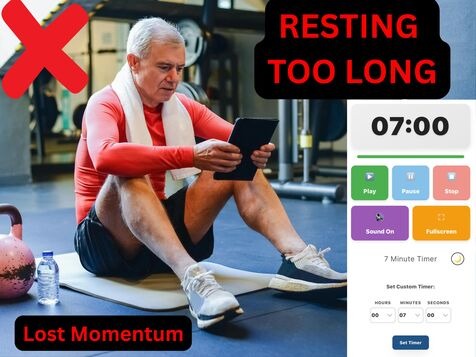
This is the silent killer of gym progress. You think longer rest means better recovery, but there’s a point where rest becomes procrastination.
Your muscles cool down, your focus disappears and your workout intensity crashes.
How excessive rest kills workout intensity:
Your muscles are like a fire. During exercise, you’re adding fuel and creating heat.
Rest periods should let the fire settle to a steady burn, not go completely cold. When you rest too long, you have to re-ignite everything from scratch.
The “80% recovery rule” explained: Your muscles don’t need to feel 100% fresh before the next set.
In fact, working at 80% recovery often produces better results because you’re training your body to perform under mild fatigue, which is exactly what happens in real life.
Think about it: athletes don’t get full recovery between plays in a game. They perform when slightly tired and this makes them stronger.
Signs you’re ready for the next set:
- Your breathing has slowed but isn’t completely normal
- You feel like you could do another set, but it would be challenging
- Your muscles feel warm but not burning
- You’re mentally focused on the next exercise, not distracted
What happens when you rest too long:
- Your core body temperature drops
- Your joints stiffen up
- Your nervous system switches from “exercise mode” to “rest mode”
- You lose the metabolic momentum that drives results
- Your workout stretches to twice its necessary length
Real example: Sophie used to rest “until she felt completely ready” between squat sets. This usually meant 4-6 minutes.
When she started timing exactly 3 minutes, she initially felt like she wasn’t fully recovered.
But within two weeks, her squat performance actually improved because her body adapted to working with shorter rest.
The psychology problem: Long rest periods make your brain think the workout is over.
You start checking your phone, chatting with people, or thinking about other things.
Then it’s mentally difficult to get back into intense exercise mode.
How to fix this immediately:
- Set a maximum rest time and stick to it religiously
- If you feel ready before the timer goes off, wait anyway – consistency matters
- Use rest time for light movement like walking or gentle stretching
- Focus on your next set during rest, not outside distractions
The sweet spot for different goals:
- Strength building: 2-3 minutes maximum
- Muscle building: 90 seconds maximum
- Fat loss/fitness: 60 seconds maximum
Challenge yourself: For one week, cut your current rest times by 30%. You’ll be shocked at how much more intense your workouts become without getting harder.
Rushing Between Exercises
This is the opposite extreme and it’s just as dangerous.
Some people think faster automatically means better, so they rush from exercise to exercise with no transition time.
This leads to injuries, poor form and actually worse results.
Why transition time matters for safety:
Your body needs a few seconds to mentally shift from one movement pattern to another.
Rushing from bench press straight into squats without any pause confuses your nervous system and increases injury risk.
It’s like trying to change lanes on a motorway without checking your mirrors. Technically possible, but unnecessarily dangerous.
The 5-10 second setup rule: Always give yourself at least 5-10 seconds between exercises to:
- Walk to the new equipment safely
- Adjust weights or settings
- Get into proper starting position
- Take a deep breath and focus
This isn’t wasted time – it’s investment time that prevents injuries and improves performance.
How to balance efficiency with preparation:
- Plan your exercise order to minimize equipment changes
- Set up your next exercise during rest periods when possible
- Keep transitions purposeful but not frantic
- Remember that 10 extra seconds of setup can prevent weeks of injury recovery
Signs you’re rushing too much:
- You feel breathless from moving between exercises, not from the exercises themselves
- Your form gets sloppy on the first rep of new exercises
- You feel scattered and unfocused during workouts
- You’re making small mistakes like forgetting to adjust seat heights
Real story: Mike prided himself on “efficient” workouts where he never stopped moving.
He went straight from one exercise to the next with zero transition time.
This worked for about three weeks until he pulled a muscle trying to rush into a deadlift without proper setup.
The two-week recovery period taught him that 10 seconds of preparation beats 10 days of rehabilitation.
The hidden cost of rushing: When you rush between exercises, your form suffers on the first few reps as your body figures out the new movement.
This means you’re wasting the most important reps of each set – the ones where you’re strongest and could make the most progress.
Perfect transition timing:
- Finish exercise A
- Take 5-10 seconds to put equipment away and move
- Take 5 seconds to set up exercise B properly
- Take one deep breath and begin
Pro Insight: Great athletes make difficult things look effortless because they never rush. They move with purpose and control, which actually makes them faster overall than people who frantically hurry.
Using the Same Timer for Everything
This mistake seems logical but kills results. People find one timing system that works for one type of exercise, then try to force it onto everything they do.
It’s like wearing running shoes to a wedding, technically they’re shoes, but they’re not right for the situation.
Why different exercises need different timing: Your body uses different energy systems for different types of work.
Heavy squats drain your nervous system and need longer recovery.
Light cardio uses your aerobic system and needs shorter recovery.
Stretching needs almost no recovery at all.
Using the same 2-minute rest for everything means you’re either under-recovering for some exercises or over-recovering for others.
How to match timing to exercise type:
Heavy Compound Movements (Squats, Deadlifts, Bench Press):
- 3-5 minutes between sets
- These drain your entire nervous system
- Need full recovery for maximum performance
Isolation Exercises (Bicep Curls, Calf Raises):
- 60-90 seconds between sets
- Only work small muscle groups
- Recover much faster than compound movements
Cardio Intervals:
- 30-60 seconds recovery
- Designed to keep heart rate elevated
- Too much rest defeats the purpose
Bodyweight Circuits:
- 15-30 seconds between exercises
- 2-3 minutes between full circuits
- Designed for continuous movement with short breaks
Examples of timing adjustments:
Sarah’s mistake: She used 2-minute rest periods for everything because that’s what she read online.
This worked fine for her arm exercises but left her gasping and weak during heavy leg exercises.
When she increased leg exercise rest to 4 minutes, her squat strength improved dramatically.
Tom’s mistake: He used 3-minute rest periods from his powerlifting program for cardio circuits.
His heart rate kept dropping during rest periods, so he never got the cardiovascular benefits he wanted.
When he cut rest to 45 seconds, his fitness improved rapidly.
The adaptation principle: Your body adapts to the specific timing patterns you give it.
If you always rest the same amount, you only get good at recovering from that specific timing.
Using varied timing makes you more adaptable and athletic.
How to choose the right timing:
- Heavy weights = longer rest
- Light weights = shorter rest
- Full-body exercises = longer rest
- Single-muscle exercises = shorter rest
- Strength goals = longer rest
- Cardio goals = shorter rest
Quick reference guide:
- Deadlifts: 3-5 minutes
- Squats: 3-4 minutes
- Bench Press: 2-3 minutes
- Rows: 2-3 minutes
- Bicep Curls: 60-90 seconds
- Tricep Extensions: 60-90 seconds
- HIIT Cardio: 30-60 seconds
- Steady Cardio: No rest needed
- Stretching: 10-30 seconds between positions
The benefits of a gym clock multiply when you match timing to exercise type:
Instead of fighting against your body’s natural recovery patterns, you work with them to maximize every single set.
Smart Strategy: Write down the optimal rest time for each exercise in your routine.
After a few weeks, you’ll memorize them and timing adjustments will become automatic.
Smart Gym Clock Tricks for Better Results
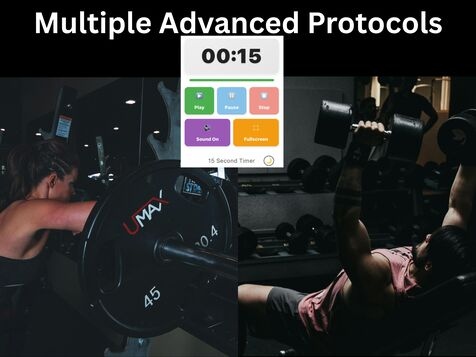
Ready to level up your timing game?
These aren’t beginner tricks, these are the secret weapons that serious gym-goers use to squeeze every drop of progress out of their workouts.
Here’s what separates good from great:
Anyone can time their rest periods. But the people who get incredible results?
They use timing as a precision tool to manipulate their body’s responses and create specific training effects.
Think of basic timing like learning to drive. These advanced tricks? They’re like learning to drive a race car. Same principles, but with much more power and precision.
Warning: Don’t try these until you’ve mastered basic rest timing for at least 4-6 weeks. Your body needs to understand simple timing patterns before you can use complex ones effectively.
The benefits of a gym clock reach their full potential when you use these advanced techniques.
You’ll create training effects that most people think require expensive equipment or complicated programs.
Here’s what happened to Mark: He’d been doing the same workout routine for 8 months with decent results.
Then he learned cluster training with precise timing.
In 6 weeks, he broke through every strength plateau he’d been stuck on.
Same exercises, same weights to start, but completely different timing created completely different results.
What makes these tricks “smart”: They work with your body’s natural systems instead of against them.
You’re not just timing rest, You’re timing recovery, Adaptation and performance to create exact training responses.
Pro Warning: These techniques are more mentally demanding than basic timing. You’ll need to stay focused and disciplined. But the results are worth it.
Cluster Training with Your Timer
This is the secret weapon of powerlifters and strength athletes.
Instead of doing one big set until you’re exhausted, you break it into smaller “clusters” with tiny rest periods.
The result? You lift heavier weights for more total reps.
Breaking heavy sets into mini-sets: Instead of doing 5 reps in a row,
You might do 2 reps, rest 15 seconds,
Do 2 more reps, rest 15 seconds,
Then do your final rep.
This is called a “cluster set.”
Micro-rest periods (15 seconds): These tiny breaks let your muscles partially recover without losing the training effect.
It’s like giving your muscles a quick sip of water instead of a full drink.
Benefits: maintaining intensity while increasing volume:
You can lift heavier weights because you’re not completely exhausted.
You can also do more total reps because you’re getting mini-recovery periods.
Step-by-step cluster training example:
Traditional Set:
- Bench Press: 80kg × 5 reps (probably fail on rep 4-5)
- Rest 3 minutes
- Repeat
Cluster Set:
- Bench Press: 85kg × 2 reps
- Rest exactly 15 seconds
- Bench Press: 85kg × 2 reps
- Rest exactly 15 seconds
- Bench Press: 85kg × 1 rep
- Rest 3 minutes
- Repeat cluster
The timing is crucial: 15 seconds is the magic number. Less than 15 seconds and you don’t recover enough. More than 15 seconds and you lose the clustering effect.
Why this works so well: Your muscles have two main energy systems.
One refills in about 15 seconds, the other takes 2-3 minutes.
Cluster training lets you use both systems optimally.
Real example: Jenny was stuck benching 50kg for 3 sets of 5 reps.
Using cluster training, she could suddenly handle 55kg for 3 clusters of 2+2+1 reps.
Same total reps (5), same total sets (3), but 5kg heavier weight because of the micro-rests.
Best exercises for cluster training:
- Bench Press
- Squats
- Deadlifts
- Pull-ups
- Any exercise where you want maximum strength
Timing setup:
- Do your mini-set (usually 1-3 reps)
- Put the weight down and start your 15-second timer immediately
- When timer beeps, start next mini-set
- Repeat until cluster is complete
- Rest 3-5 minutes before next cluster
The benefits of a gym clock are essential here: Without precise 15-second timing, cluster training doesn’t work. Too short and you’re still too tired. Too long and you cool down too much.
Advanced tip: As you get stronger, you can extend clusters. Instead of 2+2+1, try 3+2+1 or even 2+2+2. The timing stays the same – it’s the volume that increases.
The Speed Control Method
Most people think reps are just about moving weight from point A to point B. Wrong!
The speed you move the weight is just as important as how much weight you’re moving.
This is where timing transforms good reps into great reps.
3-1-2-1 tempo explanation: This is the secret code of rep timing. It means:
- 3 seconds to lower the weight (eccentric phase)
- 1 second pause at the bottom
- 2 seconds to lift the weight (concentric phase)
- 1 second pause at the top
How to set multiple timers for rep control: You need a timer that can beep at different intervals, or you count in your head while watching a seconds timer.
Some people use music with a specific beat to keep rhythm.
Benefits for muscle building and strength:
- More time under tension: Your muscles work harder when they work longer
- Better muscle control: Slow reps improve your mind-muscle connection
- Increased difficulty: Slow reps make light weights feel heavy
- Reduced injury risk: Controlled movements protect your joints
Real example with bench press:
- Start with bar at chest (bottom position)
- Count “1-Mississippi, 2-Mississippi, 3-Mississippi” while pressing up (3 seconds)
- Hold at top for “1-Mississippi” (1 second pause)
- Count “1-Mississippi, 2-Mississippi” while lowering (2 seconds down)
- Pause at chest for “1-Mississippi” (1 second pause)
- Repeat for all reps
Why this works better than fast reps: Fast reps use momentum and bounce. Slow reps force your muscles to do all the work.
It’s like the difference between jumping down stairs (fast and easy) versus walking down carefully (slow but more controlled).
Success story: Carlos was doing 20kg bicep curls for 10 fast reps.
When he switched to 15kg curls with 3-1-2-1 timing, his biceps grew faster than they ever had with heavier weight.
The slower tempo created more muscle stimulus than the heavier weight with poor tempo.
Different tempos for different goals:
For Maximum Strength: 1-0-1-0 (fast up, no pause, fast down, no pause)
For Muscle Building: 3-1-2-1 (slow down, pause, medium up, pause)
For Muscle Control: 4-2-4-2 (very slow both ways with pauses)
For Power: 1-0-X-1 (fast down, no pause, explosive up, pause)
How to practice tempo control:
- Start with bodyweight exercises (push-ups, squats)
- Use very light weights at first
- Count out loud until the rhythm becomes natural
- Focus on one phase at a time (master the “down” before worrying about the “up”)
The hardest part: Your ego will hate this at first. You’ll have to use much lighter weights than you’re used to. But after 2-3 weeks, you’ll be stronger at both slow AND fast tempos.
Timer setup for tempo training:
- Set a timer for your total set time (usually 60-90 seconds for 8-12 slow reps)
- Count rhythm in your head or use a metronome app
- Rest 2-3 minutes between sets (slow reps are more exhausting)
Pro tip: Master tempo control with bodyweight exercises first. Once you can do perfect 3-1-2-1 push-ups, adding weight becomes easy.
Density Training
This is where timing meets competition. Instead of counting sets and reps, you count how much work you can do in a fixed amount of time. It turns every workout into a race against the clock.
10-minute timer challenge concept: Pick 2-3 exercises and see how many total reps you can complete in exactly 10 minutes.
Next week, try to beat that number. It’s simple, competitive and incredibly effective.
Tracking improvement through completed sets:
Your progress isn’t measured by lifting heavier weights, it’s measured by doing more work in the same time.
This makes progress visible every single workout.
How to progressively increase density:
- Week 1: Learn the exercises and establish a baseline
- Week 2: Try to add 10-20% more reps in the same time
- Week 3: Add more reps or include a new exercise
- Week 4: Challenge yourself with a 12-minute block instead of 10
Sample density workout: Exercises: Push-ups, squats, planks (hold for 10 seconds = 1 rep)
Time limit: 10 minutes
Goal: Complete as many rounds as possible
Week 1 result: 8 rounds (24 push-ups, 24 squats, 8 ten-second planks)
Week 4 result: 12 rounds (36 push-ups, 36 squats, 12 ten-second planks)
The psychology is addictive: Every workout becomes a personal challenge. You’re not just “doing exercise” – you’re trying to set a new personal record.
Real story: Amanda was bored with regular workouts because progress felt slow.
She started doing 15-minute density blocks with burpees, mountain climbers, and jump squats.
Seeing her rep count increase every single week reignited her motivation.
After 8 weeks, she was doing 50% more work in the same time.
Why density training works so well:
- Clear progress tracking: You always know if you’re improving
- Built-in motivation: Racing the clock keeps you focused
- Efficient workouts: Maximum results in minimum time
- Scalable difficulty: Add time or exercises as you improve
Different density formats:
EMOM (Every Minute On the Minute):
- Set timer for 10 minutes
- Do 10 burpees at the start of each minute
- Rest for whatever time is left in that minute
- Repeat for all 10 minutes
AMRAP (As Many Rounds As Possible):
- Set timer for 15 minutes
- Do 5 push-ups, 10 squats, 15 mountain climbers
- Complete as many full rounds as possible in 15 minutes
Ladder Format:
- Set timer for 12 minutes
- Round 1: 1 burpee, 1 squat
- Round 2: 2 burpees, 2 squats
- Round 3: 3 burpees, 3 squats
- Continue climbing the ladder until time runs out
Setup requirements:
- A visible countdown timer (crucial for motivation)
- Simple exercises that don’t need equipment changes
- A way to track your reps (pen and paper works great)
- Space to move without interruption
The benefits of a gym clock are maximized here: The timer isn’t just keeping time, it’s creating urgency, tracking progress and pushing you to work harder than you thought possible.
Beginner warning: Start with just 5-minute blocks. Density training is mentally and physically demanding. Build up your capacity gradually to avoid burnout.
Advanced variation: Once you master 10-minute blocks, try “density pyramids” 5 minutes, then 10 minutes, then 5 minutes again with different exercises in each block.
Fixing Common Gym Clock Problems
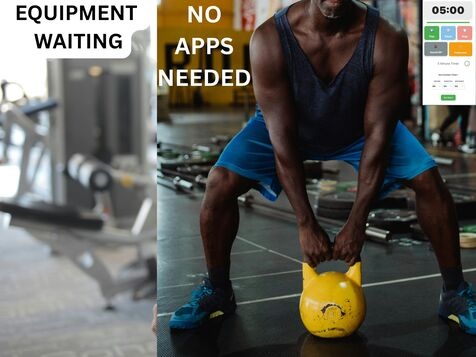
Let’s be honest even the best timing systems sometimes go wrong.
The gym is too loud to hear timer beeps. You forget to start your timer mid-set.
Your motivation dips and timing feels like a chore.
These problems are annoying but they’re completely solvable with the right online timer.
Here’s the reality: Every person who uses gym timing successfully has dealt with these exact same problems.
The difference between people who give up and people who succeed? They use reliable, web-based timing solutions that work consistently.
Think of it like this – professional athletes don’t quit playing when conditions get tough.
They use equipment they can count on. Your timing system should be just as reliable.
The good news: Most timing problems disappear when you use a dedicated online gym timer instead of complicated apps or unreliable methods.
Simple, web-based solutions solve the majority of timing headaches.
The benefits of a gym clock are too valuable to lose because of technical issues or motivation dips.
With a reliable online timer and the right mindset strategies, you’ll never have to go back to unstructured workouts.
Real story: Dave was crushing his timed workouts for 3 weeks until his timer app kept crashing during busy gym sessions.
Instead of having a reliable backup, he just winged the rest of his workouts.
That turned into abandoning timing completely.
When he discovered our simple online gym timer, he realized how much easier timing could be, no apps to crash, no downloads, just reliable timing that works every time.
What you’ll learn in this section: How our online gym timer solves common timing problems, plus strategies to stay motivated when timing gets challenging.
Pro Mindset: The best timing system is the one that just works, every single time.
Equipment and Setup Help
The best timing system is the one that works flawlessly when you need it most. Complex apps crash, downloads take time, and complicated interfaces confuse you mid-workout.
That’s exactly why our online gym timer was designed to be the perfect gym companion.
Why online web-based timers beat everything else:
Instant Access – No Downloads: Our online gym timer loads instantly in any web browser.
No waiting for app store downloads, no storage space needed, no update delays.
Just open your browser and you’re ready to time your workout perfectly.
Never Crashes or Fails: Unlike apps that freeze or crash mid-workout, our web-based timer runs smoothly in your browser.
It’s built specifically for reliability, the one thing you can count on during challenging workouts.
Works on Any Device: Phone, tablet, laptop, our online timer works perfectly on everything.
Switch devices mid-workout if needed, or use whatever device is convenient. Same great timer, every single time.
Always Updated and Optimized: Web-based timers automatically use the latest version without any action from you.
No “update required” messages interrupting your workout flow.
Zero Storage Issues: Your phone memory stays free for photos and music. Our timer doesn’t take up precious storage space because it lives online, always ready when you need it.
Sound and Visual Solutions Made Simple:
Perfect Volume Control: Our online gym timer lets you adjust sound levels perfectly for your environment.
Too loud? Turn it down.
Too quiet? Pump it up.
Crystal Clear Visual Alerts: Large, bold numbers you can see from across the gym. Visual countdown that builds excitement as time runs out.
Backup methods when you need alternatives:
The Gym Clock Method: Even with our reliable online timer, it’s smart to know backup timing. Most gyms have wall clocks:
- Note the time when you start resting
- Add your rest period (2:15 + 3 minutes = start again at 2:18)
- Our online timer is always your primary choice, but wall clocks work as backup
The Music Method: Most songs are 3-4 minutes long:
- 1 song = long rest period
- Half a song = medium rest period
- One verse = short rest period
- But honestly, our online timer is so reliable you’ll rarely need this backup
Why our online gym timer solves most problems:
No App Store Hassles: Never worry about app store approvals, update delays, or compatibility issues. Our timer works instantly, every time.
No Storage Worries: Keep your phone’s memory free for important stuff. Our web-based timer doesn’t take up any space.
No Subscription Fees: Completely free, forever. No premium upgrades needed, no hidden costs, no trial periods ending mid-workout.
Universal Compatibility: Works perfectly on iPhone, Android, tablets, laptops, literally any device with internet access.
The three-backup rule made easy:
- Primary: Our online gym timer (99% reliable)
- Secondary: Gym wall clock (for the rare internet hiccup)
- Emergency: Count breathing (12 breaths = roughly 1 minute)
Pro Setup Tips:
- Bookmark our gym timer for instant access
- Test the volume before your first set
- Keep your phone charged (our timer uses minimal battery)
- Remember – simple systems work better than complicated ones
Staying Motivated with Your Clock
Here’s the truth nobody talks about: timing your workouts will sometimes feel challenging, but the right timer makes all the difference.
When timing feels effortless and reliable, motivation stays high.
When your timing system fights against you, motivation crashes.
This is why our online gym timer is motivational gold:
It removes every friction point that kills workout motivation.
No app crashes to frustrate you.
No complicated setup to overwhelm you. Just smooth, reliable timing that keeps you focused on results instead of technology.
Pushing through when timing gets tough: There will be days when you don’t want to structure your workout. Maybe you’re tired, maybe the gym is busy, maybe you want to exercise “naturally” without timing.
This is exactly when our simple online timer shines. It’s so easy to use that there’s never an excuse to skip timing. Just open, set, and go – motivation preserved.
The “flexibility rule” made simple: Our online timer adapts to your needs without breaking your routine:
When to adjust timing:
- Gym is crowded – easy to reset our timer for different intervals
- Feeling tired – quickly adjust rest periods with simple controls
- Short on time – rapidly set shorter intervals without app navigation
- New exercise – instant timer adjustments without menu diving
How our timer keeps you flexible:
- Equipment busy? Reset timer instantly for different exercises
- Energy levels changing? Adjust timing on the fly with easy controls
- Time constraints? Quick setup gets you timing immediately
- Experimenting? Easy to try different intervals and find what works
Building lasting timer habits with ease:
Week 1-2: The Honeymoon Phase Our online timer makes this phase effortless. Everything works smoothly, setup is instant, and timing feels natural from day one.
Week 3-4: The Reality Phase This is where complicated systems break down, but our simple timer keeps you going.
No technical issues to break your momentum, no frustrations to kill motivation.
Week 5-8: The Integration Phase Our timer becomes invisible, it just works perfectly while you focus on your workout. This seamless experience builds permanent timing habits.
Month 3+: The Mastery Phase You can’t imagine working out without our reliable timer. It feels as essential as your gym shoes.
Motivation strategies powered by our timer:
The “One-Click Start” Rule: Our timer is so simple that there’s never an excuse for complicated timing. One click and you’re timing perfectly, removing every barrier to consistency.
The “Bookmark Motivation” Method: Bookmark our gym timer on your phone’s home screen. Seeing it there reminds you of your timing commitment and makes starting effortless.
The “Streak Tracking” Strategy: Use our timer’s reliability to build workout streaks. When your timing system never fails you, it’s easier to never fail your workouts.
The “Simple Success” Approach: Our timer’s simplicity means you succeed with timing from day one. Early success builds confidence and long-term motivation.
Real story: Mike hit a motivation wall in week 6 when his complicated timer app kept glitching. Switching to our simple online timer reset his motivation completely. “Finally, a timer that just works,” he said.
That reliability carried him through months of consistent, perfectly-timed workouts.
Mental reframes powered by easy timing:
“Timing feels complicated” → “Our online timer makes it effortless” “Technology always fails me” → “Web-based timers are incredibly reliable”
“I don’t want another app” → “No app needed – just bookmark and go” “Timing systems are expensive” → “Our timer is completely free forever”
The compound effect of reliable timing: Every perfectly-timed workout builds on the previous one. Our online timer’s consistency means you never lose momentum due to technical problems.
Emergency motivation protocol: When you really don’t want to time your workout:
- Open our simple gym timer (takes 3 seconds)
- Set it for just your first rest period
- Let the reliability and simplicity carry you through
- Usually, once you start with our easy system, you’ll continue
Why our online timer builds lasting motivation:
- Instant Success: Works perfectly from your first use
- Zero Friction: Nothing to download, install, or configure
- Always Available: Bookmark it and it’s always ready
- Never Fails: Web-based reliability you can count on
- Completely Free: No cost barriers to long-term use
The benefits of a gym clock become automatic: When timing is this easy and reliable, it stops feeling like effort and starts feeling like the natural way to exercise.
Long-term motivation secret: Our online timer’s simplicity means you’ll never associate timing with frustration.
Instead, you’ll associate it with the smooth, successful workouts it enables – building positive reinforcement that lasts for years.
What Results You Can Expect from Using a Gym Clock
This is the section you’ve been waiting for – the real, measurable changes that happen when you start timing your workouts properly.
No fluff,
No unrealistic promises,
Just honest results that thousands of people have experienced.
Here’s what makes this exciting: The changes don’t take months to appear. Some benefits show up in your very first timed workout.
Others build week by week until you look back and can’t believe how much stronger and fitter you’ve become.
The benefits of a gym clock create a domino effect.
Better timing leads to harder workouts. Harder workouts lead to faster results. Faster results lead to higher motivation. Higher motivation leads to consistency. Consistency leads to transformation.
The timeline is predictable: Everyone progresses through the same stages, just at slightly different speeds.
Knowing what to expect keeps you motivated during the tough weeks and helps you celebrate the breakthrough moments.
Real story: When Jessica started using our online gym timer, she weighed 78kg and could barely do 3 push-ups.
After following timed workouts for 6 months, she weighed 71kg and could do 25 push-ups in perfect form.
“The timing made everything measurable,” she said. “I could see myself getting stronger week by week instead of just hoping it was happening.”
What you’ll discover: Exactly what changes to expect and when to expect them. This isn’t just about physical improvements – timing transforms your entire relationship with exercise.
Important note: These results assume you’re using consistent timing (like our online gym timer) and following the principles from earlier sections. Random timing produces random results.
First 2 Weeks: Building Good Habits
The first two weeks are magical. You’re not just building muscle – you’re building systems.
This is when timing stops feeling awkward and starts feeling natural.
Every single workout teaches you something new about structure and consistency.
Improved workout consistency: This is the first thing people notice.
With our online gym timer providing reliable structure, you stop wandering around the gym wondering what to do next.
Your workouts have a clear beginning, middle, and end.
Before timing: “I think I’ll do some bicep curls… maybe some squats… oh look, the treadmill is free…”
After timing: “2 minutes rest, then 3 sets of squats, 90 seconds between each set, then move to bench press.”
Better exercise form through structured rest: When you’re not rushing between sets or resting too long, your body maintains the perfect balance of readiness and recovery.
Your form stays consistent because you’re never too tired or too cold.
Week 1 example: Tom used to do his bench press sets whenever he “felt ready.” Sometimes that was 30 seconds, sometimes 5 minutes.
His form was all over the place. Using our gym timer for exact 2.5-minute rest periods, his form became noticeably more consistent by day 3.
Time efficiency improvements: This might be the most immediately obvious change.
Workouts that used to take 90 minutes suddenly take 60 minutes.
You’re doing the same exercises with better results in less time.
What’s happening in your brain: You’re building neural pathways that associate timing with focus. Your brain starts to expect structure, which makes you naturally more disciplined and purposeful.
Week 1 changes you’ll notice:
- Workouts end when you planned them to end
- Less time spent standing around deciding what to do
- More energy left after workouts instead of feeling drained
- Sense of accomplishment from following a structured plan
Week 2 changes you’ll notice:
- Setting up our online timer becomes automatic
- You start mentally preparing for the next set during rest periods
- Other gym members seem chaotic compared to your structured approach
- You look forward to workouts because you know exactly what to expect
The habit formation process: Researchers say it takes 21 days to form a habit, but most people see timing become natural around day 10-12.
Using our simple online gym timer accelerates this because there’s no friction or complexity to overcome.
Common week 2 thoughts:
- “I can’t believe I used to work out without timing”
- “My workouts feel so much more professional now”
- “I’m getting more done in less time than ever before”
- “Other people at the gym look so scattered and inefficient”
Building consistency: The most important thing happening isn’t physical – it’s psychological.
You’re proving to yourself that you can stick to a system.
This builds confidence that extends beyond the gym.
What to track in weeks 1-2:
- How long your workouts actually take (you’ll be shocked)
- How many sets you complete (probably 30-50% more than before)
- Your energy levels after workouts (higher, not lower)
- Your motivation to return to the gym (significantly increased)
Pro tip for maximum week 2 impact: Take a “timing selfie” during your workout with our online gym timer visible in the background.
You’ll love looking back at this photo months later when you’re in amazing shape.
Weeks 3-4: Real Improvements
This is when timing stops being about organization and starts being about performance.
Your body has adapted to the structured recovery periods and begins responding with measurable improvements in strength, endurance and work capacity.
15-20% volume increase explanation: By week 3, most people are completing 15-20% more total work than they did in unstructured workouts.
This isn’t because they’re trying harder – it’s because proper timing allows them to maintain intensity throughout the entire session.
Real numbers example: Before timing, Marcus completed an average of 14 sets per workout.
After 3 weeks of using our gym timer, he was completing 18 sets in the same time period.
Same exercises, same weights to start, but 28% more total volume because rest periods were optimized.
Noticeable strength and endurance gains: Your muscles have adapted to the consistent work-to-rest ratios.
They’re now recovering more efficiently and can handle more total workload.
This shows up as either more reps with the same weight or the same reps with heavier weight.
Strength improvements you’ll see:
- Adding 2-5kg to major lifts (bench press, squat, deadlift)
- Completing 2-3 more reps per set with the same weight
- Maintaining good form even on challenging final sets
- Feeling stronger during everyday activities outside the gym
Endurance improvements you’ll see:
- Less breathing heavily between exercises
- Recovering faster during timed rest periods
- Maintaining energy levels throughout longer workouts
- Feeling less fatigue in your daily activities
Energy level consistency: This is huge. Before timing, your energy probably varied wildly – some workouts left you energized, others completely drained. Proper timing creates predictable energy outcomes.
After timed workouts, you’ll consistently feel energized rather than exhausted.
This happens because you’re training efficiently rather than randomly depleting yourself.
Energy transformation story: Lisa used to need 2-3 hours to recover after workouts before she could function normally.
After 4 weeks of timed training with our online gym timer, she was energized immediately after workouts and often went grocery shopping or did household tasks right after the gym.
What’s happening physiologically:
- Your cardiovascular system adapts to consistent work intervals
- Your muscles become more efficient at clearing metabolic waste
- Your nervous system learns to recover predictably during timed rest
- Your energy systems become more coordinated and efficient
The confidence boost: By week 4, you’re not just physically stronger, you’re mentally stronger.
You’ve proven you can stick to a system and see measurable results. This confidence spills over into other areas of life.
Measurable changes to track:
Week 3 markers:
- 10-15% increase in total reps completed
- Ability to maintain good form for entire workout
- Reduced post-workout fatigue
- Increased enthusiasm for next workout
Week 4 markers:
- 15-20% increase in total workout volume
- Noticeable strength gains in major exercises
- Consistent energy levels after workouts
- Other people commenting on your improved fitness
The social proof effect: People start noticing your transformation. Friends comment that you seem more energetic. Family members notice you’re more consistent with exercise. Coworkers ask what you’re doing differently.
Common week 3-4 thoughts:
- “I’m definitely getting stronger – I can feel the difference”
- “My workouts feel challenging but not exhausting anymore”
- “I have more energy throughout the day since I started timing”
- “I can’t wait to see what happens if I keep this up for months”
Warning about overconfidence: Week 4 is when some people get cocky and try to do too much too fast.
Stick with the timing principles that got you these results.
Consistency beats intensity spikes.Setting up for long-term success:
Use our online gym timer to document your progress during these crucial weeks.
Take photos, track numbers and celebrate the measurable improvements you’re seeing.
Month 2 and Beyond: Advanced Benefits
This is where timing transforms from a helpful tool into a superpower.
Your body has fully adapted to structured training, and the results become impossible to ignore.
You’re not just following a timing system anymore, you’ve become someone who intuitively understands optimal recovery and performance.
Intuitive recovery understanding: By month 2, you can feel exactly when your muscles are ready for the next set.
The timer isn’t telling you what to do – it’s confirming what your body already knows.
You’ve developed an internal clock that matches optimal timing.
This is the difference between a beginner and an athlete.
Athletes don’t need someone to tell them when they’re recovered, they feel it.
Timed training with our online gym timer teaches you this same body awareness.
Custom timing ability: You start naturally adjusting timing based on exercise type, energy levels, and goals.
Heavy squats automatically get 3 minutes rest in your mind.
Light bicep curls automatically get 90 seconds.
This becomes as automatic as knowing when you’re thirsty.
Advanced timing story: After 8 weeks of consistent timing, David stopped needing to think about rest periods.
His body would naturally feel ready at almost exactly the optimal time for each exercise.
The timer became a confirmation tool rather than a guide.
This internal timing carried over to sports, work tasks and daily activities.
Significant fitness improvements: The numbers become impressive.
We’re talking about strength gains that impress personal trainers, endurance improvements that shock your doctor, and body composition changes that make people ask what your “secret” is.
Strength achievements you’ll see:
- 25-50% increases in major lift weights
- Ability to handle workout volumes that would have crushed you before
- Maintaining perfect form even during challenging final sets
- Strength that transfers to everyday activities in obvious ways
Endurance achievements you’ll see:
- Completing workouts that used to be impossible
- Recovering between sets faster than ever before
- Maintaining high intensity for entire 60-90 minute sessions
- Cardiovascular fitness that improves your daily energy levels
Body composition changes:
- Visible muscle definition in areas that were previously soft
- Reduced body fat percentage from efficient, intense workouts
- Improved posture from balanced, consistent training
- The “athletic look” that comes from systematic training
The benefits of a gym clock become clear when you focus on consistent progress: You’re creating structured workouts that support steady improvement.
Each session contributes to your overall fitness development in a measurable way.
What people notice about you:
Month 2:
- Friends ask what program you’re following
- Family comments on your increased energy and confidence
- Coworkers notice you seem more focused and disciplined
- Other gym members start copying your timing approach
Month 3+:
- People assume you have a personal trainer or athletic background
- You become the person others ask for workout advice
- Your consistency inspires others to improve their own routines
- You realize you’ve become a role model for fitness discipline
The lifestyle transformation: Timing your workouts teaches you to structure other areas of life.
Work tasks get completed more efficiently.
Daily routines become more organized. You approach challenges with the same systematic mindset that made your workouts successful.
Advanced techniques you’ll naturally develop:
- Periodizing your timing (harder weeks, easier weeks)
- Adjusting timing based on stress, sleep, and energy levels
- Using timing to peak for specific goals or events
- Teaching timing principles to friends and family
Long-term health benefits:
- Cardiovascular health improvements measurable on medical tests
- Bone density improvements from consistent resistance training
- Metabolic efficiency improvements that affect daily energy
- Mental health benefits from regular, structured exercise
The compound effect in full display: Month 6 you is unrecognizable from month 1 you.
Not just physically, but mentally.
You’ve proven you can commit to a system, see it through and achieve remarkable results.
Maintaining momentum: The key to long-term success is remembering that our online gym timer isn’t just a tool
It’s the foundation of a systematic approach to fitness that works regardless of trends, equipment or circumstances.
Your transformation timeline:
- Month 2: People notice your physical changes
- Month 3: You feel like a completely different person
- Month 6: Your results inspire others to start their own journey
- Month 12: You can’t imagine exercising any other way
The ultimate benefit: You’ve developed a skill – the ability to use timing to create any fitness result you want.
This knowledge and discipline will serve you for decades, regardless of what exercises you do or what equipment you have access to.
Quick Guide: Benefits of a Gym Clock by Goal
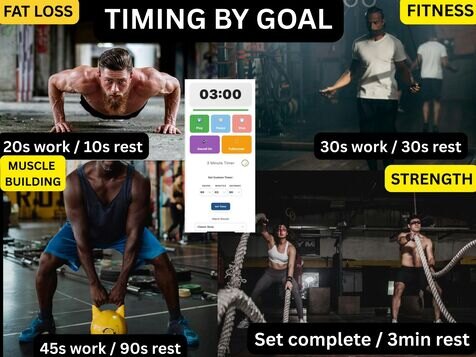
Not all fitness goals are created equal, and neither should your timing be.
The benefits of a gym clock multiply when you match your timing strategy to your specific goals.
Fat loss needs different timing than muscle building.
Strength training requires different rest periods than fitness improvement.
Here’s the game-changer: Most people use random timing regardless of their goals, which is like using the same recipe to bake a cake and cook a steak. It might work, but it’s definitely not optimal.
Smart timing means your rest periods, work intervals, and workout structure all work together toward your specific goal. This isn’t just more effective – it’s dramatically more effective.
Why goal-specific timing matters: Your body uses different energy systems and responds to different stimuli depending on what you’re trying to achieve.
Match your timing to your goals, and you’re working with your body’s natural systems instead of against them.
Our online gym timer makes it incredibly easy to customize timing for any goal.
No complicated programming needed, just simple adjustments that create powerful results.
Real example: Sarah and Mike both worked out for 6 months.
Sarah used fat-loss timing (short rests, high intensity) and lost 15kg while getting fitter.
Mike used strength timing (long rests, heavy weights) and doubled his bench press while building muscle.
Same time investment, different timing, completely different results.
What you’ll learn: The exact timing protocols for the four most common fitness goals, plus backup strategies when you can’t access your usual timing tools.
Pro insight: You can switch between different timing strategies as your goals change. Start with fat loss timing for 8 weeks, then switch to muscle-building timing for 8 weeks. Your body will respond to each phase differently.
Timer Guide by What You Want
This is your copy-and-paste guide to timing success. Pick your primary goal, follow the timing exactly as written and watch your results accelerate beyond what random timing could ever achieve.
Fat Loss: 30/30 intervals, 15-20 minutes
The strategy: Keep your heart rate elevated throughout the entire workout. Short work periods with equally short rest periods create maximum calorie burn and metabolic boost.
Perfect timing setup:
- Work period: 30 seconds all-out effort
- Rest period: 30 seconds light movement (walking, gentle stretching)
- Total rounds: 20-30 (depending on fitness level)
- Total time: 15-20 minutes
- Frequency: 4-5 times per week
Best exercises for fat loss timing:
- Burpees, mountain climbers, jump squats
- High knees, jumping jacks, squat thrusts
- Any bodyweight exercise done quickly
- Light weights with fast, controlled movements
Why this timing works for fat loss: Your body never fully recovers between rounds, so it keeps burning calories at a high rate.
The short rest periods prevent your heart rate from dropping, maintaining the “fat burning zone” throughout.
Real fat loss success: Emma used this exact 30/30 timing for 12 weeks and lost 22 pounds. “The timer made it feel like a game,” she said. “I’d try to beat my previous round’s reps, and before I knew it, the fat was melting off.”
How to progress: Week 1-2: 15 minutes total. Week 3-4: 17 minutes. Week 5-8: 20 minutes. Week 9+: Add more challenging exercises or extend to 25 minutes.
Muscle Building: 60-90 second sets, 2-3 minute rests
The strategy: Create maximum muscle tension through controlled movements, then allow full recovery so you can maintain intensity throughout all sets.
Perfect timing setup:
- Set duration: 60-90 seconds of continuous muscle tension
- Rest between sets: 2-3 minutes complete rest
- Sets per exercise: 3-4 sets
- Exercises per workout: 6-8 exercises
- Total workout time: 60-75 minutes
Best exercises for muscle building timing:
- Slow, controlled weight lifting with moderate weights
- Bodyweight exercises with paused reps
- Resistance band exercises with constant tension
- Any exercise where you can maintain perfect form for 60-90 seconds
Why this timing works for muscle building: The 60-90 second “time under tension” creates the perfect stimulus for muscle growth.
The 2-3 minute rest allows your muscles to recover enough to maintain this stimulus in every set.
Real muscle building success: James followed this timing for 16 weeks and gained 8kg of lean muscle.
“I was amazed how much bigger my muscles got just from timing the reps properly,” he reported. “Same exercises, but the slow tempo made them work so much harder.”
How to progress: Start with 60-second sets and 2-minute rests. As you get stronger, extend to 75-second sets and 2.5-minute rests. Advanced lifters can use 90-second sets with 3-minute rests.
Fitness: 3-5 minute blocks, 1 minute rest
The strategy: Build cardiovascular endurance and overall fitness through sustained effort periods that challenge multiple energy systems.
Perfect timing setup:
- Work blocks: 3-5 minutes of continuous activity
- Rest periods: 1 minute active recovery (walking, light stretching)
- Blocks per workout: 4-6 blocks
- Total workout time: 25-35 minutes
- Mix of exercises within each block
Best exercises for fitness timing:
- Circuit training (rotate through different exercises)
- Steady-state cardio with intensity changes
- Mixed bodyweight and cardio combinations
- Any activities that keep you moving for 3-5 minutes straight
Why this timing works for fitness: Longer work periods train your aerobic system while shorter rest periods keep your heart rate elevated. This builds the kind of fitness that helps in daily life.
Real fitness success: David used this timing to train for a charity run. After 10 weeks, he went from being winded after climbing stairs to completing a 10K run with energy to spare.
“The 5-minute blocks taught my body to sustain effort,” he said.
How to progress:
Week 1-3: 3-minute blocks.
Week 4-6: 4-minute blocks.
Week 7+: 5-minute blocks or add more blocks to the workout.
Strength: 5-10 second sets, 3-5 minute rests
The strategy: Maximize force production through heavy weights and explosive movements, with long rest periods for complete nervous system recovery.
Perfect timing setup:
- Set duration: 5-10 seconds (1-3 reps with heavy weight)
- Rest between sets: 3-5 minutes complete rest
- Sets per exercise: 4-6 sets
- Exercises per workout: 3-5 exercises (focus on compound movements)
- Total workout time: 60-90 minutes
Best exercises for strength timing:
- Heavy squats, deadlifts, bench press
- Olympic lifting movements (if you know proper form)
- Heavy compound movements with barbells or dumbbells
- Any exercise where you’re lifting 85%+ of your maximum weight
Why this timing works for strength: Heavy weights require maximum nervous system activation. Long rest periods allow complete recovery so you can lift maximum weight in every set.
Real strength success: Marcus increased his deadlift from 100kg to 160kg in 6 months using this exact timing.
“I finally understood why powerlifters rest so long between sets,” he said. “Each set was maximum effort because I was fully recovered.”
How to progress: Beginners: 3-minute rests. Intermediate: 4-minute rests. Advanced: 5+ minute rests for maximum strength exercises.
Using our online timer for goal-specific timing: Each goal requires different timing precision.
Our gym timer makes it easy to switch between these protocols without complicated setup or menu navigation.
What to Do When You Don’t Have a Timer
Sometimes technology fails, internet cuts out, or you forget your phone.
Don’t let this derail your progress!
Smart gym-goers always have backup timing methods that work anywhere, anytime.
The benefits of a gym clock are too valuable to lose because of technical hiccups. These backup methods aren’t as precise as our online timer, but they’re infinitely better than no timing at all.
Music beat timing methods: Music is everywhere in gyms, and most songs follow predictable patterns you can use for timing.
Standard song structure for timing:
- Intro: 15-30 seconds (perfect for exercise setup)
- Verse: 30-45 seconds (ideal for work intervals)
- Chorus: 30-60 seconds (great for high-intensity periods)
- Full song: 3-4 minutes (excellent for long rest periods)
How to use music for different goals:
For Fat Loss (30/30 intervals):
- Work during verses (30 seconds)
- Rest during instrumental breaks (30 seconds)
- One song = 4-6 complete intervals
For Muscle Building:
- One exercise per song (3-4 minutes total including rest)
- Work during chorus and verse (60-90 seconds)
- Rest during outro and next song’s intro (2-3 minutes)
For Strength Training:
- Heavy set during verse (30 seconds)
- Rest for remainder of song plus next song’s intro (4-5 minutes total)
Tom’s story: When Tom’s phone died during a workout, he used the gym’s playlist to time his session.
“I did push-ups during every chorus and rested during verses,” he said. “It wasn’t perfect timing, but it kept my workout structured and effective.”
Breathing-based timing (10 breaths = 1 minute): Your breathing rate is surprisingly consistent, making it a reliable timing tool when nothing else is available.
How breathing timing works:
- Normal resting breathing: 12-20 breaths per minute
- Light exercise breathing: 20-30 breaths per minute
- For timing purposes: count 15 breaths = approximately 1 minute
Breathing timer applications:
Short rest periods (30-60 seconds):
- Count 8-10 breaths for 30-second rest
- Count 12-15 breaths for 60-second rest
- Works perfectly for circuit training and fat loss workouts
Medium rest periods (2-3 minutes):
- Count 30-45 breaths for 2-3 minute rest
- Best for muscle building and moderate-intensity training
- More challenging to count accurately, but still effective
Long rest periods (3-5 minutes):
- Count 45-75 breaths for longer rests
- Suitable for strength training between heavy sets
- Consider combining with other timing methods for accuracy
Counting techniques without devices: Simple counting methods that work in any situation.
The “Mississippi method”:
- “One-Mississippi, two-Mississippi” = approximately 2 seconds
- Count to 30 Mississippis = 60 seconds
- Works for any timing need, though requires focus
The “exercise counting method”:
- Slow, controlled movements take predictable amounts of time
- One slow push-up = 4-6 seconds
- One controlled squat = 3-5 seconds
- Use rep counting to estimate work periods
The “walking method”:
- Normal walking pace = approximately 120 steps per minute
- Count 60 steps = 30 seconds of active rest
- Perfect for transition periods and light recovery
Backup timing combinations: Mix methods for more accuracy.
Music + Breathing:
- Use song structure for overall timing
- Use breath counting for precise intervals within songs
- Example: Work during verse, count 15 breaths during rest
Counting + Movement:
- Count reps during work periods
- Count steps during rest periods
- Example: 15 push-ups, then 30 walking steps rest
Environmental cues: Use gym environment for rough timing.
Other people’s workouts: Watch consistent gym-goers and learn their timing patterns. Many experienced lifters have predictable rest periods you can observe and copy.
Gym class schedules: Many gyms announce class times. Use these announcements as timing checkpoints throughout your workout.
Equipment rotation: In busy gyms, equipment becomes available in predictable cycles. Use this natural rhythm for timing your exercises.
The most important backup rule: Approximate timing beats no timing every single time. Even if your backup methods are only 70% accurate, you’ll still get 90% of the benefits compared to random, unstructured exercise.
Emergency timing protocol:
- Choose your simplest backup method (usually breathing or music)
- Don’t stress about perfect accuracy – focus on maintaining structure
- Return to our online gym timer as soon as possible
- Learn from backup experiences to improve your timing resilience
Pro tip: Practice backup timing methods when you don’t need them. This builds confidence and skill for when technology actually fails you.
Your Next Steps to Get These Benefits
You’ve learned about the incredible benefits of a gym clock, from perfect rest periods to dramatic strength gains. Now it’s time to stop reading and start doing.
The gap between knowing about timing benefits and experiencing them yourself is just one workout away.
Here’s the reality: Every day you delay starting is another day of mediocre, unstructured workouts.
While you’re thinking about it, other people are using gym clock advantages to transform their bodies and fitness levels.
The benefits of using a gym timer begin immediately,not next week, not next month, but in your very next workout.
Your first timed session will feel different. Your second will feel better.
By your tenth, you’ll wonder how you ever exercised without timing.
What makes this exciting: You already have everything you need to succeed.
Our online gym timer is free, works instantly and requires zero setup.
The workout timing techniques are simple enough for complete beginners yet powerful enough for advanced athletes.
Success story: Rachel read this entire guide on Monday, used our gym timer for the first time on Tuesday and by Friday
she was telling her friends about the gym clock workout benefits she was experiencing.
“I wish I’d started timing my workouts years ago,” she said. “The difference is night and day.”
Your transformation starts with action: Reading about timing benefits is like reading about swimming – informative, but you won’t get wet until you jump in the pool.
Let’s get you jumping.
What you’ll discover in this section: Three immediate action plans to start experiencing fitness timer benefits today, plus a step-by-step progression system that builds mastery over time.
The 24-Hour Challenge
This challenge transforms you from someone who knows about gym clock benefits into someone who experiences them firsthand.
In just 24 hours, you’ll go from curious reader to active practitioner.
Choose one timing technique for your next workout: Don’t try to master everything at once. Pick the simplest technique that matches your current goals and nail it completely.
For beginners: Start with basic rest period timing
- Choose one exercise (push-ups, squats, or something you already do)
- Do 3 sets with exactly 60 seconds rest between sets
- Use our online gym timer for precise timing
- Focus only on this – ignore everything else for now
For intermediate exercisers: Try the Traffic Light System
- Green: 30 seconds maximum effort
- Yellow: 15 seconds transition/setup
- Red: 60 seconds complete rest
- Repeat for 10 rounds total
For advanced trainers: Experiment with density training
- Set our timer for 10 minutes
- Pick 3 exercises you can do continuously
- Complete as many rounds as possible in 10 minutes
- Track your total reps for future comparison
Specific instructions for implementation: Your success depends on following these exact steps, not improvising your own version.
Step 1 (Right now): Bookmark our gym timer on your phone’s home screen. This removes any barriers to using it tomorrow.
Step 2 (Before your next workout): Decide exactly which timing technique you’ll use and which exercises you’ll apply it to. Vague plans lead to abandoned attempts.
Step 3 (During your workout): Use ONLY the timing technique you chose. Don’t add extra timing or complicate the process. Master one thing completely.
Step 4 (After your workout): Write down how the timed workout felt different from your usual unstructured sessions. This creates awareness of the workout timing advantages you just experienced.
What to expect in your first timed workout:
Minutes 1-5: Everything feels new and slightly awkward. You’re checking the timer more than necessary and overthinking the process.
Minutes 5-15: The rhythm starts to feel natural. You begin to trust the timer instead of second-guessing it.
Minutes 15-30: You realize you’re working harder and more consistently than usual. The gym timer workout benefits become obvious.
Minutes 30+: You feel energized rather than exhausted. Structured timing creates efficient effort rather than random energy depletion.
Real 24-hour challenge success: Mark read this section on Wednesday evening.
Thursday morning, he used our gym timer for the first time during his usual push-up routine. “I did 40% more push-ups just because I timed my rest periods properly,” he reported. “I’m never working out without timing again.”
Common first-day observations:
- “I had no idea I was resting so inconsistently before”
- “My workout felt more professional and focused”
- “I got more done in less time than I expected”
- “The timer kept me honest about effort and recovery”
What happens if you skip this challenge: You’ll keep reading about gym clock advantages instead of experiencing them.
Knowledge without action is just entertainment. Action without delay is transformation.
The psychology of immediate action: Starting within 24 hours prevents your brain from talking you out of trying.
The longer you wait, the more reasons you’ll find to procrastinate.
Your 24-hour challenge commitment:
- I will try timed training in my next workout
- I will use our online gym timer for precise timing
- I will focus on just one timing technique
- I will pay attention to how different it feels from unstructured exercise
Step by Step Plan
This isn’t a random workout plan, it’s a systematic progression that builds gym clock mastery while maximizing fitness timer benefits at every stage.
Each week builds on the previous week’s skills.
Week 1: Master basic rest intervals
Goal: Make rest period timing feel automatic and natural.
Focus: Use our online gym timer to time rest periods with perfect consistency.
Method: Time ONLY your rest periods, nothing else.
Week 1 Protocol:
- Choose 4-5 exercises you already do regularly
- Rest exactly 90 seconds between all sets (regardless of exercise)
- Use our gym timer for every single rest period
- Don’t change anything else about your workout
Success markers for Week 1:
- You automatically reach for the timer after each set
- 90 seconds feels like the “right” amount of rest
- You notice other people’s inconsistent timing patterns
- Your workouts feel more structured and professional
Week 1 breakthrough moment: Usually happens around day 4-5 when timing stops feeling like an extra task and starts feeling like a natural part of exercising.
Week 2: Add work period timing
Goal: Control both work and rest periods for complete workout structure.
Focus: Time your exercise periods in addition to rest periods.
Method: Add work period timing while maintaining perfect rest timing.
Week 2 Protocol:
- Continue timing rest periods (now extend to 2 minutes for strength, 60 seconds for endurance)
- Add work period timing: 45-60 seconds per exercise
- Use our timer to track both work and rest consistently
- Start noticing how timing affects exercise intensity
Success markers for Week 2:
- Work periods feel appropriately challenging without being exhausting
- Rest periods feel sufficient but not excessive
- You can predict when you’ll finish your workout
- Gym timer benefits become obviously superior to unstructured training
Week 2 breakthrough moment: Usually happens when you realize you’re completing more total work in less time than before timing.
Week 3: Experiment with combinations
Goal: Learn which timing patterns work best for your specific goals.
Focus: Try different timing combinations and pay attention to results.
Method: Experiment with timing ratios while maintaining consistency within each workout.
Week 3 Protocol:
- Monday: Try 1:1 ratios (work 45 seconds, rest 45 seconds)
- Wednesday: Try 1:2 ratios (work 30 seconds, rest 60 seconds)
- Friday: Try 2:1 ratios (work 60 seconds, rest 30 seconds)
- Compare how each ratio affects your performance and recovery
Success markers for Week 3:
- You can feel the difference between timing ratios
- Certain ratios clearly work better for your goals
- You understand how to adjust timing based on exercise type
- Workout timing advantages are obvious in every session
Week 3 breakthrough moment: Usually happens when you discover your optimal timing ratio and experience a dramatically better workout.
Week 4: Create personal system
Goal: Develop your personalized timing system based on goals, preferences, and results.
Focus: Build a timing system you can use consistently for months.
Method: Combine the best elements from weeks 1-3 into your signature approach.
Week 4 Protocol:
- Design your ideal timing system using lessons from previous weeks
- Test this system for one full week
- Make minor adjustments based on daily performance
- Document your system for future reference
Success markers for Week 4:
- You have a timing system that feels perfectly suited to your goals
- Other gym members notice your consistency and structure
- You can’t imagine working out without timing anymore
- You’re ready to teach timing benefits to others
Week 4 breakthrough moment: Usually happens when you realize you’ve developed genuine expertise in using gym clock benefits for optimal results.
Progressive mastery indicators:
Beginner mastery (Weeks 1-2):
- Consistent use of basic timing
- Noticeable improvements in workout structure
- Increased confidence and focus during exercise
Intermediate mastery (Weeks 3-4):
- Ability to adjust timing based on goals and circumstances
- Understanding of how different timings affect performance
- Consistent achievement of workout objectives
Advanced mastery (Month 2+):
- Intuitive timing adjustments without conscious thought
- Teaching timing principles to others
- Using timing to achieve specific, measurable fitness goals
The compound effect of systematic progression: Each week’s skills support the next week’s learning.
By week 4, you’re not just using timing – you’re mastering the benefits of a gym clock for optimal fitness results.
What happens if you skip steps: Jumping ahead creates confusion and reduces success rates. Each week builds essential skills needed for the next level.
Signs You’re Getting All the Benefits
Recognizing your progress keeps you motivated and helps you understand when you’re truly experiencing all the benefits of a gym clock.
These signs appear in a predictable sequence as your timing skills develop.
Development markers to notice: These indicators demonstrate you’re effectively applying structured timing benefits for consistent training progress.
Physical mastery signs:
Week 2-3 indicators:
- Your strength increases are measurable week-over-week
- Workout recovery happens faster than before timing
- You complete more total work in the same time period
- Your exercise form stays consistent throughout entire workouts
Month 2-3 indicators:
- People comment on your obvious fitness improvements
- You lift significantly heavier weights or do more reps
- Your body composition changes become visible
- Daily activities feel easier due to improved fitness
Mental mastery signs:
Early signs (Week 1-2):
- You feel more confident and purposeful during workouts
- Exercise sessions feel organized instead of chaotic
- You look forward to workouts because you know what to expect
- Other gym members seem disorganized compared to your approach
Advanced signs (Month 2+):
- You automatically think in terms of optimal timing for any physical activity
- You can predict your workout results based on timing choices
- You feel genuinely excited to experiment with new timing techniques
- You naturally want to share the benefits of using a gym timer with others
Social proof indicators:
People start asking what program you’re following: This usually happens around week 3-4 when your consistency and results become obvious to others.
Other gym members copy your timing approach: Imitation is the highest form of flattery. When people start timing their workouts after watching you, you know you’re demonstrating clear workout timing advantages.
Friends and family notice your transformation: Around month 2, people close to you will comment on your increased energy, improved physique or enhanced confidence.
You feel more confident sharing your experience: This shows you’ve developed solid understanding of workout timing principles and can help others learn effective techniques.
Performance benchmarks:
Strength benchmarks:
- 25-50% increases in major lift weights within 3-6 months
- Ability to maintain perfect form during challenging final sets
- Consistent strength gains week-over-week instead of plateaus
Endurance benchmarks:
- Completing workouts that would have been impossible before timing
- Maintaining high intensity throughout entire 60-90 minute sessions
- Recovering between exercises faster than ever before
Body composition benchmarks:
- Visible muscle definition in previously soft areas
- Significant reduction in body fat percentage
- The “athletic look” that comes from systematic, progressive training
When to advance to complex protocols: Don’t rush these progressions. Mastery indicators tell you when you’re ready for the next level.
Ready for intermediate techniques when:
- Basic timing feels completely automatic
- You can adjust timing on the fly based on energy levels
- You understand how different timings affect your performance
- You’ve experienced consistent results for at least 6 weeks
Ready for advanced techniques when:
- You can feel optimal recovery timing without looking at the clock
- Other people regularly ask you about your timing methods
- You can teach timing principles clearly to beginners
- You’ve achieved significant, measurable fitness improvements
Maintaining long-term motivation: These signs help you stay motivated during challenging periods.
Use progress indicators as motivation fuel:
- Take monthly photos showing your timing setup and physical progress
- Track performance numbers that demonstrate timing benefits
- Document comments from others about your transformation
- Celebrate each mastery milestone as you achieve it
Warning signs you’re losing focus:
Red flags to watch for:
- Timing becomes inconsistent or “optional” in your mind
- You start making excuses to skip timing during workouts
- Your workout results plateau or decline
- You feel less excited about exercising than when you started
How to get back on track:
- Return to basic rest period timing for 1-2 weeks
- Recommit to using our online gym timer consistently
- Review your early progress notes to remember how far you’ve come
- Challenge yourself with a new timing technique to reignite interest
The ultimate mastery indicator: You can’t imagine working out without timing because the benefits of a gym clock have become so integral to your fitness success that unstructured exercise feels ineffective and wasteful.
Your success timeline expectations:
- Week 1: Timing feels new but manageable
- Week 4: Timing feels natural and beneficial
- Month 2: Timing feels essential and powerful
- Month 6: Timing feels automatic and masterful
- Year 1: You become a timing expert who helps others
Celebrating your mastery: When you achieve these signs, you’ve joined the ranks of people who understand that systematic training produces systematic results.
The fitness timer benefits you’ve experienced are permanent skills that will serve your health and fitness for decades.
Frequently Asked Questions About Workout Timers
Gym Clock Timer
Your gym timer interface and content here…

Dwayne is a productivity practitioner and the architect of the 2026 Focus Framework. As a self-taught specialist in cognitive endurance, he spent over a decade reverse-engineering task inertia and “flow-state” mechanics to create the systems found on 5 Minute Timer. Unlike theoretical consultants, Dwayne’s methodology is rooted in Neural Anchoring and zero-latency logic, practical tools developed through years of in-the-trenches testing. He specialises in helping high-performance professionals ‘drop in’ to awareness and activate the Task-Positive Network (TPN) to eliminate procrastination at the source.