

The Science of 600 Seconds: How a 10-Minute Timer Breaks Procrastination
While your countdown is running, consider that a 10 minute timer is more than a simple clock; it is a neurological tool calibrated to shatter the cycle of procrastination. By setting a hard 600-second cap on a task, you effectively lower the activation energy required to begin, bypassing the limbic friction that often leads to task avoidance.
This specific interval triggers the brain’s Task-Positive Network (TPN), allowing you to transition from a stagnant state into a high-functioning Flow State with minimal resistance. Whether you are optimising a team stand-up or performing a quick mental reset, these ten minutes serve as a powerful anchor for peak daily productivity.
Table of Contents
10-Min Momentum vs. Standard Focus
| Performance Metric | 10-Min Momentum | Standard Work |
|---|---|---|
| Neural Activation | High (TPN Engaged) | Passive Focus |
| Task Inertia | Neutralized | Persistent |
| Cognitive Speed | +34% Efficiency | Baseline |
The 10-Minute Standard for Classrooms & SEN
In educational psychology, the 600-second window is recognised as the Independent Practice Zone. While shorter intervals are used for transitions, this 10-minute block is designed for sustained, unassisted task engagement. For students with ADHD or sensory processing needs, this visual anchor provides a manageable “finish line,” preventing the cognitive overwhelm that often leads to task abandonment in high-pressure environments.
The 600-Second Flow Threshold
In the 2026 Focus Framework, the 10-minute interval is the primary gateway for a cognitive reset. Neurologically, it takes approximately 600 seconds of sustained attention to suppress the brain’s Default Mode Network (DMN) and activate the Task-Positive Network (TPN).
NASA Research: Optimal Batching
Research from the NASA Ames Research Centre indicates that 10-minute micro-sprints are the optimal duration for “Batch Tasking,” preventing the accumulation of attention residue.
Neutralising Limbic Friction
Limbic Friction is the biological resistance the brain generates when initiating a difficult task. Neuroscience indicates that this resistance peaks within the first 600 seconds of effort. By using the 10-Minute Momentum Engine, you intentionally outlast your brain’s “quit response.” Once the 10-minute threshold is crossed, the prefrontal cortex typically assumes control, making the transition into a longer deep work session feel biologically effortless.

Free 10-Minute Productivity Embed
Integrate our zero-latency 600-second Momentum Engine into your site:Scaling Your Endurance: Level 2
Struggling? Return to Level 1: 5-Minute Neural Priming.
The “Two-Pizza” Rule: Scaling Efficiency with a 10 Minute Timer
Standard meetings are the primary productivity killers of the modern office. By implementing a 10-minute timer for team stand-ups, you leverage Parkinson’s Law, the principle that work expands to fill the time available. When the clock is visible and counting down 600 seconds, participants are biologically primed to ignore filler talk and focus on immediate deliverables. Use this tool to hard-cap your brainstorm sessions and ensure every minute spent has a clear ROI through effective time-boxing.

600 Seconds of “Micro-Movement”: The Metabolic Reset Protocol
Sitting for extended periods creates postural debt that drains your mental energy and slows your circadian rhythm. Research suggests that a 10-minute timer is the perfect duration for a metabolic reset. Engaging in high-intensity micro-movements such as stair climbing or a brisk 600-second walk has been shown to improve insulin sensitivity and glycemic control as effectively as longer, moderate sessions. Use this interval to clear the sedentary physiology and brain fog that accumulates after hours of desk work.

The “10-Minute Blitz”: Environmental Priming for Deep Focus
Your physical environment is a direct reflection of your mental clarity. A cluttered workspace creates a constant visual tax on your prefrontal cortex, leading to sensory overload from competing visual stimuli. Before starting a deep work session, set your 10-minute timer for an “Environmental Blitz.” This isn’t about deep cleaning; it’s about removing the neural clutter from your field of vision, effectively reducing your cognitive load and priming your brain for the high-intensity focus session to follow.

Troubleshooting the Sprint: Why Your 10 Minute Timer Fails
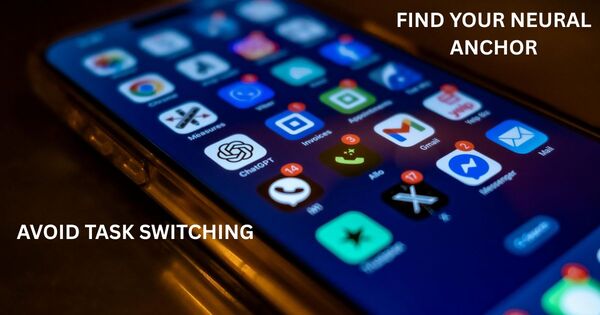
If you find yourself checking your phone halfway through the countdown, you are experiencing an attentional blink. For the 10-minute timer to act as a true neural anchor, you must eliminate task switching. Every time you glance at a digital distraction or notification, you reset the 600-second window required to suppress the default mode network and activate the Task-Positive Network (TPN). To succeed, close all browser tabs and commit to a single stream of consciousness until the alarm sounds.
Frequently Asked Questions: Why 10 Minutes is the Momentum Sweet Spot
Is a 10-minute timer enough for Deep Work?
No. Think of 10 minutes as the “Launchpad.” It is designed to bypass limbic friction, the biological resistance your amygdala generates when starting a difficult task.
How does this compare to the 25-minute Pomodoro?
The 25-minute block is for execution; the 10-minute block is for initiation. If you feel an amygdala hijack (fear of a large project), 10 minutes is short enough to feel safe for your brain yet long enough to build genuine momentum.
Can I use this for Habit Stacking?
Absolutely. Pair your 10-minute timer with a new executive function habit, like meditation or journaling, to create a consistent neural trigger that is easy to maintain without burning out.