

If you’ve tried the Pomodoro Technique for ADHD and found it didn’t stick, you’re not imagining it. The classic version, a fixed 25-minute timer, assumes the hard part is sustaining focus once you’ve started. For a lot of ADHD brains, the hard part is starting at all, and a bell going off 25 minutes later doesn’t solve that. The good news is the method isn’t a write-off, it just needs to be used differently.
This isn’t medical advice and it isn’t a treatment, it’s a practical adjustment to a time-management tool. If you’re managing an ADHD diagnosis, these ideas are worth trying alongside whatever your clinician has you doing, not instead of it.
Why the Standard Pomodoro Can Fall Short for ADHD
Psychiatrist Dr. Edward Hallowell has described the ADHD experience of time as having only two zones: “now” and “not now.” A deadline or a timer 25 minutes away doesn’t create much urgency if your brain doesn’t register it as close, which is why starting a countdown doesn’t automatically translate into starting the task.
The other common failure point runs the other way: the timer cuts you off right as you finally find focus, or a 5-minute break turns into a 40-minute detour because stopping is as hard as starting. Neither of these is a personal failing; they’re both predictable mismatches between a tool built for steady, even focus and a brain that tends to run in bursts.
Match the Timer to What You’re Actually Avoiding
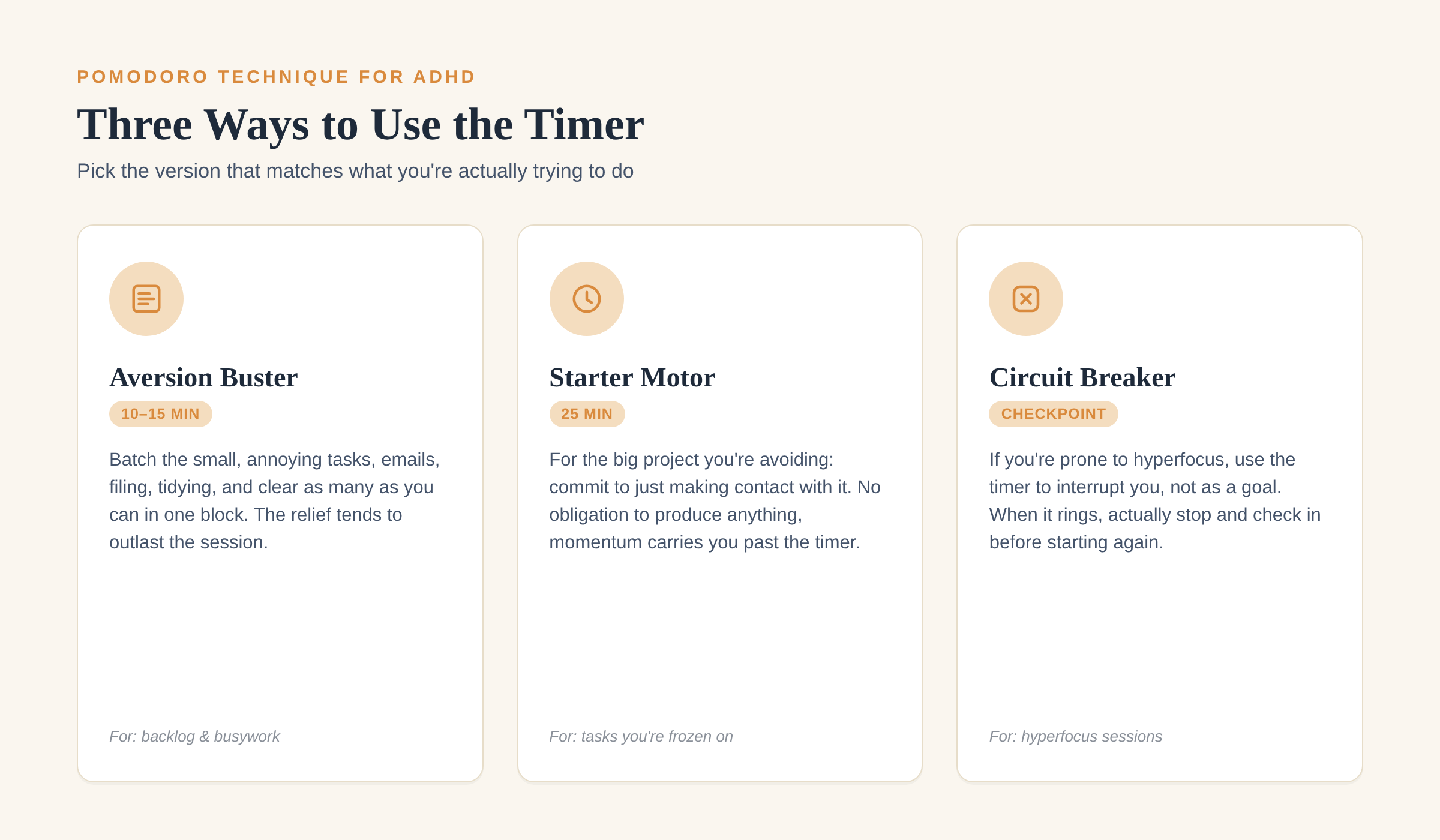
Each one works best for a different kind of stuck. Here’s what’s different about each approach
Aversion buster. This works for anything you’re dreading more than it’s actually hard: scheduling an appointment, replying to a message you’ve been avoiding, clearing a backlog of notifications, not just the obvious admin tasks. You don’t need to finish the list, just leave it shorter than it was an hour ago.
Starter motor. “Contact” can mean almost nothing: opening the file, rereading what you wrote yesterday, jotting a rough outline. The point isn’t to produce anything; it’s to break the freeze, and if you stop the second the timer ends, that still counts as a session that worked.
Circuit breaker. Treat the interruption as non-negotiable, even if it’s only thirty seconds: check whether you’ve eaten, had water, or been sitting still for hours, then decide on purpose whether to reset the timer and keep going. The decision matters more than the break itself; that’s what stops hyperfocus from running the rest of the day for you.
Adjusting the Interval Length
25 minutes isn’t a rule; it’s Francesco Cirillo’s original default, and it suits some tasks and brains better than others. If you tend to need 20 to 40 minutes just to reach real focus, a 25-minute cutoff may be working against you, a 45 to 60 minute block can suit demanding or creative work better.
Our interval timer settings guide covers how to set a custom work and break length rather than sticking with the standard 25/5.
It’s also fine to skip the timer altogether on a day when focus is already flowing. The method is there to help you start and to protect your breaks, not to interrupt something that’s already working.
Other Adjustments Worth Trying
- Add a warm-up buffer before starting the timer. If it takes you a while to settle into a task, don’t start the clock the moment you sit down. Give yourself a few unmeasured minutes to get oriented first, so that transition time isn’t eating into your focus block and making the session feel like a failure before it’s started.
- Set the interval just before your attention naturally fades, not after. If you consistently keep working past the bell or consistently lose focus before it rings, that’s useful data. Shorten or lengthen the interval to land just before the point your attention usually drops, rather than guessing at a round number.
- Treat drifting off-task as something to regroup from, not a failure. If you get interrupted or sidetracked mid-session, take a moment to reorient and continue rather than writing the whole session off. A derailed pomodoro isn’t a wasted one.
- Longer breaks only help if you can get back into focus quickly afterwards. If transitioning back from a break is its own struggle, a longer break can do more harm than good, shorter, more frequent breaks may suit you better even if it means more interruptions overall.
Adding External Urgency
Since a distant deadline often doesn’t register as urgent, adding something external, a person, a sound, a visible countdown, tends to work better than relying on internal motivation alone. Calendar blocks, reminders, and accountability check-ins with another person all serve this purpose.
One specific version worth knowing about is body doubling, working alongside another person, in person or on a video call, while you each do your own task. The other person doesn’t need to be doing the same work or even talking to you, the presence itself seems to help with starting and staying engaged. The evidence for why it works is still thin, a 2024 study found it helped participants start and finish tasks, though the research base overall is small, and it clearly doesn’t work for everyone or every task, a chatty companion or a noisy space can undo the benefit entirely.
How to Try This Week
- Pick one task you’ve been avoiding and decide which approach fits: aversion buster, starter motor, or circuit breaker.
- Set a timer length that matches the task rather than defaulting to 25 minutes. Our Pomodoro Technique guide covers the classic structure if you want a baseline to adjust from.
- Don’t assume you need silence; work in whatever environment actually helps you focus.
- If starting is the real obstacle, add a body double or a calendar block before the session, not just the timer on its own.
- At each break, notice what you actually got done (small wins count), and by week’s end notice which version you used most; that tells you more than following one method exactly.
- Mark each session as you go. If you want a simple way to track this over time, see our focus session tracking guide.
Frequently Asked Questions
Does the Pomodoro Technique work for ADHD?
It can, but usually not in its standard form. Most people who find it doesn’t work are running the unmodified 25/5 version, which assumes sustaining focus is the hard part. Adjusted versions, shorter intervals, a warm-up buffer before the timer starts, or using it to interrupt hyperfocus rather than enforce it, tend to work better.
What timer length is best for ADHD?
There isn’t one correct answer. Some people do better with very short sessions, 10 to 15 minutes, for tasks they’re avoiding, and longer ones, 45 to 60 minutes, once they’re actually in flow on demanding work. It’s worth testing a couple of lengths rather than assuming 25 minutes is right by default.
What is body doubling and does it help?
Body doubling means working near another person, in person or on a call, while each of you does your own task. Many people find the presence of another person helps them start and stay on task, though the formal research on why it works is still limited.
Why do I lose focus the moment the timer starts?
This is often a sign the real obstacle is starting, not sustaining focus, which the standard Pomodoro doesn’t address directly. The “starter motor” approach, committing to a few minutes of low-stakes contact with the task rather than a full session, tends to work better for this specific problem.
Is it bad to ignore the timer once I’m in hyperfocus?
Not necessarily, but it’s worth being deliberate about it rather than drifting past every stopping point automatically. Using the timer as a circuit breaker, a checkpoint to decide whether to keep going rather than a hard stop, keeps the benefit of hyperfocus without losing track of food, water, or other tasks entirely.
Conclusion
The Pomodoro Technique isn’t broken for ADHD, the default settings just aren’t built for it. Treat the timer as a flexible tool, shorter for tasks you’re avoiding, longer for deep work, paired with external structure like body doubling or calendar blocks when starting is the real barrier, and it becomes considerably more useful than running the same 25-minute block regardless of what you’re actually trying to do.