

Looking for a simple way to get more done in less time? The benefits of a 5-minute timer go far beyond just counting down the clock.
Whether you’re studying, working or staying on task at home, this short burst of focus can help you beat procrastination, sharpen concentration and build lasting productivity habits.
For maximum effectiveness, consider using gentle audio reminders to stay committed throughout your focused sessions.
Start Your 5 Minute Timer for Better Focus
5 Minute Timer
Table of Contents
Add This 5 Minute Timer to Your Website
Perfect for productivity, workouts, and meditation – just copy and paste:
How to Use the 5-Minute Timer
The timer is simple to use: press play, focus on a single task until the alert rings and reset when needed. For the full interactive version, use our 5-minute timer here.
Top Benefits of a 5-Minute Timer
- Boost Focus Fast: Train your brain to concentrate in short bursts without feeling overwhelmed.
- Beat Procrastination: Starting with just five minutes lowers resistance to beginning tasks.
- Increase Productivity: Small, consistent intervals add up to significant progress.
- Great for Kids & Adults: Works as a gentle motivator for children and an effective productivity hack for adults.
Using a 5-Minute Timer for “Body Doubling”
If you struggle with ADHD or “Time Blindness,” you might benefit from a technique called Body Doubling. Traditionally, this involves working alongside another person to stay on task.
However, a 5-minute timer can act as a “Digital Body Double.” Having a visible, active countdown makes your brain feel an external presence holding you accountable.
This creates a sense of urgency that helps you stay in the Task-Positive Network (TPN) and prevents you from drifting into distractions.
⏱️ 5-Minute Timer Quick Quiz
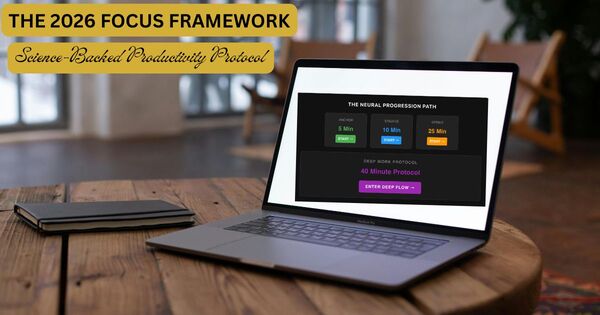
Master the 2026 Focus Framework
The 5-Minute Power Prep Checklist
- Pick ONE Task: Don’t multitask. Choose one specific thing (e.g., “Fold the laundry” or “Write the intro”).
- Clear the Visuals: Move anything off your desk that isn’t related to that one task.
- Set the Anchor: Choose your favourite alarm sound on the 5-minute timer to signal to your brain that “Work Mode” has started.
- Hit Play: Commit to staying in your seat until the chime rings.
Defeating Decision Fatigue with the “Rule of One”
One of the most overlooked benefits of a 5-minute timer is its ability to eliminate Decision Fatigue.
When we are overwhelmed, our brains enter a state of “analysis paralysis,” where the energy spent deciding what to do outweighs the energy spent doing it.
The Rule of One is a 5-minute protocol designed to bypass this mental block. Instead of looking at a massive to-do list, you set your timer and commit to one single physical movement toward a goal.
This could be as simple as opening a specific software, filing one paper, or writing one sentence.
By narrowing your cognitive field to a single 300-second window, you stop the “background noise” of other pending tasks, allowing your prefrontal cortex to lock onto a target without the stress of the “Big Picture.”
Sensory Anchoring: Choosing Your Timer Alert
To truly maximise the benefits of a 5-minute timer, you must consider the “Audio Anchor.” Not all alerts are created equal; the sound you choose dictates your brain’s response:
- High-Pitch Chimes: Best for “Urgent Admin” (emails, filing). These stimulate the sympathetic nervous system for rapid, decisive action.
- Low-Frequency Gongs: Best for “Creative Spark” (brainstorming, journaling). These encourage the Task-Positive Network without triggering a stressful “fight or flight” response.
- Visual-Only (Silent): Best for “Deep Reading.” Use a visual countdown to avoid the “startle response” that can break a fragile state of flow.
Benefits of a 5-Minute Timer for Every Environment
| Environment | 5-Minute “Micro-Win” Task |
| Office | Clear 10 emails or draft one project outline |
| Home | The “5-Minute Tidy” cleans one specific surface (sink, desk). |
| Fitness | 5-minute dynamic warm-up to prep the Task-Positive Network |
| 5-minute brain dump | The “5-Minute Tidy” cleans one specific surface (sink, desk). |
The “Autokinetic Pivot”: Re-Centreing Your Focus
Many productivity guides focus only on the mind, but the real secret lies in Neuro-Proprioception.
When you sit at a desk for hours, your brain’s “internal GPS” begins to drift, leading to what we call “Attention Decay.”
One of the most unique benefits of a 5-minute timer is its ability to trigger an Autokinetic Pivot.
By setting a 5-minute limit to perform a singular, physical task, whether it’s clearing your desk or handwriting a quick to-do list, you force your brain to re-anchor its physical and mental coordinates.
This pivot shuts down the “drifting” sensation and resets your prefrontal cortex, allowing you to return to deep work with the same mental clarity you had at the start of the day.

Short, focused sessions help the brain maintain attention and reduce fatigue. Just as the benefits of a gym clock help you maintain physical intensity, a 5-minute timer ensures your mental intensity doesn’t dip during deep work
Recent research published examined how perceived mental fatigue affects sustained attention performance, finding that understanding fatigue patterns can help develop optimised work schedules and break intervals.
By using a 5-minute timer, you tap into a method that combines motivation with structure, making tasks easier to start and finish.
Benefits of a 5-Minute Timer for Enhanced Focus and Productivity
The “Dopamine-First” Protocol for ADHD Focus
For those managing ADHD, the brain often struggles with “low tonic dopamine,” which makes starting even a simple task feel physically draining. One of the hidden benefits of a 5-minute timer is that it acts as a “Dopamine Primer.”
Because the deadline is so close (just 300 seconds), your brain releases a small burst of noradrenaline and dopamine to meet the immediate “threat” of the ticking clock.
This neurochemical shift “primes the pump,” making it significantly easier to transition into a longer 25-minute focus session once the initial 5 minutes are up
Bypassing Task Inertia with the 5-Minute Rule
The hardest part of any task isn’t the work itself, it’s the Inertia of starting. Neuropsychology suggests that our brains view large tasks as “threats,” which can trigger procrastination.
By committing to just 5 minutes, you signal to your amygdala that the “threat” is small.
Once the timer starts, your brain shifts from the Default Mode Network (mind-wandering) to the Task-Positive Network (execution).
Usually, once the 5 minutes are up, the momentum carries you forward for another 20-30 minutes of deep focus.
Ready to experience the benefits yourself? Start your 5-minute timer now and see how much you can achieve in just five minutes.
Start Experiencing the Benefits of a 5-Minute Timer Today
Benefits of 5-Minute Timer Questions & Answers
Master the Benefits of a 5 Minute Timer
This guide was developed by the 5 Minute Timer Editorial Team, specialising in neuro-productivity and behavioural focus frameworks.
By combining clinical insights into Decision Fatigue with the practical benefits of a 5-minute timer, we help thousands of users bypass task inertia and reclaim their cognitive flow.
Our mission is to provide science-backed tools that turn 300 seconds of effort into a lifetime of productive habits.