
Home Workout Routine for Beginners: 8 Easy Exercises (No Gym Required)
You’ve decided to get fit, but the thought of joining a gym makes your stomach turn.
The crowded equipment, the mirrors everywhere, the people who seem to know exactly what they’re doing, whilst you haven’t got a clue where to start.
Every home workout routine for beginners you’ve found online either assumes you already understand fitness basics or requires equipment you don’t own.
Why Home Workouts Work for Beginners
Research from the American College of Sports Medicine confirms that bodyweight training produces significant strength and fitness gains. You don’t need barbells or machines to get results.
Your body weight provides progressive resistance.
A beginner who can’t do five proper push-ups will struggle just as much as an experienced lifter struggles with heavy weights.
The challenge matches your current fitness level perfectly.
Home workouts eliminate every excuse.
No commute time.
No membership fees.
No waiting for equipment.
No self-consciousness about your fitness level.
You train when it’s convenient, in complete privacy, wearing whatever you want.
The 20-minute workout approach proves you don’t need hours in a gym. Short, intense sessions produce better results than lengthy, unfocused workouts. Consistency matters more than duration.
Essential Bodyweight Exercises Every Beginner Needs
These eight exercises form your complete home workout. Master these movements before progressing to variations.
Squats target your entire lower body whilst building core stability. Stand with feet shoulder-width apart.
Lower your hips back and down as if sitting in a chair. Keep your chest up and knees tracking over your toes.
Push through your heels to stand. That’s one rep.
Push-ups develop chest, shoulders and triceps. Start in a plank position with hands slightly wider than shoulders.
Lower your chest towards the floor, keeping your body straight. Push back up.
Can’t do a full push-up yet? Start with hands elevated on a sturdy chair or do knee push-ups. Progress gradually.
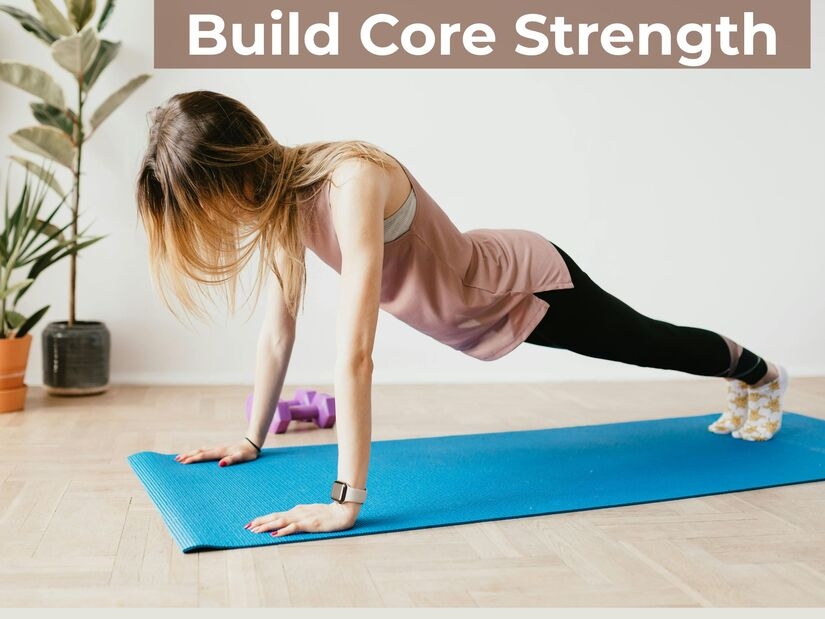
Planks build core strength that is essential for every movement. Hold a straight-body position on your forearms and toes.
Don’t let your hips sag or pike upward. Start with 20-30 seconds. Add 10 seconds weekly.
Lunges challenge balance whilst strengthening each leg independently. Step forward with one foot.
Lower your back knee towards the floor. Keep your front knee aligned over your ankle. Push back to standing. Alternate between legs.
Glute bridges activate your posterior chain, the muscles along your back. Lie on your back, knees bent, feet flat.
Lift your hips until your body forms a straight line from knees to shoulders. Squeeze your glutes at the top. Lower slowly.
Mountain climbers combine cardio with core work. Start in push-up position. Alternate driving your knees towards your chest in a running motion. Keep your core tight and hips level.
Burpees provide full-body conditioning. Stand tall. Drop into a squat, hands on the floor. Jump feet back to push-up position.
Do a push-up (optional for beginners). Jump feet forward. Jump up with arms overhead. That’s one brutal rep.
Wall sits build lower body endurance. Lean against a wall.
Slide down until thighs are parallel to the floor, as if sitting in an invisible chair. Hold this position. Your legs will burn. That’s normal.
Your First Week: The Beginner Home Workout Schedule
Start with three workout days per week. Monday, Wednesday and Friday work well. Your body needs recovery time between sessions to adapt and strengthen.
Week 1 Workout (Repeat 3x per week):
Warm-up (5 minutes):
- Marching in place: 2 minutes
- Arm circles: 30 seconds each direction
- Bodyweight squats: 10 reps
- Leg swings: 10 each leg
Main Workout (Circuit Format – 20 minutes):
Set a 20-minute timer. Complete this circuit three times:
- Squats: 10 reps
- Push-ups (modify as needed): 5-10 reps
- Plank: 20-30 seconds
- Lunges: 6 reps each leg
- Glute bridges: 12 reps
- Rest: 60-90 seconds
Cool-down (5 minutes):
- Walking in place: 2 minutes
- Basic stretching: hold each stretch 20-30 seconds
Total workout time: 30 minutes, including warm-up and cool-down.
Between workout days, stay active with gentle walking, light stretching, or activities you enjoy. Movement aids recovery without overtaxing your muscles.
Understanding Workout Timing and Intervals
The gym clock timer concept explains why workout timing matters. Intervals create structure, prevent overtraining, and ensure adequate rest between exercises.
For beginners, use moderate-paced circuit training. Complete each exercise, rest briefly and move on to the next.
This approach builds both strength and cardiovascular fitness simultaneously.
As you progress past week four, consider adding 3-minute HIIT intervals. High-intensity interval training burns more calories in less time. But first establish solid form and base fitness.
Research on HIIT training shows it produces significant fitness improvements, but it’s genuinely difficult.
Build your foundation first. You’ll know you’re ready when your Week 1 workout feels manageable.
Progressive Overload: How Beginners Get Stronger
Your body adapts to stress. This week’s challenging workout becomes next week’s warm-up. Continuous improvement requires progressive overload, gradually increasing demands on your muscles.
For bodyweight training, progression looks like:
Week 1-2: Master form, complete prescribed reps
Week 3-4: Add 2-3 reps per exercise
Week 5-6: Add a fourth circuit round
Week 7-8: Reduce rest periods by 15 seconds
Week 9-10: Progress to exercise variations (decline push-ups, jumping lunges)
Small increases compound into significant gains. Don’t rush. Proper form trumps rep count every day of the week!
Common beginner mistake: Trying to do too much too soon. Soreness is normal. Pain is not. If something hurts beyond muscle fatigue, stop and assess your form. Pushing through actual pain leads to injury, not progress.
Track your workouts in a simple notebook. Write down exercises, reps completed and how you felt. This data shows your progress and prevents stagnation.
Form Over Everything: Safety Tips for Home Workouts
Without a trainer watching, you become responsible for your own form. These cues prevent injury:
Squats: Keep your chest up throughout the movement. Your knees should track in line with your toes, not cave inward. If your heels lift off the floor, you’re going too low for your current mobility.
Push-ups: Your body should move as one solid plank. If your hips sag or your backside pokes upward, your core isn’t strong enough yet for full push-ups. Modify by elevating your hands or dropping to your knees.
Planks: Don’t hold your breath. Breathe normally whilst maintaining a straight line. If you feel pressure in your lower back, then your hips are sagging. Tighten your core and lift your hips slightly.
Lunges: Your front knee should stay behind your toes. If it shoots forward past your foot, take a longer step. Your back knee descends straight down, not forward.
Film yourself occasionally. Your phone’s self-facing camera provides immediate form feedback. Watch for the cues above.
Pain is your body’s warning system. Muscle burn during a set is fine. Sharp pain, joint discomfort or pain lasting beyond the workout indicates a problem. Stop, rest, and reassess.
Recovery and Rest Days Matter
Your muscles don’t strengthen during workouts. They strengthen during recovery. Workout stress creates tiny muscle tears. Your body repairs these tears, building slightly stronger tissue each time.
This process requires rest days. Schedule them deliberately. Don’t work out on consecutive days as an absolute beginner. Your body hasn’t adapted to training with stress yet.
Active recovery days don’t mean doing nothing. Gentle activities enhance blood flow and speed recovery:
- 20-30 minute walks
- Light stretching sessions
- Swimming or gentle cycling
- Yoga or similar gentle practices
Sleep provides your most powerful recovery tool. Research on exercise and sleep shows they create a beneficial cycle. Exercise improves sleep quality. Better sleep enhances recovery and next-session performance.
Building consistent workout habits follows the same principles as breaking bad habits; it’s about systems, not motivation. Set a specific time.
Prepare your workout space the night before. Start so small that skipping feels silly.
Common Beginner Mistakes to Avoid
Mistake 1: Skipping warm-ups. Your body performs better and reduces injury risk when properly warmed up. Always spend five minutes preparing your body for work.
Mistake 2: Comparing yourself to social media. The fitness influencers you follow aren’t beginners.
They’ve trained for years. Your Week 1 won’t look like their highlight reel. That’s completely normal.
Mistake 3: All-or-nothing thinking. Did you miss Monday’s workout? Don’t abandon the week.
Do Tuesday’s workout instead. It’s about consistency over perfection.
Mistake 4: Neglecting nutrition. You can’t out-exercise a poor diet. Focus on whole foods, adequate protein and reasonable portions. Extreme restriction undermines your training.
Mistake 5: Training through injury. That niggling pain won’t improve if you ignore it. Rest, assess, and address issues early before they become serious problems.
Mistake 6: Expecting immediate results. Noticeable changes take 4-6 weeks. Strength improvements come first. Visual changes follow. Trust the process. Track progress beyond the mirror – reps completed, exercises mastered, energy levels improved.

Frequently Asked Question
How often should beginners work out at home?
Three days per week provides optimal results for beginners. This frequency allows adequate recovery between sessions whilst building consistency.
Your muscles need 48 hours to recover and adapt after training. Working out on Monday, Wednesday and Friday gives you this recovery time whilst establishing a regular schedule.
After 8-10 weeks, you can progress to four days per week if desired.
Some beginners train too frequently, which leads to burnout and injury. Others train too infrequently to see results. Three days hit the sweet spot.
What if I can’t do a single push-up?
Most beginners are unable to do proper push-ups initially. This is completely normal. Start with incline push-ups – hands elevated on a sturdy chair, coffee table, or kitchen counter. The higher your hands, the easier the movement. Perform these for 2-3 weeks, gradually lowering hand height as you strengthen. Then progress to knee push-ups before attempting full push-ups. This progression takes most beginners 4-8 weeks. Don’t rush it. Building strength takes time.
Do I really not need any equipment?
For your first 3-4 months, absolutely not. Bodyweight exercises provide plenty of resistance for beginners. As you progress beyond the beginner stage, simple additions help,
resistance bands (£10-20), a pull-up bar (£20-30) or adjustable dumbbells (£30-100).
But these come later. Start with zero equipment. Prove consistency first. Equipment doesn’t create results – effort and consistency do.
How long until I see results?
Strength improvements come first – you’ll notice exercises getting easier within 2-3 weeks.
Physical changes (muscle definition, fat loss) take longer, typically 6-8 weeks with consistent training and reasonable nutrition.
Your body composition changes gradually. Weekly progress photos help you see changes that daily mirror checks miss.
Most beginners feel discouraged at week 4-5 when initial enthusiasm fades, but visible results haven’t appeared yet. Push through this phase. Week 8-10 is when others start noticing.
Should I do cardio separately or just work out circuits?
Circuit training provides cardiovascular benefits alongside strength training. The brief rest periods keep your heart rate elevated throughout the workout.
Dedicated cardio isn’t necessary as a beginner, though adding 2-3 weekly walks provides active recovery and additional calorie burn.
After 8-10 weeks, you can add specific cardio if desired.
Short HIIT sessions using a 3-minute timer provide maximum cardio benefit in minimal time.
What’s the best time of day to work out at home?
The best time is the time you’ll actually do it consistently.
Some people prefer morning workouts before work obligations interfere. Others have more energy in the afternoon or evening.
Experiment during your first two weeks. Notice when you feel strongest and most motivated. Schedule workouts at that time consistently.
Your body will adapt to your chosen schedule, performing better at your regular workout time.
Start Your First Workout Today
You now have everything needed to begin: eight fundamental exercises, a specific workout schedule, form cues to prevent injury, and realistic expectations for progress.
Your action plan for today:
Choose your three workout days for next week. Put them in your calendar now.
Set a 30-minute timer for your first session, this includes warm-up and cool-down. Lay out workout clothes the night before.
Remove every barrier between deciding to work out and actually starting.
Tomorrow morning, do the warm-up routine listed above. Just the warm-up.
If you want to continue, great. If not, you still built the habit.
Starting is the hardest part.
Most people fail because they try to completely transform overnight.
You’re not overhauling your entire life.
You’re adding three 30-minute sessions per week.
That’s manageable.
That’s sustainable.
That’s how real change happens.
Stop researching.
Stop comparing programmes.
Stop waiting until you have the “perfect” setup.
You have your body and a small bit of floor space.
That’s sufficient.
Start now. Your future self will thank you.

Dwayne is a productivity practitioner and the architect of the 2026 Focus Framework. As a self-taught specialist in cognitive endurance, he spent over a decade reverse-engineering task inertia and “flow-state” mechanics to create the systems found on 5 Minute Timer. Unlike theoretical consultants, Dwayne’s methodology is rooted in Neural Anchoring and zero-latency logic, practical tools developed through years of in-the-trenches testing. He specialises in helping high-performance professionals ‘drop in’ to awareness and activate the Task-Positive Network (TPN) to eliminate procrastination at the source.