Timer-Based Goal Setting: Turn Big Goals into 15-Minute Action Blocks
Most people fail to reach their goals because the finish line feels too far away. When a project feels massive, your brain triggers a resistance response, leading to procrastination and “analysis paralysis”.
The secret to breaking this cycle is timer-based goal setting. By shifting your focus from the final result to a specific, timed interval, you remove the fear of the task. Instead of “writing a book”, your goal becomes “focusing for 15 minutes”.
This approach transforms your relationship with work. It turns vague intentions into concrete, manageable sessions that build momentum. If you have struggled with traditional planning, learning how to build a daily schedule with timers is the first step toward regaining control.
The Psychological Architecture of Timer-Based Goal Setting
While traditional goal setting overemphasizes the “what,” timer-based scheduling prioritizes the temporal window. This shift is rooted in Parkinson’s Law: the observation that work expands to fill the specific duration allocated for its completion. By establishing a fixed, constrained window, you compel the brain to bypass low-value details and focus exclusively on high-impact objectives.
Psychologically, a timer serves as a sophisticated Commitment Device. Utilizing a specific “if-then” planning structure creates strong implementation intentions. This neurological anchor significantly reduces the cognitive load required to initiate a task, effectively neutralizing the common procrastination triggers associated with complex goal pursuit.
By integrating systematic intervals, you align your professional output with Biological Focus Rhythms. This ensures high-intensity cognitive work is followed by necessary recovery, preventing the neural fatigue that leads to burnout.
Beyond the Clock: The Neuroscience of Strategic Goal Blocks
Strategic Interval Theory
Effective goal setting requires more than just a countdown; it requires Neural Anchoring. Most productivity failures occur because the brain cannot sustain maximum output for undefined periods.
The Goal-Setting Power Stack:
- Activation: Use a 1 minute timer to overcome initial “Task Inertia.”
- Strategy: Use the 18-minute TED protocol for high-intensity planning.
- Execution: Use a 90 minute timer for complex project deep-work.
By utilizing these specific intervals, you synchronize your work with your Ultradian Rhythm. This ensures that every second spent on your goals is spent at peak neurological capacity, preventing the burnout that follows unmonitored sessions.
How To Get Started In 5 Minutes
- Identify one big goal that you have been avoiding for more than a week.
- Define the very next physical action required (e.g., “Open the spreadsheet” or “Draft one email”).
- Clear your desk of all distractions – put your phone in another room or on aeroplane mode.
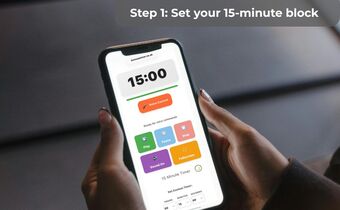
- Start a 5-minute timer to commit to just the setup and the first few steps.
- Begin the task immediately once the countdown starts; do not check your email.
- When the timer ends, decide if you have the energy to continue for a longer block.
The Goal-Achievement Matrix: Precision Intervals for Execution
The Sustained Momentum Protocol: Architectural Strategies for Peak Consistency
1. Visual Urgency and Environmental Anchoring
Maintain an unobstructed line of sight to your timer. This visual feedback loop triggers a healthy urgency response. It actively prevents Perfectionism Paralysis. Pair this with Environmental Design by associating a specific lighting setup or seating position with your work. This significantly reduces the cognitive cost of task switching.
2. Sequential Stacking
Optimize your neural energy by priming your brain for deep work. Initiate your day with a rapid-fire action block to clear administrative friction and build early wins. Once momentum is established, transition directly into your high-depth focus cycles for complex project execution. This ensures you capture your most productive cognitive windows.
3. The 80% Output Threshold
High-performance goal setting accounts for real-world volatility. Aim for an 80% Completion Rate of your planned blocks. Shift your metrics from binary task completion to Interval Volume. Audit the total number of focus sessions successfully maintained to create a data-driven view of your true productivity capacity.

Cognitive Friction: Avoiding Strategic Failures in Timed Execution
1. Underestimating Neural Ramp-Up Time
Many users set a short timer for a task that requires deep cognitive processing. This leads to immediate frustration when the alarm sounds before the brain has fully engaged. Use the first five minutes of any session specifically to gauge the true complexity of the work before committing to a final duration.
2. The Flow State Fallacy
Ignoring the stop signal because you feel focused is a primary cause of afternoon burnout. When your timer concludes, you must respect the boundary to protect your long-term energy. If you are in a productive groove, finish your current sentence or calculation and then transition immediately to a mandatory recovery period.
3. Environmental Dilution
The objective of interval-based work is absolute mono-tasking. Introducing external stimuli like phone notifications or email checks during a focus block dilutes the intensity of the work. Treat your timed window as a closed system where only the primary goal exists until the countdown reaches zero.
4. Vague Objective Assignment
Setting a timer for broad categories like “Working on my business” is too abstract for high-performance output. Define a granular, physical action for every block. Instead of general work, set the goal to draft three specific social media updates or reconcile a single financial statement to ensure the time is utilized with precision.
Adaptive Execution: Scaling Your Goal-Setting Framework
The Activation Phase: The Five-Minute Threshold
For those facing high task-initiation friction, the five-minute rule serves as a critical neurological bridge. Commit to a singular focus on your primary objective for only 300 seconds. In the vast majority of cases, the momentum generated during this micro-window effectively bypasses the brain’s resistance to complex work, naturally leading into a sustained secondary session.
The Efficiency Phase: Interstitial Timing
Busy professionals and parents should utilize the small gaps between primary commitments for rapid timed bursts. This strategy of utilizing transition periods allows you to reclaim significant productivity volume that is otherwise lost while waiting for a perfect hour-long window. These high-intensity intervals ensure professional momentum remains constant regardless of external schedule volatility.
The Mastery Phase: Bi-modal Scheduling
Advanced practitioners can implement Bi-modal Scheduling to balance intensity with recovery. This involves a strategic alternation between high-depth focus sessions and short, restorative resets. By oscillating between these two states, you maintain consistent goal progress over long durations without sacrificing mental well-being or risking neural fatigue.
Strategic Insights on Temporal Goal Setting
What is timer-based goal setting?
Q What is the psychological basis of timer-based goal setting?
Timer-based goal setting is a cognitive framework designed to combat Parkinson’s Law; the principle that work expands to fill the time available for its completion. By assigning a strict temporal boundary to a task, you force the brain to prioritize high-impact actions over low-value perfectionism. This creates a state of artificial scarcity that sharpens executive function and reduces the likelihood of procrastination.
Q Why is the 15-minute interval considered the “Gold Standard” for initiation?
A 15-minute window leverages the Ovsiankina Effect; the quasi-need to resume an interrupted or unfinished task. By using a short timer to initiate a project, you create a “tension system” in the mind. Once the timer ends, the brain remains neurologically primed to continue the work, making it significantly easier to transition into a longer focus block with minimal resistance.
Q How do I manage goals that require more than one timed session?
For complex objectives, focus on Interval Volume rather than binary completion. If a task remains unfinished when the countdown concludes, simply log the session and schedule a recovery period. This prevents neural fatigue and ensures that your next focus block begins with a refreshed cognitive capacity. Consistent effort over multiple blocks is superior to a single session of exhausted hyper-focus.
Q Why is an online timer more effective than a smartphone app for goal setting?
Using a dedicated online timer minimizes Digital Friction. Smartphones are high-distraction environments filled with social notifications and algorithmic feeds. By using a browser-based tool, you isolate your work environment and reinforce the boundary between your personal devices and your professional focus windows.

Dwayne is a productivity practitioner and the architect of the 2026 Focus Framework. As a self-taught specialist in cognitive endurance, he spent over a decade reverse-engineering task inertia and “flow-state” mechanics to create the systems found on 5 Minute Timer. Unlike theoretical consultants, Dwayne’s methodology is rooted in Neural Anchoring and zero-latency logic, practical tools developed through years of in-the-trenches testing. He specialises in helping high-performance professionals ‘drop in’ to awareness and activate the Task-Positive Network (TPN) to eliminate procrastination at the source.