
What Can You Do in 1 Minute? Your Quick Win Productivity Catalyst
1 Minute Timer
Add This 1 Minute Timer to Your Website
Perfect for quick tasks and micro-breaks – just copy and paste:
What can you do in 1 minute? More than you think. Learn how 60-second bursts overcome procrastination and transform wasted time into real progress.
Quick Summary (TL;DR)
One minute is 60 seconds. In one minute, you can send quick messages, make a few fast plans, check lots of emails or tidy your desk. Short tasks like this help you start working and stop putting things off. If you know you only need to work for one minute, it’s easy to begin and your brain doesn’t fight back.
Here’s what you’ll discover:
• Why 60 seconds triggers your brain’s action circuits, whilst longer durations activate resistance and negotiation mechanisms.
• What specific microtasks deliver measurable progress in one minute, from quick decisions to rapid workspace resets.
• How to chain 1-minute bursts into sustained productivity without the exhaustion of traditional long focus blocks..
• When ultra-short intervals beat longer sessions for habit formation, procrastination recovery and momentum building psychology.
Why 1 Minute Is Your Quick Win Catalyst
One minute helps you start work because it makes the first step really small and easy. When you only have to work for 60 seconds, your brain doesn’t resist, so you can begin without feeling stressed.
Productivity researcher BJ Fogg at Stanford’s Behaviour Design Lab discovered that behaviour change succeeds when you make actions “tiny” rather than relying on motivation or willpower.
His research demonstrates that reducing a behaviour to its absolute minimum viable form,something that can be completed in 30-60 seconds, eliminates the psychological friction that prevents action.
One minute represents this sweet spot: brief enough that resistance never activates, yet long enough to complete meaningful microtasks.
Your brain decides if a task is worth doing by quickly weighing the effort it takes against the reward. When you think about starting a big project, part of your brain (called the amygdala) notices how hard it seems and makes you want to avoid it.
A one-minute commitment doesn’t register as threatening. The effort seems negligible, so your brain’s resistance systems remain dormant whilst you begin working.
The 2024 Annual Review of Psychology shows strong evidence that dopamine helps the brain weigh effort versus reward when making decisions.
Professor John Salamone’s 2024 review establishes that mesocorticolimbic dopamine (The brain’s reward and motivation system) helps you try harder when things get tough.
The research shows that dopamine is not just a “reward chemical.” It also plays a key role in motivating you to take action and put in effort. Studies clearly show that dopamine affects how you judge the work required compared to the reward you expect.
For microtasks, this is a game-changer. When the effort feels tiny but the reward still gives your brain a dopamine boost, your brain sees the task as a win.
The research shows that 1-minute tasks work not because of willpower, but because of how your brain uses dopamine. You are using a simple dopamine rule: very little effort can still create a strong reward. In your mind, finishing a task matters more than how long it takes. Completing even a small task releases dopamine and builds motivation.
Finishing one 1-minute task gives you more motivation than starting a 30-minute task and quitting. That first minute breaks your resistance and gets you moving, which is why tiny tasks often lead to longer work sessions.
This is why micro-habits succeed while big goals often fail. You are not battling your brain’s built-in resistance. You are using your brain’s biology by making the first step so small that your resistance never shows up.
This idea has been proven in thousands of behaviour change studies. It shows that 1-minute tasks are especially helpful for people who find it hard to get started.
The Science Behind the 1-Minute Focus Window

A 2023 narrative review published in Frontiers in Behavioural Neuroscience looked at more than 20 years of brain research about how we stay motivated. Dr Aviv Weinstein studied 64 scientific papers and found that the brain’s dopamine reward system helps control motivated behaviour.
His behaviour model shows that when a task is easy enough, usually taking only 30–90 seconds, your brain will start doing it automatically, even if you are not very motivated.
One-minute tasks fit inside this “easy zone,” which is why they help you take action when longer tasks feel too hard.
The brain’s thinking centre, called the prefrontal cortex, decides whether to start a task by weighing effort versus reward. Brain scans show that thinking about hard tasks activates a part called the anterior cingulate cortex, which notices conflict and predicts effort.
If a task feels too hard, your brain wants to avoid it. Very short tasks, like 60 seconds, are so small that your brain doesn’t see them as hard, so you start right away.
Your brain uses chemicals called neurotransmitters to help you work in short bursts. Dopamine is one of these chemicals, and it helps you feel motivated to start and finish tasks. When you complete a task, even a small one in just 1 minute, your brain releases a little burst of dopamine. This gives you a quick boost and encourages you to keep working.
Unlike extended sessions where dopamine gradually depletes, chaining brief tasks creates multiple dopamine hits, sustaining motivation across longer periods through repeated reinforcement rather than sustained depletion.
Recent research shows that simple behaviours under two minutes can become automatic in about 18-22 days, much faster than complex habits, which may take months.
Frequent repetition in a stable context strengthens the automatic link between cues and actions, making short 1-minute tasks effective for quick habit formation and sustainable routines.
This is supported by a 2024 systematic review on habit formation, which emphasises realistic timelines and consistency for developing lasting behaviours https://www.mdpi.com/2227-9032/12/23/2488
What You Can Actually Accomplish in 1 Minute

Quick Decision Making and Planning Tasks
In 60 seconds of focused decision-making, you accomplish 8-12 specific planning decisions or choices that would normally scatter across an unfocused hour.
Write down your three highest-priority tasks for the day, taking 15-20 seconds per task to articulate clearly.
Pick one thing to decide before tomorrow morning. Choose the first task you will focus on. Find the one important thing or piece of info you need to move a stuck project forward. Check your calendar and mark one possible problem with your schedule that you can fix.
These rapid-fire decisions eliminate the planning paralysis that wastes hours.
You don’t have to worry about making a whole new plan or organising everything. Just make one clear choice that helps move your work forward. Being specific is what makes this short time so useful
Use our free 1-minute timer to structure these quick decision bursts without getting lost in planning rabbit holes.
Set it, make your decisions, stop when it rings.
The external boundary prevents the “planning feels like productivity” trap, where you spend hours organising instead of doing. One focused minute of decision-making beats 20 minutes of meandering task list reviews every time.
Communication and Message Management
Scan through email subject lines and flag 15-20 messages for later processing in one minute flat.
You’re not reading bodies or crafting responses; you’re triaging what deserves attention versus what gets archived.
This preliminary filtering transforms a 60-message inbox into a 12-message priority list in the time you’d normally spend deciding whether to start.
Draft one critical sentence or two for an important message you’ve been avoiding. Not the entire email.
Just the opening acknowledgement or the core request. Often, it is the only real barrier. That first sentence written removes 80% of the psychological resistance to completing the message.
Review and refine 3-4 Slack or team messages before sending, checking for tone, clarity and completeness.
Quick review prevents the multi-message back-and-forth that fragments your day.
One minute of careful sending saves ten minutes of clarification later.
This is especially helpful for communication where people don’t talk at the same time. When messages are unclear, it can cause delays and confusion.
Mastering the 1-Minute Session for Maximum Productivity
Setting Up Your Instant Action Environment
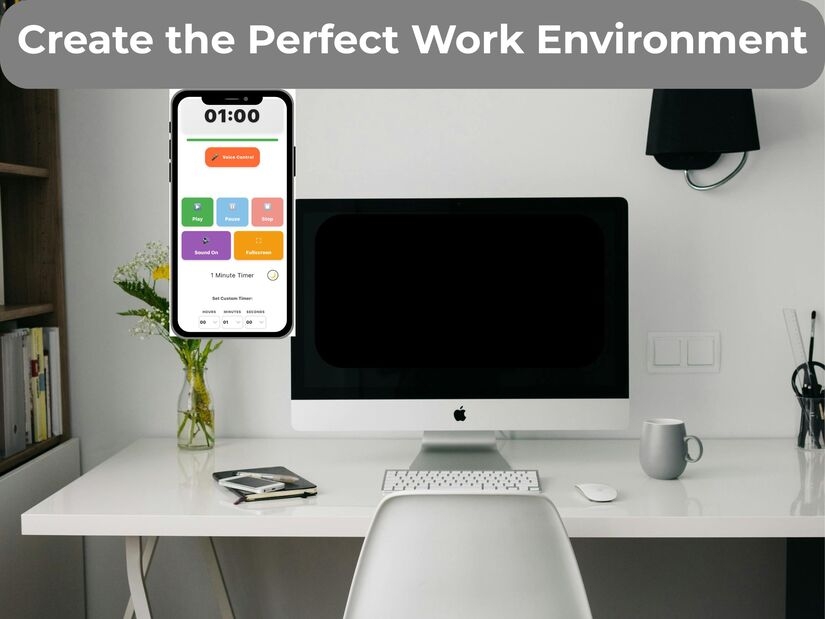
Before you start your 1-minute timer, close all tabs except the one with the timer. This cuts down distractions from many open tabs.
If you use your phone for the timer, turn on Do Not Disturb mode and silence notifications.
Keep only the timer open so you can focus better for your short work time.
Your work area also matters. Research from Princeton University shows that when your desk or space is messy, it competes for your brain’s attention and makes it harder to focus well. Learn more about this here:
Princeton Neuroscience Institute – Psychology: Your Attention, Please
Before each 1-minute burst, take 10 seconds to remove everything from your immediate desk space except what’s needed for this task.
One notebook, one pen, one screen. Nothing else visible. This is backed by research from the Princeton Neuroscience Institute, which shows that having too much clutter makes your brain work harder and makes focusing harder.
Pre-session rituals for ultra-short work need radical simplification. You don’t have time for elaborate preparation.
The ritual becomes: timer visible, task defined in six words or fewer, one deep breath, start.
This 10-second sequence signals focused mode without burning precious seconds from your actual work window.
After two weeks of repetition, this micro-ritual triggers focus automatically.
Real-World Example
I struggled with starting my writing projects for months. The moment I sat down, my brain would flood with reasons why I wasn’t ready: more research needed, the outline wasn’t perfect, wrong time of day. Procrastination masked as preparation.
Previously, I’d try forcing myself into 90-minute writing sessions, which triggered massive resistance and usually ended with me checking my email instead. Now, I set our 1 minute timer and commit to writing the first paragraph. That single minute bypasses all the resistance.
The paragraph gets written. That’s 60 seconds that previously would have vanished into task-switching or planning loops. After finishing that first minute, I’m usually warmed up enough to continue for 20-30 minutes naturally.
The secret wasn’t building more discipline or finding more motivation. It was making the starting threshold so small that my brain’s resistance systems never activated.
How Habits Form: What Recent Research Shows
A study published in December 2024 shows how habits form over time. The researchers looked at many health studies from six big databases. They found that simple habits taking less than two minutes become automatic much faster than complex ones.
Habits form gradually, not all at once. Doing the habit often in the same situation helps it become automatic faster. For short 1-minute tasks, you can do them 8-10 times a day without stopping your routine.
This frequent practice with consistent reminders helps habits develop in weeks, not months.
The study also showed that the old idea of habits forming in 21 or 66 days isn’t true. Instead, how long it takes depends on how complicated the habit is and how long it takes to do.
Short tasks become habits faster because they are easier for your brain to handle
Building Your 1-Minute Session Practice Over Time
Week 1-2: Establishing the Microtask Foundation
Complete 8-10 separate 1-minute bursts throughout your day, targeting dead time like waiting for meetings to start, coffee brewing, or file downloads. Don’t chain them yet. Each burst stands alone. Track completions with simple tick marks in a notebook. Your goal is to prove that 1-minute commitments actually happen, building evidence that you’ll honour these tiny promises to yourself.
Week 3-4: Introducing Intentional Chains
Begin linking 1-minute tasks into 5-minute chains: five consecutive bursts with 30-second pauses between them. This teaches your brain that small commitments can extend without becoming overwhelming.
Try morning routine chains: 1 minute clearing desk, 1 minute inbox triage, 1 minute priority setting, 1 minute calendar review, 1 minute tool preparation.
You’re building stamina whilst maintaining the psychological safety of ultra-short commitments.
Week 5-8: Integration with Longer Sessions
Use 1-minute bursts as momentum starters before longer focus blocks. Set a 1- minute timer to write your first paragraph before transitioning to a 25-minute session.
This “warm-up minute” eliminates the cold-start resistance that prevents longer focus sessions from beginning. You’re creating a reliability bridge between intention and action.
Month 3+: Strategic Microtask Deployment
At this mastery stage, 1-minute sessions become precision tools for specific scenarios: breaking procrastination on stalled projects, capturing value from transition time and recovering focus after interruptions.
You’re no longer questioning whether a minute matters. You’ve accumulated dozens of hours of completed microtasks that would have otherwise vanished.
Consider exploring our 5-minute timer for slightly longer microtasks or our 25-minute timer when you’re ready to extend focus duration whilst maintaining structured boundaries.
Tracking Your Microtask Success for Continuous Improvement
Track completion rate rather than quality for 1-minute tasks.
Your metric is simple: did you do the thing when the timer rang? Yes or no. Record this immediately after each session in a simple spreadsheet or notebook.
After two weeks, you’ll have 50-100 data points revealing patterns about when and where you actually follow through versus when you don’t.
Pattern recognition emerges faster with microtasks than with longer sessions because you accumulate more data points rapidly. Notice which times of day produce 90%+ completion rates versus which produce 40%.
Notice which task types you consistently complete versus which you abandon.
This data reveals your actual behavioural patterns, not your aspirational ones. Morning 1-minute sessions might have 95% completion, whilst afternoon attempts fail 70% of the time. That’s actionable intelligence.
Optimisation becomes straightforward with clear data. If morning microtasks succeed and afternoon ones fail, schedule all 1-minute bursts before lunch.
If planning tasks succeed but communication tasks fail, you’ve identified where resistance actually lives. Adjust your approach based on evidence rather than theory.
Double down on what works. Eliminate what doesn’t. After four weeks of tracking, you’ll understand your microtask psychology better than years of untested experimentation.
Troubleshooting Common 1-Minute Session Challenges

One Minute Feels Too Short for Real Work
This concern reflects a productivity myth: only extended sessions produce meaningful results. Challenge this assumption with data.
One focused minute of decision-making eliminates more procrastination than 30 minutes of task-list reorganisation.
Writing just one sentence to start your message or story can break the block that’s stopping you. These small actions have a big impact, even if they only take a short time.
Consider what actually prevents progress on most projects: not the time required for completion, but the resistance preventing initiation. Large tasks trigger avoidance, whilst tiny tasks trigger action.
When you need to start rather than finish, 1-minute intervals are precisely the right tool. They solve the actual problem, which is beginning, not the imagined problem of insufficient time.
For tasks that genuinely require extended focus, 1-minute sessions serve as momentum starters, not complete solutions. Use a quick 60-second burst to write your first paragraph, then naturally extend into a longer session once inertia breaks.
Many people find that committing to “just one minute” leads to 20-30 minute sessions because starting was the only real barrier.
You can also explore our 20 minute timer for tasks needing moderate focus or our 1 hour timer when you’re ready for deeper work blocks.
The key is matching the tool to the problem. One-minute sessions excel at initiating action and capturing tiny time windows. They’re not designed to replace deep work. They’re designed to make deep work possible by eliminating the starting friction that prevents it.
I Can’t Stay Focused Even for 60 Seconds
If you can’t focus for one minute, it’s usually because of your surroundings or how you think about the task, not because you can’t.
People can pay attention to things they care about for longer than one minute.
The key is to make your task clear and simple. Saying “work on the project” is too vague and makes your brain wander.
But saying “write three bullet points for section two” is clear and easy to focus on. When you have a clear goal, your brain knows exactly what to do. Learn more about how attention works from the Princeton Neuroscience Institute.
Biological factors impact attention, even briefly. If you slept less than six hours, consumed excessive caffeine, created anxiety or ate a heavy meal, triggering digestive redirection of blood flow, sustained attention becomes difficult regardless of duration.
Address the root cause: sleep, nutrition and stress management. No technique compensates for exhausted biology.
Start with 30-second commitments if 60 feels genuinely impossible. Build from where you are, not where you think you should be.
You should complete five consecutive 30-second bursts with perfect focus before attempting full minutes.
Prove to yourself that you can do this. That evidence becomes the foundation for progressive extension. Success breeds capability, not the other way around
What’s Your 1-Minute Mastery? Take the Quick Knowledge Check
1 Minute Timer Productivity Quiz
Test your knowledge about the science of quick productivity wins
Frequently Asked Questions About 1-Minute Focus Sessions
How long is 1 minute in seconds?
One minute equals exactly 60 seconds. This might seem obvious, but understanding the exact duration matters for structuring effective microtasks. In 60 seconds, you can write 150-250 words of quick messaging, make 8-12 specific planning decisions, or complete 10-15 rapid organisation actions.
The key is treating these 60 seconds as a complete productivity unit with clear beginning and end points, not a vague, brief moment.
When you approach one minute with structure and intention, it transforms from “barely any time” into a powerful tool for building momentum, decision-making and procrastination elimination.
Is 1 minute long enough to accomplish anything meaningful?
Yes, when you define “meaningful” correctly. One minute isn’t sufficient for completing complex projects, but it’s perfect for initiating them, which is where most productivity fails.
Breaking procrastination, making a critical decision, drafting the first sentence of a difficult message, flagging priority emails from noise these actions have leverage far exceeding their 60-second duration.
The real barrier to most work isn’t time availability; it’s starting resistance. One-minute commitments bypass resistance by making the threshold vanishingly small.
That first minute often naturally extends into 20-30 minutes once inertia breaks. Even when it doesn’t, you’ve captured value from a time window that would otherwise vanish into distraction or indecision.
How many 1-minute tasks can I do per day sustainably?
Most people can sustain 40-60 separate 1-minute bursts throughout a day before experiencing decision fatigue or reduced effectiveness. However, optimal implementation isn’t about maximising count.
Use 1-minute sessions strategically: momentum starters before longer focus blocks (3-5 per day), decision-making bursts during transition periods (8-12 per day) and procrastination breakers when stuck (as needed).
Quality beats quantity. Ten focused 1-minute tasks, completing specific microtasks, produce far more value than fifty scattered attempts lacking clear objectives. Track your completion rate rather than attempting arbitrary daily targets.
What should I do during breaks between 1-minute tasks?
For isolated 1-minute bursts, breaks aren’t necessary because 60 seconds of focus doesn’t deplete cognitive resources meaningfully. Move to your next activity or task.
However, if you’re chaining multiple 1-minute sessions together (creating 5-10-minute focus blocks), take 30-60 second micro-breaks between them. Stand up briefly, take three deep breaths, look away from your screen at something 20 feet distant, or do quick shoulder rolls.
These aren’t recovery periods like breaks after extended focus sessions. They’re brief resets preventing the accumulated tension that develops when you maintain rigid posture and visual fixation across multiple consecutive minutes.
Can I extend my sessions if I’m in flow after 1 minute?
Absolutely, and you should. The purpose of 1-minute commitments is to eliminate starting resistance, not impose arbitrary stopping points. When the timer rings after 60 seconds, assess your state honestly. If you’ve built momentum and clarity, continue naturally for however long feels productive—often 15-30 minutes.
The timer succeeded: it got you started by making it feel manageable. If you feel scattered or the task reaches a natural pause point, stop as planned.
The key distinction: you’re free to continue but never obligated to. This asymmetry is crucial. Easy to start, optional to extend. That structure eliminates the pressure that triggers avoidance whilst preserving flexibility for genuine flow states.
Why use 1-minute sessions instead of longer intervals like Pomodoro’s 25 minutes?
Different durations serve different purposes strategically. Use 1-minute sessions when starting resistance is your primary barrier, when you’re capturing value from brief waiting periods or transitions, when building new micro-habits requiring minimal friction, or when recovering from procrastination and need quick wins for momentum.
Use longer intervals like our 25-minute timer for sustained focus work, complex task completion, deep learning sessions or creative work that may require extended context building.
The tools aren’t competing; they’re complementary.
Many productive people use 1-minute bursts to initiate momentum, then naturally extend into 25-90 minute focus blocks once inertia breaks.
Match duration to the problem: ultra-short for initiation, extended for completion.
Start Mastering 1-Minute Focus Sessions Today

One minute makes starting work easy because it feels so simple. When your task only takes 60 seconds, your brain doesn’t fight it, and you can begin without delay.
This time frame is backed by science as being short enough to avoid feeling like hard work, making it ideal for anyone who struggles to start or keep going. Learn more about how attention works at the Princeton Neuroscience Institute..
1. Set your free 1 minute timer right now and commit to completing just one specific microtask before reading further. Choose something you’ve been avoiding, like drafting a difficult first sentence or making a single planning decision.
2. Define your microtask with precision using six words or fewer; vague intentions produce wandering, whilst specific actions produce completion in brief windows.
3. Track every 1-minute session completion with a simple tick mark in a notebook for two weeks to build evidence that you honour these micro-commitments to yourself.
4. Take your micro-break only if chaining multiple sessions; otherwise, move immediately to your next activity, since 60 seconds doesn’t deplete focus meaningfully.
5. Commit to 8-10 separate 1-minute bursts tomorrow targeting transition periods and dead time that currently vanish into phone checking or indecision.
6. Use our free 1-minute timer with customisable alarms, fullscreen mode for distraction elimination, and voice control to maintain zero-friction access for rapid microtask deployment throughout your day.
Try Our Free 1 Minute Timer with Alarm:

Dwayne is a productivity practitioner and the architect of the 2026 Focus Framework. As a self-taught specialist in cognitive endurance, he spent over a decade reverse-engineering task inertia and “flow-state” mechanics to create the systems found on 5 Minute Timer. Unlike theoretical consultants, Dwayne’s methodology is rooted in Neural Anchoring and zero-latency logic, practical tools developed through years of in-the-trenches testing. He specialises in helping high-performance professionals ‘drop in’ to awareness and activate the Task-Positive Network (TPN) to eliminate procrastination at the source.