
Best Study Techniques: 8 Science-Backed Methods to Learn Faster
You’ve got a massive biology exam in two weeks. You’ve been using what you think are the best study techniques, rereading your notes for hours, highlighting important passages, making flashcards.
You feel busy, productive even.
But when you try to recall the material later, your mind goes blank.
Here’s the uncomfortable truth: most popular study techniques don’t actually help you learn.
Research from psychological science shows that rereading, highlighting and passive review rank among the least effective methods for long-term retention. Your brain needs something completely different.
This guide covers eight study techniques with actual scientific backing. Not the methods your teachers suggested or what feels productive in the moment, but strategies proven to help you learn faster and remember longer.
I tested all of these during my own academic struggles. The ones that worked transformed how I approached learning.
The ones that didn’t, taught me why productivity feels different from actual progress.
Why Most Study Methods Fail
Your brain doesn’t work like a hard drive, where you can just copy information.
Dr Barbara Oakley’s research on learning shows that understanding requires your brain to build neural connections through active engagement, not passive absorption.
The illusion of competence hits hardest with rereading.
It feels familiar, so you assume you know it. However, cognitive psychology research demonstrates that recognition and recall are distinct mental processes.
Let’s fix that with techniques that actually engage your brain.
1. Active Recall: Make Your Brain Do the Work
Stop reviewing your notes. Close them completely and try to write down everything you remember about the topic.
This feels harder than rereading because it is indeed more challenging. That difficulty is the entire point.
Research by Roediger and Karpicke found that students who used retrieval practice scored 50% higher on final tests compared to those who studied the material multiple times.
Here’s how to implement it: After reading a section, close your book and spend 5-10 minutes writing or speaking everything you can recall.
Don’t peek. The struggle to remember is what builds stronger memory traces.
Set a 40-minute timer for your study session.
When it rings, close your materials and spend the next 5 minutes doing pure recall.
Write what you remember, check what you missed, then repeat.
The gaps in your knowledge become immediately obvious. That’s the feedback you need.
2. Spaced Repetition: Time Your Reviews Strategically
Cramming the night before an exam is incredibly inefficient. Your brain needs time between exposures to move information from short-term to long-term memory.
Hermann Ebbinghaus’s forgetting curve shows that we forget about 70% of new information within 24 hours unless we review it.
But here’s the key: each time you successfully recall something, the retention interval gets longer.
Review new material after 1 day, then 3 days, then 7 days, then 14 days. This spacing effect makes information stick without endless repetition.
Use a 5-minute timer for quick daily review sessions. Five minutes of spaced recall beats an hour of last-minute cramming every single time.
3. The Pomodoro Technique: Maintain Peak Focus
Your attention span isn’t infinite. Fighting to stay focused for 3-hour stretches makes studying feel torturous and reduces how much you actually absorb.
Research on cognitive load shows that focused work in shorter bursts, followed by genuine breaks, produces better retention than marathon sessions.
The Pomodoro method is simple: 25 minutes of focused study, 5-minute break, repeat. After four cycles, take a longer 15-20 minute break.
During your 25-minute block, you’re fully engaged with one topic. No phone, no switching tabs, no distractions. When the 25-minute timer rings, you actually take the break. Your brain needs that downtime to consolidate what you just learned.
The technique works because it matches your natural attention capacity while providing structured rest.
4. Elaborative Interrogation: Ask “Why” Constantly
Don’t just memorise facts. Question why they’re true and how they connect to what you already know.
Research published in Psychological Science shows that students who explain the reasoning behind concepts rather than just memorising them score significantly higher on comprehension tests.
For every concept you study, ask:
Why is this true?
How does this connect to other things I know?
What would happen if this were different?
If you’re studying photosynthesis, don’t just memorise the equation. Ask why plants need light, how the process relates to cellular respiration and what would happen to oxygen levels if photosynthesis stopped.
This deeper processing creates more neural connections, making the information easier to recall later.
5. Interleaving: Mix Up Your Practice
Studying one topic until you’ve mastered it, then moving to the next, sounds logical. It’s also wrong.
Research on learning strategies demonstrates that mixing different topics or problem types during study sessions leads to better long-term retention and transfer compared to blocked practice.
Instead of doing 20 algebra problems, then 20 geometry problems, alternate between them.
Your brain has to work harder to identify which strategy applies to each problem.
That extra cognitive effort feels less smooth. You’ll probably get more wrong during practice. But you’ll remember more when it counts.
Use a 20-minute timer and divide it into four 5-minute segments, each covering a different topic or problem type. The switching forces your brain to stay actively engaged.
6. Practice Testing: Simulate Exam Conditions
Taking practice tests isn’t just an assessment; it’s one of the most powerful study techniques available.
Research on learning strategies ranking study strategies found that practice testing produced the highest learning gains across different subjects and student populations
The testing effect works for two reasons: it forces retrieval practice (which strengthens memory), and it exposes what you actually don’t know (which directs future study).
Find or create practice questions that match your exam format.
Set a 1-hour timer and take the practice test under realistic conditions. No notes, no pausing, no looking things up.
After the timer rings, grade yourself honestly. The questions you missed show you exactly where to focus your next study session.
7. Self-Explanation: Teach the Material Out Loud
The Feynman Technique asks you to explain a concept as if teaching it to someone with no background knowledge.
Cognitive science research shows that students who explain concepts aloud demonstrate 30-40% better understanding compared to those who review silently.
Pick a concept and literally speak it out loud. Explain it completely, using simple language. When you get stuck, that’s where your understanding breaks down.
Go back to your materials for those specific gaps, then try explaining again. Repeat until you can teach the entire concept without hesitation or referring to notes.
This technique reveals a superficial understanding immediately. You can’t fake your way through speaking a complete explanation.
8. Dual Coding: Combine Words and Visuals
Your brain processes visual and verbal information through different channels. Using both creates stronger, more retrievable memories.
Research on learning and memory demonstrates that students who combine verbal explanations with visual representations retain significantly more information than those using either approach alone.
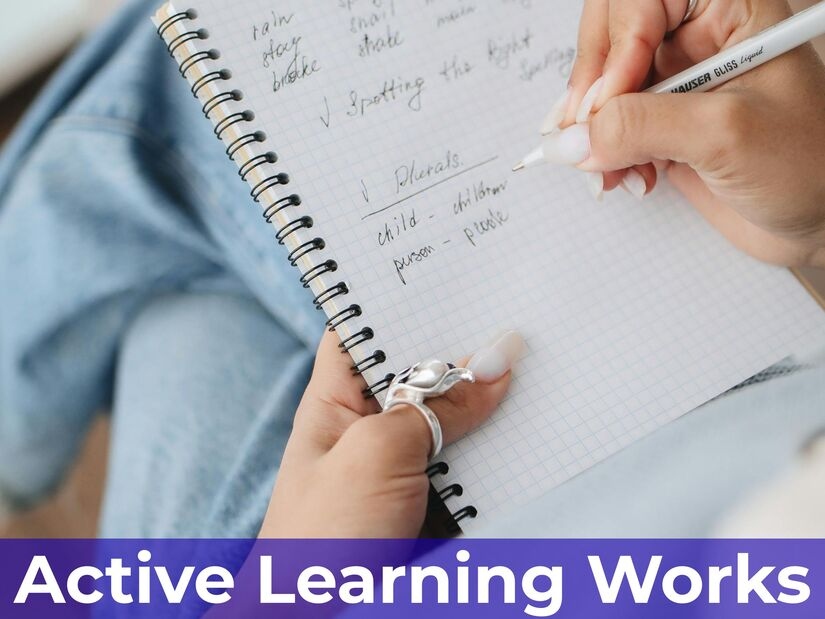
This doesn’t mean mindlessly copying diagrams. Create your own visual representations of concepts: mind maps, flowcharts, simple sketches that show relationships.
For processes, draw each step. For hierarchies, create branching diagrams. For comparisons, build tables or Venn diagrams.
The act of translating verbal information into visual form forces deeper processing. When you recall the concept later, you can pull from either the verbal or visual memory, doubling your retrieval paths.
If you’re covering multiple related topics, use a 90-minute timer to create comprehensive visual summaries.
That focused time produces more useful study materials than hours of passive note-taking.
Combining Techniques for Maximum Impact
The real power comes from using multiple techniques together. Here’s a practical study session framework that combines several methods:
Hour 1: Read new material actively, taking notes in your own words. Ask “why” questions as you go (elaborative interrogation + dual coding).
5-minute break: Actual break, not phone scrolling.
Hour 2: Close your notes and write everything you remember (active recall). Check what you missed and study those gaps specifically.
5-minute break
Day 2: Quick review using a 2-minute timer (spaced repetition).
Day 4: Practice problems mixing different topics (interleaving + practice testing).
Day 8: Teach the material out loud (self-explanation).
This approach feels more demanding than passive review. That’s because your brain is actually working to build lasting understanding rather than just creating the illusion of learning.
For guidance on optimal study session length based on the material complexity, check out how long a focus session should be. Different subjects and cognitive loads require different time blocks.
Common Study Mistakes to Avoid
Mistake 1: Highlighting everything important. Highlighting is passive. It doesn’t force retrieval or deeper processing. Stop highlighting, start recalling.
Mistake 2: Rereading until it feels familiar. Familiarity isn’t understanding. Close the book and see what you actually remember.
Mistake 3: Studying the same way for every subject, Math needs practice problems. History needs connections and context. Biology needs both memorisation and conceptual understanding. Match your technique to the material.
Mistake 4: Skipping breaks because you’re “on a roll” Your brain needs downtime to consolidate memories. Pushing through diminishing focus wastes time.
Mistake 5: Cramming instead of spacing. Cramming gets you through tomorrow’s quiz. Spaced repetition gets you through the final exam and helps you actually remember the material long-term.

FAQ: Best Study Techniques
How long should I study each day?
Quality matters more than quantity. Two focused hours using active recall and spaced repetition beats six hours of passive rereading every time.
Break your study time into 25-50 minute blocks with breaks between. Most students find 3-4 hours of genuine focused study per day sustainable, but this varies based on your schedule and the material’s difficulty.
The key is maintaining full attention during study blocks rather than half-focused marathon sessions.
Which study technique is most effective?
Research by cognitive psychologists consistently ranks practice testing and active recall at the top.
These techniques force your brain to retrieve information, which strengthens memory far more than passive review.
Spaced repetition comes in second, as it optimises when you review material for maximum retention.
The most effective approach combines multiple techniques: use active recall during study sessions, space your reviews over days and weeks and test yourself under exam-like conditions.
How many times should I review material before an exam?
Follow the spacing effect: review new material within 24 hours, then after 3 days, 7 days, and 14 days.
Each successful retrieval strengthens the memory and extends the next optimal review interval.
You don’t need endless repetition; you need strategically timed retrieval.
For exam preparation, do at least three spaced reviews plus one practice test under realistic conditions.
The last review should be 1-2 days before the exam, not the night before.
Is it better to study one subject at a time or mix subjects?
Mixing subjects produces better long-term retention than blocked practice, according to learning science research.
While it feels less smooth during practice, it forces your brain to discriminate between problem types and builds a more flexible understanding.
Study one subject for 25-40 minutes, switch to a different subject, then return to the first.
This approach works especially well for subjects with problem-solving components like math, physics or chemistry.
What should I do during study breaks?
Move your body and rest your eyes. Walk around, stretch, get water, or step outside.
Avoid screens during short breaks, as they keep your brain in the same processing mode as studying.
For 5-minute breaks between Pomodoro sessions, physical movement helps your brain consolidate what you just learned.
For longer 15-20 minute breaks after several study blocks, you can have a snack or chat with someone.
The break should feel genuinely restful, not just switching to a different form of mental stimulation.
Can I study effectively with background music?
Research on cognitive load shows that music with lyrics interferes with reading comprehension and memorisation because language processing conflicts with studying verbal material.
Start Using Science-Backed Study Methods Today
The techniques in this guide aren’t revolutionary or complicated. They’re just what cognitive science has proven actually works.
The difference between struggling students and successful ones often isn’t intelligence or time invested.
It’s using methods that align with how your brain actually learns rather than what feels productive in the moment.
Start with one technique. Try active recall for your next study session.
Set a 25-minute timer, study the material, then close everything and write what you remember.
Notice how much harder it feels than rereading. Notice how much more you actually retain.
Then add spaced repetition. Then interleaving. Build gradually until these techniques become your default approach to learning anything.
Your study habits determine your results. Make them count.

Dwayne is a productivity practitioner and the architect of the 2026 Focus Framework. As a self-taught specialist in cognitive endurance, he spent over a decade reverse-engineering task inertia and “flow-state” mechanics to create the systems found on 5 Minute Timer. Unlike theoretical consultants, Dwayne’s methodology is rooted in Neural Anchoring and zero-latency logic, practical tools developed through years of in-the-trenches testing. He specialises in helping high-performance professionals ‘drop in’ to awareness and activate the Task-Positive Network (TPN) to eliminate procrastination at the source.