
How Long Should a Focus Session Be? The Science-Backed Answer for Peak Productivity
2 Hour Timer
You sit down to work, determined to be productive. Twenty minutes later, you're checking your phone.
An hour passes and you've made little progress. The problem isn't your willpower. It's your approach to focus session timing.
Everywhere you look, productivity experts offer conflicting advice. Pomodoro advocates swear by 25-minute sprints. Deep work enthusiasts like Cal Newport recommend 4-hour blocks.
Meanwhile, neuroscience research points to 90-minute ultradian cycles. No wonder you're confused about the right approach.
TL;DR
Most people perform best with 60-90 minute focus sessions that match your brain's natural ultradian rhythms. Beginners should start with 25-45 minutes and build progressively. Complex creative work thrives with 2-hour blocks, but requires training. Your optimal duration depends on task complexity and current capacity. Use the timer above to track sessions and build capacity systematically.
Here's what you'll learn: the biological science behind optimal focus duration, how to identify your personal sweet spot based on task type and experience level and how to progressively build your concentration capacity from beginner to expert.
So how long should a focus session be? The answer depends on your brain's natural rhythms and the complexity of your task, it's more trainable than you think.
Your brain operates in natural 90-120 minute performance cycles called ultradian rhythms.
For deep work on complex tasks, 2-hour sessions align perfectly with these cycles and prevent costly context-switching.
Use our 2-hour timer to track these extended focus blocks without breaking concentration to check the clock.
Beginners should start with 25-45 minute sessions and progressively build capacity.
Match your duration to task complexity: quick tasks need 25-45 minutes, learning requires 60-90 minutes, and creative or analytical work thrives with 120-minute blocks.
Start where you are, track your focus quality and add 10-15 minutes weekly as you improve.
Why Focus Session Length Matters for Your Productivity
The Science Behind Ultradian Rhythms
Your brain doesn't maintain constant energy throughout the day. Sleep researcher Nathan Kleitman discovered ultradian rhythms, which are natural 90-120 minute performance cycles that govern everything from sleep patterns to concentration capacity.
During these cycles, your brain moves through peaks of alertness followed by natural dips requiring recovery.
When you focus intensely, your brain consumes glucose and depletes neurotransmitters like dopamine and norepinephrine.
After 90-120 minutes, these resources need replenishment. Fighting against this biological rhythm is like trying to sprint a marathon. You'll burn out quickly and produce mediocre work.
New research shows that your brain works best in cycles of about 90 minutes. When you match your work sessions to these natural brain rhythms called ultradian rhythms, you can focus better and feel less tired.
Scientists have found that taking breaks at the right times during these cycles helps you stay productive throughout the day.
Your productivity isn't just about effort. It's about working with your biology rather than against it.
Finding Your Optimal Focus Duration
Task complexity determines your ideal session length more than any other factor. Writing a novel demands different cognitive resources than answering emails.
Complex problem-solving, creative work and analytical tasks require extended periods to build and maintain context in your working memory.
Individual variation matters too. Your current experience level, sleep quality, circadian rhythm and even what you ate for lunch affect focus capacity.
I've tested everything from 15-minute sprints to 4-hour deep work marathons across different times of day and task types.
The pattern is clear: extended sessions work brilliantly for complex work, but only after you've built the capacity.
Your optimal duration isn't fixed. It evolves as your attention strengthens through consistent practice, just like cardiovascular endurance improves with regular training.
What's Your Ideal Focus Session Length? Take the 60-Second Assessment
Master Focus Session Length
Test Your Knowledge of Science-Backed Focus Duration
![Person in deep concentration looking down while working, demonstrating focused mental state and brain's natural ultradian rhythm during productive work session
```
**Character count:** 166 characters ✅
---
## **Title:**
```
Your Brain's Natural Rhythm
```
**Alternative:**
```
Deep Focus and Natural Brain Rhythms
```
---
## **Caption (Short - for social media/WordPress):**
```
Deep focus in action. Your brain operates in natural 90-120 minute performance cycles called ultradian rhythms. Working with these biological rhythms—not against them—is the key to sustained productivity.
```
**Character count:** 217 characters ✅
---
## **Caption (Medium - for article context):**
```
Understanding your brain's natural rhythm: This moment of deep concentration illustrates the focused mental state that occurs during peak ultradian cycles. Your brain moves through 90-120 minute performance windows followed by natural recovery periods. Aligning your focus sessions with these biological rhythms maximizes concentration and prevents cognitive fatigue.
```
**Character count:** 382 characters ✅
---
## **Description (Long - for image library/metadata):**
```
Close-up portrait of a person in a state of deep concentration and focus while working. The subject's downward gaze and contemplative expression capture the intense mental engagement characteristic of productive focus sessions. This image represents the concept of ultradian rhythms—the natural 90-120 minute performance cycles discovered by sleep researcher Nathan Kleitman that govern concentration capacity and brain function. The photograph illustrates the importance of understanding your brain's biological patterns to optimize work session duration. The focused, introspective moment demonstrates the quality of attention achievable when working in alignment with your natural cognitive rhythms rather than against them. Ideal for articles about focus management, productivity science, deep work strategies, and brain-based time management.
```
**Character count:** 769 characters ✅
---
## **WordPress Image Settings:**
**File Name:**
```
brain-natural-rhythm-deep-focus-concentration.jpg
```
**Title Field:**
```
Your Brain's Natural Rhythm
```
**Alt Text Field:**
```
Person in deep concentration looking down while working, demonstrating focused mental state and brain's natural ultradian rhythm during productive work session
```
**Caption Field:**
```
Deep focus in action. Your brain operates in natural 90-120 minute performance cycles called ultradian rhythms. Working with these biological rhythms is the key to sustained productivity.
```
**Description Field:**
```
Close-up of person in deep concentration illustrating ultradian rhythms and natural brain performance cycles during optimal focus work session.
```
---
## **Social Media Variations:**
### **Instagram Caption:**
```
This is what deep focus looks like 🧠✨
Your brain doesn't maintain constant energy all day. It operates in natural 90-120 minute performance cycles called ultradian rhythms.
The secret to sustainable productivity?
→ Work WITH these cycles, not against them
→ Match session length to your brain's natural rhythm
→ Take recovery breaks when your brain needs them
Stop fighting your biology. Start optimizing it.
Full guide to finding your perfect focus session length 👆 [link in bio]
#DeepFocus #Productivity #BrainScience #UltradianRhythms #FocusSessions #TimeManagement #WorkSmart
```
### **Twitter/X:**
```
Your brain operates in 90-120 minute performance cycles 🧠
This is deep focus in its natural state.
The productivity hack? Work WITH your biology, not against it.
How to find your optimal focus session length 👇
```
### **LinkedIn:**
```
The Science of Deep Focus
This moment captures something crucial about productivity: true focus isn't about willpower—it's about biology.
Your brain operates in natural 90-120 minute performance cycles called ultradian rhythms. During these windows, your concentration peaks. Between them, your brain needs recovery.
Most productivity advice ignores this biological reality. That's why forcing 4-hour "deep work" sessions often backfires, while strategic 90-minute blocks produce breakthrough results.
The key? Align your focus sessions with your brain's natural rhythm, not arbitrary time blocks.
Read the full science-backed guide 👉 [link]
#ProductivityScience #FocusManagement #DeepWork #BrainOptimization #WorkStrategy
```
### **Pinterest Description:**
```
Your Brain's Natural Focus Rhythm | Understanding ultradian rhythms for optimal productivity. Discover the science behind 90-120 minute performance cycles and learn how to align your focus sessions with your brain's biological patterns. Science-backed strategies for deep work, sustained concentration, and preventing cognitive fatigue. #productivity #focussessions #brainscience #deepwork #timemanagement #workoptimization
```
---
## **Image Context in Article:**
**Placement suggestion:**
Use this image right after introducing the concept of ultradian rhythms in your article, where you write:
> "Your brain doesn't maintain constant energy throughout the day. Sleep researcher Nathan Kleitman discovered ultradian rhythms..."
**In-article caption:**
```
Deep concentration during peak ultradian rhythm: Your brain's 90-120 minute performance cycles determine optimal focus session length.](https://5minutetimer.co.uk/wp-content/uploads/2025/10/2_optimized_150.jpg)
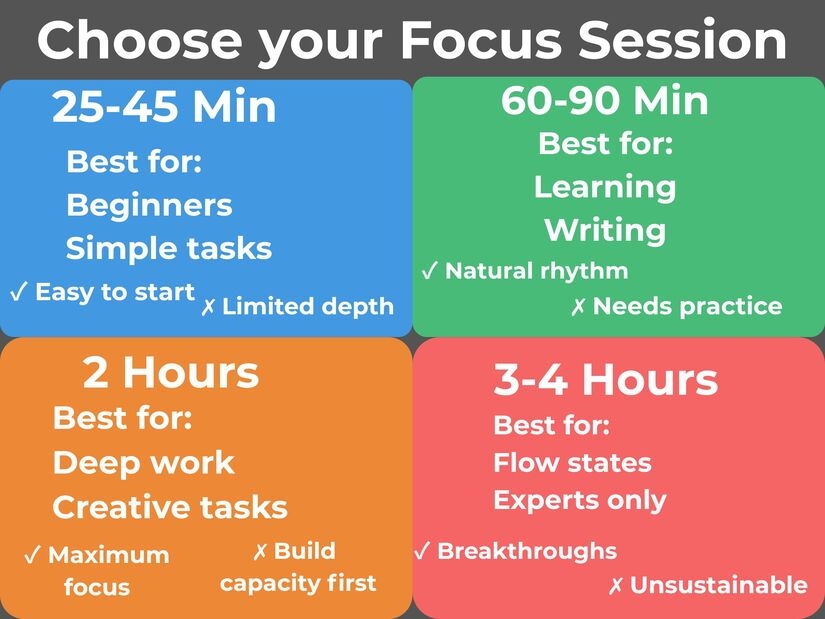
The Four Focus Session Lengths That Actually Work
Short Sessions (25-45 Minutes): The Beginner's Choice
The Pomodoro Technique made 25-minute sessions famous for good reason.
This duration works brilliantly when you're building new focus habits, tackling simple tasks or working in high-distraction environments.
Your untrained attention span naturally wavers after 20-30 minutes, making this a sustainable starting point.
Short sessions excel for routine work: emails, scheduling, light editing or administrative tasks. They're also perfect for days when you're tired, stressed or recovering from illness. The frequent breaks prevent overwhelm and maintain motivation.
However, short sessions have serious limitations for complex work. Every time you stop and restart, you lose 20-30 minutes to context-switching.
That means reloading all the details you were juggling in working memory. For deep thinking, 25 minutes barely gets you warmed up before the timer interrupts your flow.
Medium Sessions (60-90 Minutes): The Sweet Spot for Most People
This duration aligns with your first complete ultradian cycle before energy naturally dips.
Research shows cognitive performance peaks during 60-90 minute windows, making this the sweet spot for focused work that requires sustained attention but doesn't demand hours of deep immersion.
Medium sessions work beautifully for learning new material, writing articles or reports, analytical work, planning projects, and creative tasks with clear milestones.
You get enough time to build momentum and make real progress without pushing past your biological limits.
Most knowledge workers find 60-90 minutes sustainable for 2-3 sessions daily. This provides 3-4.5 hours of focused work, often more productive than 8 hours of fragmented attention.
Extended Sessions (2 Hours): When Deep Work Demands More
Here's where productivity transforms. Two-hour sessions match your complete ultradian cycle of 90-120 minutes, providing enough time to fully immerse in complex work without breaking the delicate web of context you're building in your mind.
Complex problem-solving, creative projects, software development, research analysis, and strategic planning all thrive in 2-hour blocks.
When you're juggling multiple variables, exploring different approaches or crafting something intricate, every interruption costs 20-30 minutes of context rebuilding.
Cal Newport's research on deep work demonstrates that knowledge workers produce exponentially better results in extended, uninterrupted sessions compared to fragmented time.
I've experienced this difference firsthand. Writing a technical article in six 25-minute sessions produces disjointed, surface-level work.
Writing the same article in one 2-hour session yields cohesive, insightful content because my mind maintains all the connections simultaneously.
To experience the benefits of extended focus without clock-watching, try our free 2 hour timer with built-in alarms and voice control.
Ultra-Long Sessions (3-4 Hours): The Expert Territory
Some people enter flow states lasting 3-4 hours, producing their best creative work during these extended periods. However, research shows cognitive performance declines significantly after 120 minutes for most tasks and most people.
Reserve ultra-long sessions for rare circumstances: finishing a critical deadline, riding an unexpected wave of creative inspiration or tackling a once-yearly deep analysis project.
Don't make 4-hour sessions your daily standard. The diminishing returns and accumulated fatigue aren't sustainable.
For 95% of knowledge work, 2 hours represents the optimal ceiling where quality meets sustainability.
Mastering Your Chosen Focus Session Duration
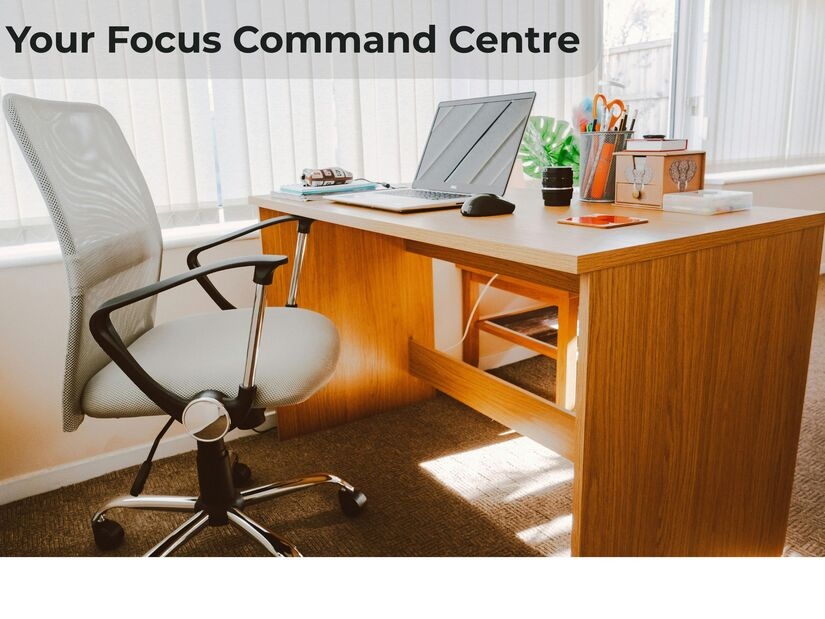
Creating Your Distraction-Free Environment
Environment shapes focus more than willpower ever will. Research shows that having your phone in another room, at least 3 metres away, reduces checking urges by 60% compared to having it face down on your desk. Physical distance matters.
Close all browser tabs except those essential for your current task. Use website blockers like Freedom or Cold Turkey during focus sessions. Studies suggest moderate background noise around 70 decibels, like a coffee shop, enhances creativity for some people, while others need complete silence. Test both.
Temperature affects cognition more than you'd expect. Keep your workspace between 20-22°C for peak mental performance.
Warmer temperatures trigger drowsiness, while cold environments distract with discomfort.
Set up a pre-session ritual: close unnecessary tabs, silence phone, clear your desk, grab water, and spend 5 minutes defining what success looks like for this session. These small actions signal your brain that it's time to focus.
Best Tasks for Different Session Lengths
Creative work, such as writing, design or content creation, benefits enormously from 2-hour blocks. You need extended time to explore ideas, make connections, and refine your output.
Context-switching destroys the creative state because you lose the mental model you're building.
Complex problem-solving, whether debugging code, analysing data or developing a strategy, requires sustained attention to hold multiple variables in working memory simultaneously.
For projects like software development, research analysis, or strategic planning, use our 2 hour timer to maintain the deep context necessary for breakthroughs.
Learning and studying work best in 60-90 minute sessions. This duration allows proper encoding into long-term memory without mental fatigue that impairs retention.
Break complex subjects into focused study blocks rather than marathon cramming sessions.
Administrative tasks, emails, scheduling and quick communications need only 25-45 minutes. Batching these during shorter sessions prevents them from fragmenting your day and reserves extended blocks for work that truly demands deep thinking.
Sustaining Energy Throughout Your Session
Hydration affects cognitive performance significantly. Drink 250ml of water before starting your session, then take small sips throughout.
Even mild dehydration at 2% body weight impairs concentration and working memory.
Eat a light protein snack 30 minutes before extended sessions. Aim for 15-20g of protein from sources like Greek yoghurt, nuts or eggs. This provides steady glucose without the crash that follows sugary snacks or heavy meals.
Avoid large meals 60-90 minutes before deep work because digestion redirects blood flow from your brain to your stomach.
Change your posture every 30 minutes. Stand up briefly, adjust your sitting position or shift your weight.
Physical stagnation creates mental stagnation.
Practice the 20-20-20 rule: every 20 minutes, look at something 20 feet away for 20 seconds to prevent eye strain and mental fatigue.
Approach your session with progressive intensity. Start at 60-70% effort while you're warming up.
Peak around the 60-minute mark when you're fully immersed. Then finish strong in the final 20-30 minutes, knowing rest is coming.
This pacing prevents early burnout and maintains quality throughout.

Building Your Focus Capacity Over Time
Starting Point: Where Beginners Should Begin
Don't start with 2-hour sessions if you currently struggle to focus for 30 minutes. Build capacity gradually through progressive training over 12-16 weeks.
Week 1-2: Complete four 25-minute sessions daily with 5-minute breaks between them. Focus on consistency rather than duration. Track each session with a simple tick mark.
Week 3-4: Extend to three 45-minute sessions daily. You're building endurance while maintaining high focus quality. Notice how the additional 20 minutes feels. It should be challenging but achievable.
Week 5-8: Shift to two 60-minute sessions daily. You'll likely notice significant improvements in work quality as you have time to truly immerse yourself in tasks. Maintain 15-minute breaks between sessions.
Week 9-10: Progress to two 75-minute sessions daily. You're approaching the ultradian rhythm sweet spot. Some tasks that previously required multiple sessions now fit comfortably in one block.
Week 11-12: Achieve two 90-minute sessions daily. This is sustainable for most knowledge workers long-term and covers the majority of deep work needs.
Month 4+: Once you've consistently maintained 90-minute sessions with high focus quality, 8 out of 10 or better on a subjective scale, use our 2 hour timer to tackle your most demanding deep work projects like creative writing, complex analysis or strategic planning.
Progressive Training for Extended Focus
Add 10-15 minutes to your longest session each week, not each day. Your attention capacity needs recovery time between challenges, just like your muscles need rest days between strength training sessions.
Track your subjective focus quality on a 1-10 scale after each session. If your score drops below 7 out of 10 for three consecutive sessions, you've progressed too quickly. Return to the previous duration for another week before attempting to extend again.
Research on neuroplasticity confirms that attention is trainable through consistent practice. Your prefrontal cortex literally strengthens its ability to sustain concentration when you regularly challenge it at the edge of your current capacity.
Think of each focus session as a workout for your brain.
Don't push duration every single day. Intersperse challenging long sessions with easier, shorter ones. This variation prevents burnout and maintains long-term sustainability. Some days call for 3-4 shorter sessions rather than extended blocks. Honour your energy levels.
Recognising When to Adapt Your Duration
Warning signs of over-extension appear clearly if you pay attention. Irritability during or after sessions, headaches, declining work quality, increased procrastination, or resistance to starting all indicate you've pushed too far too fast.
Shorten your sessions when you're experiencing high stress, poor sleep (less than 7 hours), illness or especially distracting circumstances.
Better to complete excellent 45-minute work than mediocre 2-hour work. Flexibility beats rigid adherence to arbitrary systems.
Seasonal energy variations affect focus capacity. Many people find extended sessions easier in cooler months than during hot summers.
Women may notice that focus fluctuates with menstrual cycle phases, with higher capacity during the follicular phase and slightly lower during the luteal phase. Adapt your expectations accordingly rather than fighting biology.
The goal is sustainable high-quality focus, not suffering through arbitrarily long sessions because a system tells you to. Listen to your body and mind more than any external rule.

Recovery and Transitions Between Sessions
Optimal Break Strategies After Focus Sessions
Break duration should match session intensity.
After 25-45-minute sessions, take 5-10-minute breaks.
After 60-90 minute sessions, take 15-20 minute breaks.
After 120-minute sessions, take 20-30-minute breaks to properly recover.
Research from Stanford University demonstrates that active recovery produces significantly better cognitive restoration than passive screen time.
A 10-minute walk outdoors boosts creative thinking by 60% compared to sitting. Movement increases blood flow to your brain and triggers neurochemical changes that enhance subsequent focus.
Active recovery options ranked by effectiveness include 10-minute outdoor walks, which provide nature exposure for additional cognitive benefits. Try 5-7 minute stretching routines targeting neck, shoulders and back.
Brief social interaction about non-work topics helps, genuine conversation rather than small talk. Looking at natural scenery through windows or tending to plants also provides restorative benefits.
Avoid passive recovery traps that provide zero mental restoration. Scrolling social media maintains cognitive load and doesn't allow your attention systems to rest.
Checking email keeps you in work mode and prevents true recovery. Reading news articles continues to demand focused attention when you need genuine rest.

Scheduling Multiple Sessions Daily
Maximum sustainable deep focus for most knowledge workers is 2-3 extended sessions totalling 4-6 hours of concentrated work.
Beyond this, quality drops precipitously, and you're just accumulating fatigue without proportional output.
Morning versus afternoon performance follows predictable patterns. Most people experience peak cognitive performance 2-4 hours after waking, making this ideal for your most demanding session.
Energy naturally dips in early afternoon, around 2-3 pm for most, then rises again in late afternoon. Schedule your hardest work first when willpower and focus are strongest.
Space extended sessions with a minimum of 2-hour gaps between them. Attempting back-to-back 2-hour sessions without substantial recovery leads to rapidly declining quality in the second session.
Better to do two excellent 2-hour blocks with proper breaks than three mediocre ones.
Weekly limits matter for sustainability. Don't attempt three 2-hour sessions daily for seven consecutive days because you'll burn out quickly.
Most people thrive with 2-3 deep sessions 4-5 days weekly, with lighter schedules on remaining days for recovery and administrative work.
Transition Rituals That Work
Spend 5 minutes at the end of each session capturing where you'll start next time.
Write down your exact next step, any open loops still in your mind and quick wins from the session. This prevents the anxiety of wondering where you were when you return.
Make a deliberate physical state change. Stand up, walk to a different room or step outside briefly.
This signals your brain that the focused work period has ended and recovery has begun. Your environment should shift along with your mental state.
Mental reset techniques prepare you for breaks or next sessions. The 4-7-8 breathing method works brilliantly: inhale for 4 counts, hold for 7 counts, exhale for 8 counts. Repeat 3-4 times.
This activates your parasympathetic nervous system and reduces accumulated stress.
Quick meditation of just 2-3 minutes provides measurable cognitive benefits. Use a guided app like Headspace or simply sit quietly focusing on your breath.
Gratitude reflection, noting 1-2 wins from your session, creates positive associations with deep work and increases motivation for future sessions.
Troubleshooting Common Focus Session Challenges
I Can't Focus for More Than 20 Minutes
This is completely normal if you're just beginning focused work practice. Your attention span is trainable, but it starts wherever you currently are, not where you think it should be.
Research on cognitive training shows that sustained attention capacity improves significantly within 4-6 weeks of consistent practice.
Start with achievable durations rather than aspirational ones. If 20 minutes is your current limit, begin with 15-minute sessions to build confidence and consistency. Success breeds motivation for progression.
Check environmental factors systematically.
Is your phone truly out of reach, not just face-down nearby?
Are browser tabs closed except for essential ones?
Is your workspace reasonably organised? Often, focus struggles stem from the environment rather than the capability.
Sleep quality is non-negotiable for concentration. If you're sleeping less than 7 hours nightly, no productivity technique will fully compensate.
Prioritise sleep as your foundational focus intervention before worrying about session duration.
Nutrition timing affects focus significantly. Heavy meals 60-90 minutes before work sessions redirect blood to digestion rather than cognition. Light protein 30 minutes before provides steady energy without crashes.
My Mind Wanders Even in Short Sessions
Distinguish between task clarity problems and attention problems. If you're unclear about what success looks like, your mind wanders searching for direction.
Spend 5 minutes before each session defining specific outcomes. "Write introduction section" works better than "Work on article."
Goal-setting research demonstrates that specific, challenging goals dramatically improve sustained attention compared to vague intentions. Your brain focuses better when it knows exactly what it's pursuing.
Meditation training transfers powerfully to work focus. Even 10 minutes daily of focused breathing practice strengthens your ability to notice mind-wandering and redirect attention. Think of meditation as strength training for your concentration muscle.
Break large tasks into smaller sub-goals that fit within your session. Working toward "Complete rough draft" feels overwhelming in 45 minutes. Working toward "Write three paragraphs explaining concept X" provides clear direction and achievable progress.
Approach your work with curiosity rather than obligation. Frame sessions as exploring interesting problems rather than grinding through requirements. Intrinsic interest sustains attention far better than external pressure.

When Should I Push Through vs Take a Break?
Use the 40% productivity drop rule. If your output quality declines 40% from your peak during the session, stop immediately. More time won't improve results. You're just accumulating fatigue while producing mediocre work.
Physical discomfort always trumps arbitrary time goals. Back pain, eye strain, or headaches signal you've exceeded your current capacity.
Pushing through these warnings doesn't build resilience. It creates injury and negative associations with deep work.
Research confirms steep diminishing returns after 90-120 minutes for complex cognitive work. Your best thinking happens in the first 90 minutes of sustained focus.
The additional 30 minutes to reach 2 hours still produces value, but extending to 3+ hours usually wastes time that would be better spent recovering for another quality session.
Listen to your body and mind more than the clock. Some days you're sharper and can sustain longer. Other days, 45 excellent minutes beats forcing 120 mediocre ones. Quality always beats arbitrary duration.
Adapting Pomodoro for Extended Sessions
Micro-breaks within 2-hour blocks maintain freshness without breaking deep focus. Take 2-3 minute pauses at the 45-minute and 90-minute marks during extended sessions. These aren't full breaks, just brief resets.
During micro-breaks: stand, take 5-10 deep breaths, look away from your screen, stretch your neck and shoulders. What you don't do matters more.
Don't check your phone, read emails, or switch contexts. Stay in your work environment and maintain mental continuity.
Set a 2 hour countdown timer with interval alarms at 45 and 90 minutes to remind yourself to take brief micro-breaks without losing focus.
This hybrid approach combines Pomodoro's restorative pauses with deep work's extended immersion. You get the biological benefits of movement and visual rest without the cognitive costs of complete context switches.
Some people need micro-breaks while others find them disruptive. Experiment to discover your preference.
The goal is maintaining your highest quality output, not adhering to someone else's system.
Achieving Flow State in Extended Sessions
Flow, the state of complete absorption where time disappears and work feels effortless, requires specific conditions. Your task must match your skill level with slight challenge.
Too easy creates boredom.
Too difficult creates anxiety.
The sweet spot is 10-15% beyond your comfortable capability.
Clear goals with immediate feedback loops enhance flow. Knowing exactly what you're creating and seeing progress in real-time keeps you engaged. This is why coding often produces flow because the compiler immediately shows if your work functions.
Eliminate external interruptions with zero tolerance. Flow states take 15-20 minutes to achieve but break instantly with disruptions.
During deep work sessions, silence everything. Research by Mihaly Csikszentmihalyi, who first studied flow extensively, confirms that even anticipated interruptions prevent flow from forming.
Single-tasking is non-negotiable for flow. Your brain cannot maintain the deep immersion of flow while juggling multiple contexts. One complex task per extended session, nothing more.
Environmental consistency triggers flow more easily. Same place, same time, same setup creates neurological associations. Your brain learns "when I'm here, I focus deeply" and enters flow states faster over time.
Quality beats quantity always. One 2-hour session in genuine flow produces more valuable output than three mediocre 2-hour sessions of distracted work. Protect the conditions that create your best thinking.

Start Your Optimised Focus Practice Today
Different tasks and experience levels require different session durations. Research supports 90-120 minute sessions for deep work, perfectly aligning with your brain's ultradian rhythms.
However, starting with achievable 25-45 minute sessions builds sustainable habits without overwhelming your current capacity. Progressive training allows anyone to reach 2-hour capacity within 3-4 months of consistent practice.
Quick action steps:
Start by timing your next work session to assess current capacity honestly. Choose a starting duration based on current ability, not aspiration. Most beginners thrive with 25-45 minutes.
Set up a truly distraction-free environment with the phone in another room, notifications silenced and the desk cleared.
Schedule strategic recovery breaks matched to session length, typically 15-20 minutes after 90+ minute sessions.
Track focus quality on a simple 1-10 scale to guide progression decisions. Add 10-15 minutes weekly when you're consistently scoring 8+ on focus quality.
Ready to experience the power of extended focus sessions? Our 2 hour timer is specifically designed for deep work with features that eliminate distractions. Fullscreen mode removes visual clutter.
Customisable alarms mark optional micro-breaks.
Voice control means you never break concentration to adjust settings. Thousands of knowledge workers, students and creators use it daily to protect their most valuable creative time and produce their best work.
Your focus capacity isn't fixed. It's trainable through consistent practice. Start with achievable sessions that match your current ability. Honour your recovery periods as much as your work sessions.
Gradually build toward 2-hour deep work blocks over 3-4 months. The productivity gains, creative breakthroughs and satisfaction of sustained concentration are worth every minute of practice.

Frequently Asked Questions
Q: How long should a focus session be for beginners?
Start with 25-45 minute sessions and gradually increase over time. Your attention capacity is trainable like any other skill, but it begins wherever you currently are, not where you think it should be. Most beginners can handle 3-4 sessions of this length daily before experiencing mental fatigue. After maintaining this consistently for 2-3 weeks, try extending to 60 minutes and assess how your focus quality holds up.
Q: Is a 2 hour focus session better than multiple shorter sessions?
For deep work requiring complex thinking, yes. Extended sessions prevent context-switching costs that waste 20-30 minutes every time you stop and restart.
For projects like software development, research analysis, or creative writing, a 2 hour timer eliminates fragmentation and allows deep immersion in challenging work.
However, shorter sessions work better for routine tasks, administrative work, or when you're still building focus capacity. Match your session length to task complexity and your current ability.
Q: How many focus sessions can I do per day?
Most people can sustain 2-3 deep focus sessions lasting 90-120 minutes each before quality declines significantly. That's 4-6 hours of concentrated work daily, often more productive than 8 hours of fragmented attention. Beyond this, you experience steep diminishing returns and accumulate fatigue without proportional output. Respect your cognitive limits to avoid burnout and maintain consistency over weeks and months rather than burning out after a few days of unsustainable effort.
Q: What should I do during breaks between focus sessions?
Take 15-20 minute breaks after 90-minute sessions to properly restore cognitive capacity. Walk outside for 10 minutes if possible. Research shows outdoor walking boosts creativity by 60% compared to sitting. Stretch your body, have a light protein snack, or engage in genuine conversation with someone. Avoid screens and social media entirely during breaks because they don't allow mental recovery despite feeling like rest. Physical movement and nature exposure prepare your brain optimally for your next session.
Q: Can I build up to 2 hour sessions gradually?
Absolutely, and gradual progression is far more sustainable than forcing extended sessions before you're ready. Start with 25-45 minutes for weeks 1-2, progress to 60-75 minutes in month one, reach 90 minutes consistently in month two, then graduate to 120-minute capacity in month 3-4. Add 10-15 minutes weekly when your focus quality remains high, 8 out of 10 or better. Once you've built this capacity through progressive training, you'll find complex work that previously felt overwhelming now fits comfortably in extended deep work blocks.
Q: What types of work are best suited for longer focus sessions?
Creative projects, complex problem-solving, software development, research and analysis, strategic planning, and detailed writing all benefit enormously from 90-120 minute blocks. These tasks require sustained context because you're building an intricate mental model that takes time to construct and shatters easily with interruptions. Conversely, save emails, scheduling, quick communications, and routine administrative work for shorter 25-45 minute sessions between your deep work blocks. Match duration to cognitive demand rather than using one-size-fits-all timing for everything.

Dwayne is a productivity practitioner and the architect of the 2026 Focus Framework. As a self-taught specialist in cognitive endurance, he spent over a decade reverse-engineering task inertia and “flow-state” mechanics to create the systems found on 5 Minute Timer. Unlike theoretical consultants, Dwayne’s methodology is rooted in Neural Anchoring and zero-latency logic, practical tools developed through years of in-the-trenches testing. He specialises in helping high-performance professionals ‘drop in’ to awareness and activate the Task-Positive Network (TPN) to eliminate procrastination at the source.





Thanks for the marvelous posting! I quite enjoyed reading it, you might be a great author.I will make certain to bookmark your blog and may come back down the road.
I want to encourage you to definitely continue your great work, have a nice evening!