
Professional 90 Minute Timer
The 90-Minute Limit: Why Mental Fatigue Reduces Decision Quality
After sustained high cognitive load, mental fatigue can reduce attention, error detection and decision quality. Research on cognitive fatigue shows that prolonged effort is associated with lower executive and attention efficiency.
By respecting the 90-minute hard stop, you avoid the Wired-Tired trap, a state where you feel mentally active but are actually just repeating low-value cognitive loops. This timer ensures you exit the session while your decision-making integrity is still high, preserving your energy for the next peak cycle.
You glance at the clock and realise a complete 90-minute focus session has just flown by. Most people assume 90 minutes is either too long to maintain concentration or too short to accomplish meaningful work.
Science reveals that this duration aligns perfectly with your brain’s natural energy cycle. It is the optimal timeframe to produce your best work without experiencing burnout.
Performance Restoration Protocol
Spend 5 minutes of your break doing a physical, non-digital task, like making coffee or stretching, to re-ground your nervous system.
Physically leave the room where you worked. This Context Switch signals to your brain that the high-arousal work state is officially over.
Why 90 Minutes is Your Brain’s Sweet Spot
90 minutes isn’t some random time period; it’s exactly how long your brain’s natural work cycle lasts.
Scientific Discovery: The Ultradian Rhythm
Researcher: Nathan Kleitman, University of Chicago (1960s)
What he found: Your brain doesn’t work at the same level all day. Instead, it goes through 90-120 minute cycles of high and low energy, both when you’re sleeping and when you’re awake.
Why this matters: The 90-minute sleep cycle is well established. Whether the same clean cycle holds during waking hours is less settled, some research finds evidence for ultradian patterns in daytime attention, but the sharp “peak at 30-40 minutes, decline at 75-85 minutes” breakdown isn’t something the research actually pins down that precisely. Treat 90 minutes as a practical, well-reasoned starting point rather than a hard biological law.
Source: National Institutes of Health – Basic Rest-Activity Cycle research →

Around 30-40 minutes in, you hit your peak; this is when you’re thinking your best.
By 75-85 minutes, the wave starts to come down as your brain chemicals get used up and you naturally need a break.
Here’s the essential part: you’re not lazy or weak when you can’t focus after 90 minutes. Your brain is working exactly how it’s supposed to.
Your dopamine (the focus chemical) starts running low, your brain uses up its quick energy and waste products build up. Trying to push through this is like trying to hold your breath forever; it just doesn’t work.
What This Means for You
Schedule your hardest work in 90-minute blocks. You’ll get more done in three focused 90-minute sessions than you would in 8 hours with constant interruptions.


The Science That Proves 90 Minutes Works
Dr Gloria Mark from the University of California, Irvine, conducted groundbreaking research on workplace interruptions that reveals exactly how much cognitive damage constant disruption causes. Her team tracked knowledge workers for years, monitoring every task switch between apps, projects, and activities to measure the precise time and mental energy cost of each interruption.
💡 Pro-Tip: Master the art of the long-form sprint.
A 90-minute block is the gold standard for high-level creative and analytical output. To ensure you make the most of this significant time investment, pair your timer with the strategies found in our guide, Deep Work Techniques: 4 Scientific Rules for High-Intensity Focus.
Why 90-Minute Uninterrupted Blocks Win
People who worked in uninterrupted 90-minute blocks produced significantly better work than those constantly interrupted. This aligns perfectly with the neuroscience of ultradian rhythms—when you protect your full focus window, you maximise dopamine and norepinephrine levels for deep thinking and breakthrough creativity.
The Compound Effect of Interruptions
If you’re interrupted every 20-30 minutes (a common pattern in modern work):
- You never complete a full 90-minute ultradian focus cycle
- You’re spending 23+ minutes recovering after each interruption
- Your neurotransmitter levels never reach optimal, sustained levels
- You miss the window for deep connection-making and breakthrough thinking
How to Protect Your 90-Minute Windows
Based on Dr Mark’s findings:
- Block communication during your 90-minute focus sessions (email, messages, calls)
- Close unnecessary apps to prevent visual distractions
- Communicate boundaries to colleagues about your deep work times
- Schedule interruptions intentionally outside your focus windows
- Take real breaks after 90 minutes to reset rather than forcing continued work
The science is clear: protecting your 90-minute uninterrupted focus blocks is one of the highest-impact productivity changes you can make.
The Shocking Discovery: 23 Minutes to Recover
After just 20 minutes of interrupted work, it takes an average of 23 minutes to refocus and return to your original task fully. This means interruptions don’t just steal the time you spend switching, they permanently erode your cognitive performance for nearly half an hour afterwards.
Dr Mark’s research measured two critical costs:
- Time cost: The actual minutes spent switching tasks
- Attention residue: The mental energy your brain continues spending on the previous task, reducing capacity for the new one

Dr Gloria Mark’s research reveals the hidden price of interruptions
Your brain needs time to build what scientists call a “task set”, basically, the complete picture of what you’re working on.
This includes all the details, connections and variables you need to hold in your mind at once. Building this mental picture takes real time and sustained attention, so losing it partway through costs you more than just the minutes you were interrupted for.
When you get interrupted before the 90 minutes are up, you destroy this mental picture and have to rebuild it.
That’s why checking your phone “just for a second” actually costs you 20-30 minutes of good work time.


How Dopamine and Norepinephrine Drive Your 90-Minute Focus Window
Neuroscience research on attention and focus confirms that two critical brain chemicals, dopamine and norepinephrine, regulate your ability to maintain deep concentration.
These neurotransmitters are genuinely involved in sustained attention, but there isn’t solid research pinning their decline to exactly 90 minutes. Treat the 90-minute window as a practical guideline shaped by real biology, not a precise chemical countdown.
The Science Behind Your 90-Minute Focus Cycle
During this 90-minute window, your brain operates at its cognitive best:
- Multiple complex ideas: You can process and integrate several sophisticated concepts simultaneously
- Cross-connection thinking: Your brain makes connections between different topics, enabling breakthrough insights
- Deep focus maintenance: Sustained attention needed for breakthrough thinking remains stable
- Optimal neurotransmitter levels: Dopamine (motivation and reward) and norepinephrine (alertness and attention) peak together
What Happens After 90 Minutes
When dopamine and norepinephrine levels naturally drop, your brain sends a clear signal: it’s time to rest. This decline is not a failure—it’s your brain’s built-in mechanism indicating you need:
- A physical break
- Movement or walking
- Social interaction (talking to someone)
- Switching mental gears to a different type of task
Why This Supports 90-Minute Work Sessions
Working in alignment with these ultradian rhythms means:
- Maximising your peak neurotransmitter window for cognitively demanding work
- Taking breaks when chemicals drop rather than forcing continued focus
- Using movement and social interaction to reset dopamine and norepinephrine levels
- Avoiding burnout by respecting your brain’s natural rest-activity cycle
This neuroscience validates the productivity principle: work deeply for 90 minutes, then take a genuine break to recharge before your next focus cycle.
Why 90 Minutes Works Better Than Shorter Sessions
When you work in 90-minute focus blocks, you give your brain enough time to:
- Enter deep flow state: It typically takes 15-20 minutes to immerse yourself in complex work fully. Shorter sessions, like the popular 25-minute Pomodoro method, interrupt this process before you reach peak productivity.
- Solve complex problems: Complex problem-solving and creative thinking require sustained mental immersion. The 90-minute window allows you to work through multiple layers of a problem without interruption.
- Build creative connections: Your brain needs time to connect disparate ideas and generate innovative solutions. This creative synthesis happens during extended periods of focused attention.
- Reduce cognitive switching costs: Every time you stop and restart work, your brain pays a “switching cost” in terms of mental energy and time. Longer sessions minimise these transitions.
Who Benefits Most from 90-Minute Sessions?
This approach is ideal for anyone doing work that requires sustained deep thinking, including:
- Writers developing complex narratives or research pieces
- Programmers tackling intricate code architecture
- Researchers are analysing data and forming hypotheses
- Designers creating comprehensive visual solutions
- Analysts working through multi-layered problems
When to Use Shorter Sessions
Shorter time blocks (like 25-30 minutes) remain valuable for:
- Administrative tasks
- Quick email responses
- Routine maintenance work
- Low-motivation days when starting is difficult
The key is matching your time block to the cognitive demand of the task. Use 90-minute blocks during your peak energy times for cognitively demanding work, and reserve shorter sessions for routine tasks.
What You Can Actually Get Done in 90 Minutes

Writing and Creating Content
| Task Type | What You Can Complete |
| Writing | 2,000-2,500 words of quality content (4-6 pages) |
| Blog Posts | Complete draft with intro, body and conclusion |
| Technical Writing | Detailed documentation with 3-4 examples |
| Business Proposals | Complete proposal with analysis and recommendations |
| Research Papers | 3-4 sections with proper citations |
| Marketing Copy | Strategic content for 3-5 different platforms |
| Video Scripts | 15-20 minute presentation with detailed notes |
| Presentations | 8-12 slides with comprehensive supporting info |
| Email Campaigns | 3-5 strategic emails with proper messaging |
The Secret to Getting More Done
Being specific about your goal makes a huge difference in how much you actually accomplish. When you start a 90-minute session with a vague goal, your brain doesn’t know what success looks like, so it’s easy to wander off track or feel unsure if you’re making progress.
Instead of general intentions, define exactly what you’ll complete. This gives your brain a clear target and helps you stay focused for the full 90 minutes.
Bad goal: “Write blog post”
Good goal: “Write a complete introduction explaining three main benefits, then write an 800-word how-to section with four real examples”
Why this works: Your brain focuses way better when it knows exactly what success looks like. Vague goals lead to wandering thoughts.
Use our free 90-minute timer to keep your momentum going at the top of this page:
Research and Analysis Work
| Task Type | What You Can Complete |
| Reading | 50-75 pages of complex material with notes |
| Competition Research | Thorough analysis of 8-12 competitors |
| Academic Papers | Critical review of 3-5 research studies |
| Data Analysis | Clean, explore and visualise medium datasets |
| Strategic Planning | Framework combining multiple information sources |
| Literature Review | Connect themes across 10-15 sources |
| Market Research | Synthesise findings into actionable insights |
| Financial Analysis | Complete quarterly review with trends |
This kind of work needs you to hold multiple ideas in your head at once. Every time you take a break, you lose the connections you’ve made between concepts. Protecting 90 uninterrupted minutes means building your mental model once and using it the whole time.
Research on interruptions shows that fragmented work can reduce productivity and weaken retention of key information, while longer uninterrupted focus blocks tend to support better comprehension and recall. Frequent phone checking and task switching are associated with lost work time and lower productivity

How to Set Up Your Space for Maximum Focus
Your Phone Is Killing Your Focus (Even When It’s Off)
Study: The “Brain Drain” Effect
Researchers: University of Chicago, Booth School of Business
The experiment: participants performing hard tasks. Some had phones on the desk (face down and off), and some had phones in another room.
Shocking result: People with phones on the desk scored significantly lower on the tasks – even though the phones were turned off!
Why this happens: Part of your brain is constantly monitoring the phone, waiting for it to buzz or light up. This uses up mental energy you need for your actual work.
The fix: Put your phone in another room, at least 3 meters (10 feet) away.
Source: Journal of the Association for Consumer Research, Brain Drain Study → https://www.journals.uchicago.edu/doi/full/10.1086/691462
Your Pre-Session Checklist (Takes 90 Seconds)
- Close all browser tabs except those you need for this task
- Put the phone in another room (not just face down, actually gone)
- Clear your desk, only computer, notebook and water
- Get your water now so you don’t break focus later
- Use the bathroom now
- Write down your exact goal for the next 90 minutes
- Take three deep breaths
- Start your timer and begin immediately
Your Digital Environment
Research on interruptions suggests that even anticipating the possibility of email, messages, or notifications can reduce performance on complex tasks. During your focus blocks, shut out email, social media, and news with website blockers so you can protect your attention and stay on task.
For the tools, Cold Turkey is a reputable option for blocking distracting sites and apps. Freedom is another widely used blocker that can lock out websites and apps across devices; the comparison articles also mention it as a focus tool.
Your Physical Space
Study: Visual Clutter Reduces Brain Power
Researchers: Princeton University Neuroscience Institute
What they discovered: Visual clutter (messy desk, multiple items in view) actually competes for your attention at the brain level. This reduces your working memory and makes you tired faster.
The test: People did the same task in cluttered vs. organised spaces. The cluttered space group performed noticeably worse and made more mistakes.
Your action: Before starting, clear your desk completely. Only have what you need for this specific task.
Temperature Matters More Than You Think
Study: Optimal Temperature for Brain Work
Researchers: Cornell University, Department of Design and Environmental Analysis
The findings: When researchers raised the office temperature from 68°F (20°C) to 77°F (25°C), typing errors fell by 44% and output rose by 150%.
Why: Being too cold is distracting and pulls attention away from the task. The study’s comparison only covered 68-77°F, so it doesn’t tell us what happens above that range.
Your action: If your workspace feels cold, try warming it up, somewhere in the 22-25°C (72-77°F) range, rather than assuming cooler is better.
My Personal Story
I tried 90-minute sessions for months and failed. I thought I just couldn’t focus. Then I realised, it wasn’t my brain, it was my environment.
I used to start with my phone on the desk, email open, and papers everywhere. I’d check messages “real quick” every 15-20 minutes, thinking it didn’t matter. One 90-minute session would actually take 140 minutes, and the work was mediocre.
Now I do this: Phone goes in another room. Every app closes except what I need. I spend 60 seconds writing down exactly what “done” looks like. Then I start my 90-minute timer.
Start your 90-minute timer here above.
After two months of this? I get more done in one focused 90-minute session than I used to get done in an entire morning. The difference is night and day.
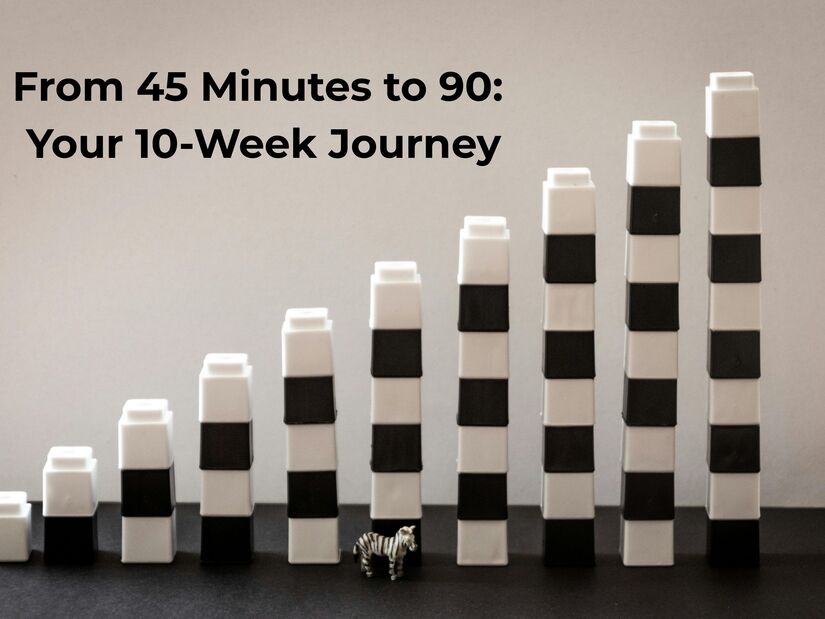
Building Up to 90 Minutes (Even If You Can Only Focus for 20 Minutes Now)
Don’t try to jump straight to 90 minutes if you currently struggle to focus for 30 minutes. Your attention is like a muscle; you have to train it gradually.
Study: Attention Can Be Trained
Research: Attention tends to improve with consistent, gradual practice, similar to other trainable cognitive skills, though individual timelines vary.
Key finding: Your brain’s ability to focus gets stronger with practice, just like your muscles get stronger with exercise. Many people notice their focus improving within a few weeks of consistent practice, similar to building any other skill.
Important: The training has to be gradual. Jumping too fast leads to burnout and quitting.
| Weeks | Session Length | How many per day | What success looks like |
| 1-2 | 45-60 minutes | 3-4 Sessions | Finish without checking the phone |
| 3-6 | 75 minutes | 2-3 Sessions | Finish without checking the phone |
| 7-10 | 90 minutes | 1-2 Sessions | Complete the ultradian cycle comfortably |
| 11+ | 90 minutes | 2-3 Sessions | Sustained mastery |
How to Know When to Progress
After each session, rate your focus:
• 8-10 = Deep focus, very little mind-wandering
• 5-7 = Moderate focus, some distraction
• 1-4 = Struggled to focus
Rule: Only increase your session length when you rate 8+ for three sessions in a row.
If you drop below 6 for three sessions, go back to the previous duration for another week.
Track Your Progress
Keep a simple log in a notebook or spreadsheet:
| Date | Time of Day | Session Length | Focus Rating | Task Type |
| Nov 15 | 09:00 AM | 90 min | 8/10 | Writing |
| Nov 16 | 02:00 PM | 90 min | 6/10 | Research |
After 15-20 sessions, you’ll see patterns:
- What time of day do you focus best
- Which types of tasks are easier or harder
- How sleep affects your focus the next day
- Whether exercise helps your concentration
Use Your Data
If you discover you rate 8-9 in the morning but 5-6 in the afternoon, schedule your hardest work before lunch.
If Friday sessions always rate low, do lighter work then. Let your actual performance guide your schedule, not what you think should work.
Common Problems and How to Fix Them
Problem: “90 Minutes Feels Too Long”
This usually means one of two things:
1. Task mismatch: You’re trying to use 90 minutes for work that doesn’t need it. Email, quick admin tasks and simple communications work better in 30-45 minute blocks. Save 90 minutes for hard thinking work, writing, coding, analysis, and strategic planning.
2. You’re not going deep enough: If “hard work” feels done in 45 minutes, you might be staying surface-level.
Ask yourself:
- Am I really developing my ideas fully, or just hitting word counts?
- Am I considering all angles, or just the obvious ones?
- Am I just getting it done, or am I actually making it good?
The solution: For work that genuinely needs 45-75 minutes, use a 60-minute timer instead. Match your session length to your task’s complexity.
Try the 60 minute timer: → https://5minutetimer.co.uk/1-hour-timer/
Problem: “I Can’t Stay Focused for 90 Minutes”
If you’re struggling, you’re probably starting too hard. Don’t try 90 minutes if you can currently focus for 30 minutes. Start with 45-minute sessions for 2-3 weeks, then add 10-15 minutes when you consistently rate 7+ out of 10.
Research: Building Attention Capacity
Finding: Progressive, gradual challenge tends to be easier to sustain than jumping straight to a long session, in the same way most habits stick better when you build up slowly.
Building up gradually rather than jumping straight to 90 minutes is generally easier to sustain, in the same way any habit sticks better when you scale it up slowly.
Check your environment: Before assuming you can’t focus, fix these first:
- Are all notifications off on ALL devices?
- Is your desk clear?
- Are you working during your best time of day?
- Did you sleep 7+ hours last night?
- Are you hydrated?
- Is your workspace comfortable (temperature, chair, light)?
Make your goal crystal clear: “Work on the project” is too vague.
Your brain needs specific direction.
Try: “Write the three main sections explaining the methodology with two examples in each section.”
What About Breaks?
Study: The Best Kind of Break
Researchers: Stanford University
What they tested: Different types of breaks after focused work. Which ones actually help you recover?
The results:
- Walking outside: Increased creative thinking by 60% for the next session
- Sitting and looking at the phone: No recovery actually made people more tired
- Social media scrolling: Decreased performance in the next session
Why outdoor walking works: It moves your body (increases blood flow to brain) and exposes you to nature (which has a restorative effect on attention)
Source: Stanford News, Walking Improves Creativity → https://news.stanford.edu/2014/04/24/walking-vs-sitting-042414/
Your Perfect 15-Minute Break (After 90 Minutes)
- Move your body (10-12 minutes): Walk outside if possible. Even walking around your building or neighborhood helps.
- Stretch (2-3 minutes): Neck, shoulders, back. Increases blood flow.
- Hydrate: Drink water, not more caffeine.
- Rest your eyes: Look at things far away, not screens.
- Light snack if hungry: Protein is better than sugar.
AVOID during breaks:
- Phone or social media (your brain needs rest, not different stimulation)
- Email or work messages (this isn’t recovery)
- News or videos (keeps your attention working)

How Many 90-Minute Sessions Can You Do Per Day?
Research and expert commentary on deep work suggest that most people can sustain only a limited number of high-quality focus blocks each day, often around 2–4 hours total.
After several demanding sessions, cognitive fatigue rises and the quality of output tends to fall, so trying to force more deep work usually adds tiredness rather than value;
The smart schedule:
- Morning (9-10:30 AM): Session 1 – Your hardest thinking work
- Break (15-20 minutes): Walk, stretch, hydrate
- Late Morning (11 AM-12:30 PM): Session 2 – Complex work
- Lunch (60 minutes): Actual break, not working lunch
- Afternoon (2-3:30 PM): Session 3 – Moderate difficulty work (or lighter work if tired)
- Rest of day: Email, meetings, admin tasks, lighter work
Test Your Knowledge: 90-Minute Sessions Quiz
90-Minute Brain Cycle Quiz
Test Your Knowledge of Your Brain’s Natural Performance Cycle
Common Questions About 90-Minute Sessions
Q: How long is 90 minutes in seconds?
A: 90 minutes = exactly 5,400 seconds. This matters because it matches one complete ultradian rhythm cycle – your brain’s natural work pattern. Understanding this helps you see that 90 minutes isn’t random. It’s based on real biology discovered by scientist Nathan Kleitman in the 1960s at the University of Chicago.
Q: Is 90 minutes too long? I can only focus for 20 minutes now.
A: Start where you are, not where you want to be. If you can focus for 20 minutes now, start with 30-minute sessions. After 2 weeks of successful 30-minute sessions, try 45 minutes. Then 60 minutes. Then 75 minutes. Then 90 minutes. This gradual build-up takes about 10-12 weeks. Don’t rush it.
Q: How many 90-minute sessions can I do in one day?
A: Most people can do 2-3 quality sessions per day (3-4.5 hours total). This might sound like a small amount, but many people find that focused, uninterrupted work beats a full day of distracted hours.
After 3 sessions, your brain is tired and quality drops fast. Better to do 2 excellent sessions than 4 mediocre ones. Schedule your hardest work in your first 1-2 morning sessions when your brain is freshest.
Q: What should I actually do during my break?
A: Take a 15-20 minute active break. Best option: Walk outside for 10-12 minutes (Stanford research shows this increases creativity by 60% for your next session).
Also, do: stretch your neck/shoulders/back, drink water, have a light protein snack if hungry, rest your eyes.
Don’t do: Check phone, look at social media, read email or watch videos. Your brain needs actual rest, not just different stimulation. Screen time during breaks doesn’t help you recover and actually makes you more tired.
Q: Can I split 90 minutes into two 45-minute sessions with a break in between?
A: No – this defeats the whole point. Building the complete mental picture of what you’re working on takes real, sustained time. Breaking at 45 minutes means you have to rebuild this picture twice instead of once. priceThat’s why it feels like starting over each time.
If 90 minutes feels too long, gradually build up to 60 minutes, not split it into pieces.
However, you CAN take a 2-3 minute “micro-break” at the 45-minute mark to stand, stretch, and look away from your screen, as long as you stay in your workspace and don’t switch tasks.
Q: Why 90 minutes instead of 60 or 120 minutes?
A: 90 minutes matches one complete ultradian rhythm cycle – your brain’s natural energy wave throughout the day. Research shows your focus peaks during the first 90 minutes, then naturally drops as brain chemicals get used up.
60-minute sessions are good for moderate work, but don’t let you complete the full cycle. 120-minute (2-hour) sessions push past your biological limits for most work, leading to accumulated fatigue that hurts your next session.
90 minutes is the sweet spot: long enough to go deep, short enough to stay sustainable across multiple sessions per day.
If you’re ready for more advanced deep work after mastering 90-minute sessions, try our 2 hour timer for extended focus blocks.
Q: I work from home with kids/pets/roommates. Can this still work?
A: Yes, but you need to set clear boundaries.
Tell people, “I’m working until 10:30 AM and can’t be interrupted unless it’s an emergency.” Put a sign on your door.
Use headphones as a visual signal. Consider working very early morning (before others wake up) or during nap time.
Some people find that working at a library or coffee shop for their 90-minute session helps.
The key: you need 90 uninterrupted minutes, so plan around when that’s actually possible in your situation.
Q: What if I get interrupted during my 90 minutes?
A: If it’s a quick interruption (under 2 minutes): pause your timer, handle it, then resume. If it’s longer than 2 minutes, the session is done. Dr Gloria Mark’s research shows it takes 23 minutes to get fully back into complex work after an interruption.
At that point, you might as well take your break and start fresh. This is why preventing interruptions (phone in another room, notifications off, door closed, tell people your schedule) is so important.
Q: Does this work for studying?
A: Yes! 90-minute sessions work great for studying complex material, writing papers, working through problem sets, and preparing for exams.
However, pure memorisation (like vocabulary or dates) works better in shorter 30-45 minute sessions with more frequent breaks.
Match your session length to your task type: complex understanding and application = 90 minutes, simple memorisation = shorter sessions.
Q: What about late-night work sessions?
A: Your focus quality depends heavily on sleep. If you’re working late because you didn’t sleep well, your 90-minute session will probably feel more like struggling for 90 minutes.
Research shows cognitive performance drops significantly when you’re tired. If you must work late, consider doing lighter tasks that don’t need deep focus and save your demanding 90-minute sessions for when you’re actually rested. Protecting your sleep is more important than adding more work hours.
Start Your First 90-Minute Session Today
You now understand the science. You know what you can accomplish. You have the strategies to succeed. The only thing left is to start.
90 minutes isn’t random; it’s your brain’s complete natural work cycle. This is biology, not just another productivity hack. When you work with your brain’s natural rhythm rather than fight it, everything changes.
Your Simple Action Plan (Start Right Now):
- Pick ONE task that needs deep thinking (not your whole to-do list)
- Write down exactly what “done” looks like (be specific!)
- Remove all distractions (phone in another room, close extra tabs, clear desk)
- Start your timer and begin immediately
- Rate your focus after the session (1-10 scale)
- Take your 15-minute break (walk outside if possible)
- Track your data (write down: date, time, task type, focus rating)
If 90 minutes feels too long right now, start with 45-60 minutes instead. Build up gradually over 10 weeks. The research shows that slow and steady actually works.
Works on all devices. No download or signup required. Includes alarm and full-screen mode.
Additional Resources
Related Timers for Different Work Types:
• 60 Minute Timer: Good for moderate complexity work
• 2 Hour Timer : For advanced users doing extremely complex work
• 25 Minute Timer: Boost Focus and Deep Work Efficiency
Want to understand how to choose the right timer duration for your work?
Read our complete guide: How Long Should a Focus Session Be?
Frequently Asked Questions About Deep Work Sessions
How do I handle the “afternoon slump” when doing a 90-minute session?
If you find your focus ratings drop during afternoon sessions, it is likely due to natural circadian dips. Try scheduling your most cognitively demanding work like deep writing or complex problem-solving for your morning blocks. Save administrative or lighter tasks for the afternoon when your peak brain chemical levels have naturally subsided.
Should I track my focus rating even on days when I feel unproductive?
Yes, tracking is most valuable on your “bad” days. These entries help you identify external variables such as poor sleep, dehydration, or a cluttered workspace, that might be causing the dip. Over time, this data helps you stop blaming yourself for a lack of focus and start fixing the environmental factors that are actually responsible.
What if I finish my task before the 90 minutes are up?
If you complete your defined goal early, do not use the remaining time to jump into a new, unrelated task. Instead, use the leftover minutes for high-value refinement, such as reviewing your work, organizing your next session, or simply taking an early break to start your recovery protocol. This prevents the “task switching” that drains your mental energy.
Can I listen to music or white noise during these sessions?
Many people find success with instrumental music or brown noise, as these can help drown out environmental sounds. However, avoid anything with lyrics or podcasts, as language processing competes with the same cognitive resources you need for “deep work.” If you use music, pick a consistent playlist so it becomes a Pavlovian signal to your brain that it is time to focus.
Is it better to do a 90-minute session at the same time every day?
Building a routine is highly beneficial for your brain. By starting your sessions at the same time, you condition your mind to enter a high-acuity state more quickly. This reduces the “warm-up” time required and helps you hit that immersion window with less resistance.
Why is physical movement specifically recommended for the recovery phase?
Your brain and body are not separate systems. During deep work, your nervous system remains in a high-arousal state. Physical movement like walking or stretching mechanically assists in flushing out metabolic byproducts and signals to your nervous system that it is safe to transition back into a lower-arousal, restorative state.
Do I really need to put my phone in another room, or is face down enough?
Scientific studies on the “Brain Drain” effect confirm that even the presence of a silent or face-down phone reduces your cognitive capacity. Part of your brain remains constantly alert for potential notifications, which consumes energy you should be using for your task. “Out of sight” is the only way to ensure your brain is not monitoring for digital interruptions.
Can I ask Google or Alexa to set a 90 minute timer?
Yes. Saying “Hey Google, set a timer for 90 minutes” or the equivalent to Alexa or Siri works instantly. Come back here when you want the visible countdown, the break protocol, or the attention-building schedule.