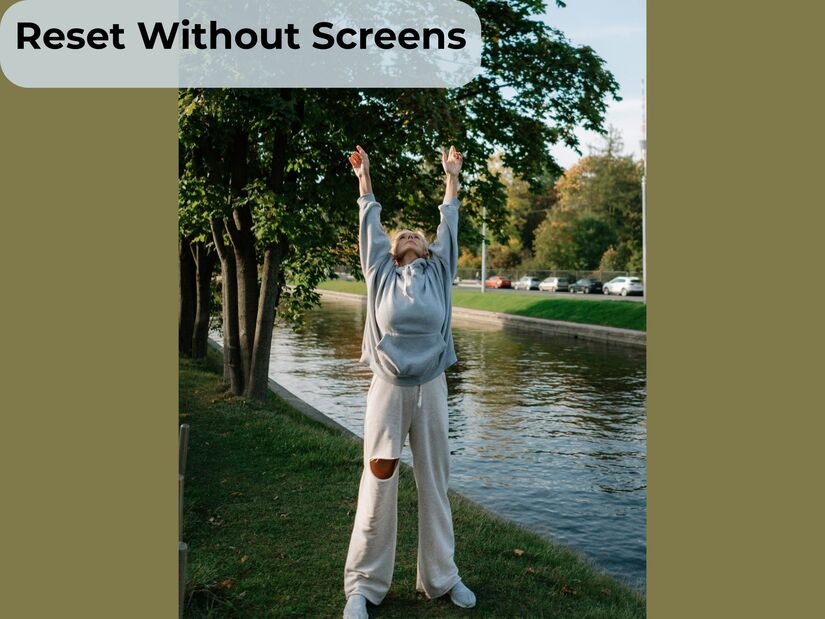

Most “breaks” during the workday aren’t breaks at all; they’re just a different screen. Checking your phone between tasks keeps the same effortful attention system running that you use at your desk, so you come back no more rested than when you left. Genuine digital detox breaks, ones with no screen at all, work differently. When you return to work, you actually have cognitive capacity again.
Table of Contents
The Attention Restoration Mechanism
The difference comes down to which kind of attention gets used during the break. Psychologists Rachel and Stephen Kaplan’s Attention Restoration Theory distinguishes between “directed attention,” the effortful, voluntary focus you use to concentrate on work, and “involuntary attention” (or “soft fascination”), the effortless, ambient kind of attention you use when you’re walking, staring at a view, or letting your mind wander. Only a break that engages the second kind gives the first kind a genuine rest.
| Passive phone break | Active digital detox | |
|---|---|---|
| Attention engaged | Directed attention, the same effortful system you use at your desk | Involuntary attention, effortless and ambient |
| What’s actually happening | Notifications and novelty keep pulling your focus, so the effortful system never disengages | Movement, quiet, or an undemanding activity let the effortful system switch off |
| Typical result | The same attention fatigue you had before the break | A genuine sense of restored focus |
Table 1: How a phone break and a screen-free break engage different attention systems, based on Kaplan’s Attention Restoration Theory.
Finding the Goldilocks Zone
Timing matters as much as content. Breaks under 3 minutes give your nervous system barely enough time to shift gears. Breaks over an hour risk losing the day’s momentum entirely. The sweet spot sits between 3 and 40 minutes, long enough to actually reset, short enough that you come straight back to work rather than losing the afternoon. This balance is a central part of the 2026 Focus Framework, which treats genuine recovery as a prerequisite for deep work rather than a nice-to-have.
The research on phones specifically is a little more nuanced than “phones bad, everything else good.” Some studies on brief, occasional smartphone use during a break find it can be about as refreshing as any other short microbreak. But the picture consistently shifts once a break stretches past a couple of minutes, or the phone genuinely captures your attention (scrolling, a game, a video): the same directed-attention system you were trying to rest stays switched on, and people tend to report feeling less recovered afterward than after a walk, a conversation, or a few minutes of real stillness. In practice, the longer your break, the more it matters that it’s actually screen-free.
The 3-Minute Quick Reset: Breathing and Stillness
When you need an immediate mental reset but can’t leave your workspace, a 3-minute breathing routine works remarkably well. Three minutes is long enough to shift your nervous system, but short enough that you can’t really justify checking your phone instead.
Set your 3-minute timer. Put your phone face down or in a drawer, you’re not touching it for three minutes. Stand up or sit comfortably; your body needs a break from its current position.
Minute 1: Box breathing. Breathe in for 4 counts, hold for 4, out for 4, hold for 4. Repeat four times.
Minute 2: Extended exhale breathing. Breathe in for 4 counts, out for 8. The longer exhale in particular engages your vagus nerve, deepening the relaxation response. Repeat three times.
Minute 3: Stillness and awareness. Sit or stand quietly, eyes closed if that’s comfortable. Notice how different your body feels compared to three minutes ago.
Both breathing patterns start shifting your nervous system out of its stressed, alert state within the first few breaths, that’s the fast part. The hormonal side of stress, cortisol, takes longer to actually clear from your system, so don’t expect an instant chemical reset, but the felt sense of settling happens quickly and is real.
The beauty of three minutes: it’s so short your mind can’t talk you into “just quickly checking” your phone.
The timer creates accountability; when it rings, you’ve completed a genuine screen-free break. Many people find that repeating this routine 4 to 5 times daily takes the edge off the usual afternoon slump.
Consider pairing these quick resets with stress management techniques you’re already using, for a compounding effect. If you only have a moment, our 30-second timer is enough for a quick mental clear-out.
The 20-Minute Restorative Walk: Nature’s Complete Reset
A 20-minute walk delivers real mental restoration, but only if it’s an actual walk, not a scroll-while-walking phone break. Your phone stays in your pocket or at your desk, completely untouched.
Set your 20-minute timer. Walk out your door. Ten minutes out, ten minutes back. The timer removes the “just a bit further” creep that turns a planned break into an aimless hour away from your desk.
Outside, if you can manage it. Natural light helps reset your circadian rhythm, and fresh air is a change from the stale office air you’ve been breathing. If you have to stay inside, hallways, stairs, or a different floor, anywhere that isn’t your desk, still gives you the movement and environmental change that matters.
No podcasts, no music, no calls. This isn’t a time to be productive or take in more information, it’s a time to give your attention a genuine rest. Let your mind wander. Notice your surroundings. Think about nothing in particular.
That wandering is doing real work. A well-known 2012 study on creative problem-solving found that participants who spent a break on an undemanding, low-stimulation task, one that let their minds wander, were the only group who improved on a creative test taken right afterward; people given a demanding task, or no break at all, didn’t show the same improvement.
An aimless walk is a reliable way to create that same low-stimulation, wandering state. Scrolling a feed, with its constant novelty and notifications, is close to the opposite of undemanding, so it doesn’t offer the same effect.
You don’t strictly need twenty minutes to get some benefit; recent research suggests even 15 minutes outdoors can measurably help, and shorter still isn’t nothing. But twenty to thirty minutes is where most of the research on stress reduction and creative benefit clusters, which is why it’s the length used here.
Image: A physical book at your desk. Twenty-five minutes with pages instead of a screen gives your eyes and attention a genuine break, rather than just swapping one screen for another.
Schedule these walks deliberately; mid-morning (10:30 am), post-lunch (1:30 pm), or mid-afternoon (3:30 pm) all work well. Even one 20-minute walk daily can noticeably improve both mood and output; two starts to change your whole relationship with work stress. If the weather permits, pairing your walk with an element from your morning routine makes for a solid midday energy boost that carries into the afternoon.
The 25-Minute Deep Break: Reading, Journaling or Meditation
When you need something more substantial, a 25-minute deep break gives you a fuller reset. The length also happens to line up neatly with Pomodoro-style rest periods, after several intense focus sessions, your brain genuinely needs more than a few minutes.
Physical books only. E-readers still live on devices that also hold your email and social apps, one notification and the break is over. Keep a dedicated break book at your desk. Fiction works well because it fully removes you from your work headspace; unrelated non-fiction (gardening, history, cooking, whatever has nothing to do with your job) works too.
Set your 25-minute timer and read until it rings, even mid-chapter. The discipline of stopping on time is what prevents “just one more chapter” from eating your afternoon.
Alternatively, try stream-of-consciousness journaling. Grab a notebook and write whatever comes to mind for 25 minutes. Don’t organise it, don’t edit it, just get it onto the page. This externalises the mental clutter that’s been quietly competing with your work for attention, and plenty of people find that a problem they’ve been stuck on resolves itself somewhere in the middle of writing.
Or guided meditation or breathwork. Twenty-five minutes is enough for a full session, body scans, breath-focused practice, loving-kindness, whatever suits you. Use audio-only guidance or complete silence, nothing that requires looking at a screen.
Whichever you choose, the point is the same: your eyes rest from screens, your fingers rest from typing, and your brain rests from processing digital information. These breaks also pair well with deep work techniques, a 90-minute focus block followed by a genuine 25-minute recovery is a solid rhythm for sustainable output.
The 40-Minute Creative Hobby Break: Complete Mental Departure
For deeper, longer-term recovery, try building one or two 40-minute hobby sessions into your week. It sounds indulgent. It’s actually one of the more reliable ways to avoid burnout.
Choose something that occupies your hands and mind without a screen in sight: drawing, knitting, an instrument, cooking, woodworking, gardening, pottery. The only real requirements are that it’s genuinely enjoyable rather than another obligation, that it doesn’t involve a device, and that you can make some visible progress on it inside 40 minutes.
Keep supplies within easy reach, a sketch pad on the desk, a guitar in the corner, a knitting basket nearby. The less friction between “I need a break” and “I’m doing my hobby,” the more likely you are to actually take it. Set your 40-minute timer, engage fully, and when it rings, clean up and head back to work. A defined endpoint stops the guilty spiral of feeling like you’re “wasting time.”
This connects to the same mechanism behind the walking benefit above: an undemanding, absorbing activity seems to give your mind room to keep working on a problem quietly in the background. There’s no single universal number for how much faster this makes you solve things, that varies by person and task, but the underlying idea (low-stimulation activity, attention free to wander) is the same one.
Forty minutes is also enough time for real, if small, progress: a finished sketch, a few rows of knitting, a section of a song practised, a simple meal cooked from scratch. After a month of three sessions a week, that adds up to something you can actually point to, which is a different kind of satisfaction than half an hour of scrolling ever provides. Pairing these sessions with work on breaking a bad habit can make them a natural replacement for the evening phone-checking urge too.
Creating Your Digital Detox Break Schedule
Random breaks don’t work nearly as well as scheduled ones. Your brain needs a consistent pattern before it will actually trust that rest is coming, so schedule digital detox breaks the way you’d schedule a meeting.
Example intensive workday schedule:
- 9:00am: Start deep work session
- 10:30am: 3-minute breathing reset
- 10:35am: Resume work
- 12:00pm: Lunch (kept separate from breaks)
- 1:00pm: 20-minute walk outside
- 1:20pm: Resume work
- 3:00pm: 25-minute reading break
- 3:25pm: Resume work
- 5:00pm: 3-minute breathing reset
- 5:05pm: Final work sprint
- 6:00pm: Finish work
Four breaks, 51 minutes total, spread across an 8-hour day at predictable times. Your brain learns the rhythm and stops fighting you on break time.
Alternative lighter schedule:
- Mid-morning: 3-minute breathing
- Post-lunch: 20-minute walk
- Mid-afternoon: 3-minute breathing
- Evening: 40-minute hobby session (3x weekly)
Use calendar blocks or recurring timers, and when the alarm sounds, take the break immediately rather than “after I finish this email” (which becomes five emails). Stopping mid-task on a schedule actually improves focus, because you know real rest is already on the way. Combining this with time blocking gets you dedicated work blocks separated by genuine rest, rather than a day that’s just one long blur.
Common Pitfalls: What a Digital Detox Break Is Not
Checking email on your phone while walking. Scrolling Instagram while sitting outside. Watching YouTube during your “reading time.” Taking work calls while stretching.
Listening to work podcasts on your walk. None of these are digital detox breaks, any screen involvement, even briefly, defeats the purpose. You can’t reset from screens using a different screen.
The most common way people sabotage this: “I’ll just quickly check my phone before my break.” That quick check reliably becomes ten minutes and the break is gone before it started. Set a clear boundary: phone in a drawer, another room, or deep in your bag, not “on silent in my pocket where I’ll feel every vibration.” Fully inaccessible.
This will feel uncomfortable at first. That discomfort is largely withdrawal from constant connectivity, and it fades faster than you’d expect, usually by your third break of the day, and almost always by your third day of doing this consistently.
Troubleshooting Common Obstacles
“I don’t have time for breaks.”
You already have time for thirty minutes of scattered phone checking throughout the day, redirect that into structured breaks instead. A rested brain works faster, so you recover the time almost immediately.
“My office has nowhere to walk for 20 minutes.”
Stairs, hallways, different floors, the car park, the block outside. Unless you genuinely work somewhere with no exit, there’s somewhere to walk for 20 minutes.
“I can’t leave my desk, what if something urgent comes up?”
Truly urgent situations are rarer than they feel. Most things can wait 20 minutes. An auto-reply saying you’re back shortly covers the rest, if something is genuinely on fire, someone will come and find you.
“I feel guilty taking breaks when my colleagues don’t.”
Give it time. Once you’re solving problems faster and still have energy at 4pm while they’re running on fumes, results tend to make the case on their own.
“I always intend to take breaks, but forget.”
Recurring alarms, a physical timer on your desk, calendar notifications you can’t dismiss, or an accountability partner who breaks with you. Remove the decision entirely, when the alarm sounds, you break.
“40 minutes feels too long for a hobby break.”
Start with a 20-minute timer instead. Once you feel the benefit, extending to 40 minutes tends to happen naturally.
For a broader approach, pair this with our guide to managing your time better.
Frequently Asked Questions
Can I listen to music or podcasts during digital detox breaks?
For walks and hobby breaks, instrumental music without lyrics is fine if you need some sound, nature sounds, classical, or ambient music generally don’t interfere with mental restoration. Podcasts, audiobooks, or anything with lyrics engage your language processing centres, the same parts of your brain you’re trying to rest. For breathing breaks, silence works best. Try it without sound first, and if you genuinely can’t settle into the quiet, it’s worth asking honestly whether that’s discomfort with stillness itself, which is often exactly what the break is meant to address.
What if I work from home and can’t “leave” my workspace?
Designate a specific break zone that isn’t your desk, a chair by a window, your garden or balcony, even the kitchen table. The physical move from desk to break zone signals to your brain that work has paused. Never take the break sitting at your desk, if space is genuinely tight, at least face away from your computer, or step out into a hallway or onto the front step. For a 20-minute walk, laps around the house, up and down the stairs, or pacing your longest hallway all work.
How do digital detox breaks differ from regular work breaks?
Most “breaks” involve swapping computer work for phone scrolling, still processing digital information, still under blue light, still making the same stream of small decisions (scroll, tap, swipe, react). A genuine digital detox break drops all of that: you move your body, use your hands on something physical, or simply sit with no input at all. The research on brief, occasional phone use during breaks is mixed, some studies find it’s not meaningfully worse than other short breaks. But passive scrolling specifically, the most common way people actually use a “phone break,” tends to leave people reporting less recovery than a walk, a chat, or real stillness would. Try a week of mostly phone breaks against a week of mostly screen-free ones and notice the difference for yourself.
Can I check my phone “just quickly” during a break if something important might come up?
Not really, “just quickly” rarely stays quick. One notification leads to another, which reminds you of an email, which needs a reply, and ten minutes are gone. If you’re genuinely on-call or managing something urgent, set specific check-in windows, say 11 am and 3 pm for two minutes each, separate from your detox breaks, and keep the rest of your breaks phone-free. Be honest with yourself about how often a true emergency actually happens in the twenty-five minutes you’re reading a book; for most people, it’s rare.
Which break duration should I start with if I’m new to this?
Start with the 3-minute breathing reset, it’s short enough that skipping it isn’t really an option, and long enough to produce a noticeable shift. Do it twice a day for a week.
Once you’ve felt that it works, add one 20-minute walk daily, then after another couple of weeks, a weekly 40-minute hobby session.
Build gradually, it’s better to make one break type a genuine habit than to attempt all four and quit within three days.
The 25-minute deep break tends to fall into place naturally once the shorter ones are established, and it pairs well with the session lengths in our study tracker research.
How long until I notice benefits from digital detox breaks?
The physical effects show up almost immediately: shoulders drop, and heart rate slows within a single 3-minute breathing break, and a 20-minute walk tends to leave your eyes and posture noticeably better.
The sense of mental clarity builds over the first 3 to 7 days, as your brain starts to trust that rest is actually coming. Productivity gains, faster problem-solving, steadier energy, and fewer afternoon crashes usually become obvious within two weeks.
The bigger, longer-term benefits (better sleep, less phone dependency, improved mood) tend to show up over 4 to 6 weeks of consistent practice. Don’t expect an overnight transformation, but you should feel measurably different after your very first proper screen-free walk today.
Start Your First Digital Detox Break Now
You now have four specific break routines, exact timing for each, and a framework for scheduling them through your day. Not theory, methods you can start in the next three minutes.
Your plan for right now: set a 3-minute timer, put your phone in a drawer or another room, and stand up. Spend one minute on box breathing (in for 4, hold for 4, out for 4, hold for 4), one minute on extended exhale breathing (in for 4, out for 8), and the final minute in stillness, eyes closed if that’s comfortable. When it rings, notice how different you feel.
That’s one digital detox break done. Tomorrow, add a 20-minute walk.
The day after, try 25 minutes of reading.
By the end of the week, schedule your first 40-minute hobby session. Within seven days you’ll have tried all four and have a decent sense of which ones actually suit your schedule.
The goal isn’t perfection. You’ll skip a break some days, and check your phone during one on others, that’s normal. What matters is the overall pattern, more days with breaks than without, more of those breaks genuinely screen-free than not.
Stop reading. Open your timer. Take your first digital detox break. Everything else can wait three minutes.